
Listen to this story:
Some Alaskans are fired up about water pollution from heavy fuel oil burned on large cruise ships. At a panel discussion in Juneau on Wednesday, members of tribes and conservation organizations said there’s a solution: using cleaner fuel.
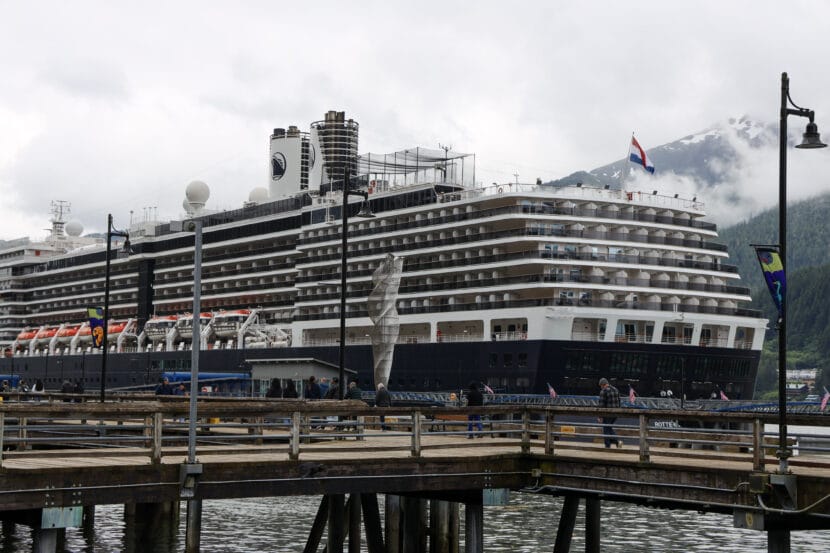
Heavy fuel oil is the stuff from the bottom of the barrel — the waste product at the end of the oil refining process. It’s cheaper than distillate fuels and is used widely by most of the large cruise ships that travel along Alaska’s coastline every year.
When it’s burned, heavy fuel oil exhaust releases sulfur oxide into the air, which can cause heart and lung disease and lead to acid rain. In 2020, the International Maritime Organization, or IMO, required ships that burn heavy fuel oil to use scrubbers, which filter the exhaust through seawater.
Aaron Brakel is a clean water campaigner at the Southeast Alaska Conservation Council, which organized the panel. He said scrubbers didn’t solve the pollution problem — they just moved it into the ocean.
“They spray the water, transferring pollutants from the air into the water from the exhaust,” he said. “Most of the scrubbers worldwide, most of the ones here in Alaska, are open-loop systems.”
That means they pump seawater infused with toxic exhaust back into the ocean instead of storing it and disposing of it at an onshore facility.
Nearly 80% of the cruise trips made in Alaska last year burned heavy fuel oil through open-loop or hybrid systems. Hybrid scrubbers can switch between dumping the effluent or storing it, depending on discharge regulations in the waters the ship is passing through.
Brakel probed into U.S. Environmental Protection Agency records and found that between 2023 and 2024, 17 ships using open-loop scrubber systems reported more than 700 water quality violations off the coast of Alaska, as Alaska Public Media reported last month. But the data doesn’t show exactly where the violations happened.
Kay Brown is the Arctic policy director at Pacific Environment, an advocacy nonprofit. Last year, she and her colleagues published a literature review of studies around the world on the negative effects of scrubbers.
“The big takeaway here is that scrubber pollution is toxic to marine life at very low concentrations,” Brown said.
One study found scrubber wastewater at a concentration of 5% killed tiny crustaceans called copepods within one day, and called the wastewater a “witch’s cauldron” of toxic compounds. Another study found that exposure to scrubber discharge affected the reproduction success of some mussel and sea urchin species at even lower concentrations.
Several Southeast tribes have passed resolutions calling for cleaner fuel, including the Yakutat Tlingit Tribe, the Organized Village of Kake, the Organized Village of Kasaan and the Ketchikan Indian Community.
Ilsxilee Stáng Gloria Burns is president of the Ketchikan Indian Community. She said she wants cruise lines to take initiative.
“This practice of fuel dumping makes the cruise ships an extractive industry,” she said.
Burns said the onus is on the cruise industry to build a relationship of reciprocity instead.
Linda Behnken is the executive director of the Alaska Longline Fishermen’s Association and board president of Alaska’s Sustainable Fisheries Trust. She’s fished commercially for 40 years and says the statewide seafood marketing strategy is built on telling the story of Alaska’s healthy, pristine waters.
“To have this information, to me, where we know sort of that dirty secret, I feel like we’re being disingenuous by continuing to build our reputation on this,” she said.
Behnken said Alaskans have a responsibility to protect the water from pollution.
Cruise ships that burn heavy fuel oil are equipped to switch between fuel types.
Some regulations have already taken effect in U.S. waters. Last year, the IMO banned heavy fuel oil in Arctic waters, with some fuel tank exceptions. Scrubber discharge is restricted in Hawaii’s waters and banned within the Port of Seattle. California has long required ships to burn cleaner fuels upon entering its waters.
Sen. Jesse Kiehl, D-Juneau, attended the panel. He said he’s concerned about water pollution from scrubbers, but hasn’t decided on a policy path yet.
He said he’s been meeting with a lot of people about it, including cruise companies.
“We had some serious conversations and they presented some research, some of which I bought and some which I didn’t,” Kiehl said.
Cruise Lines International Association Alaska represents the cruise industry.
“There is no scientific basis to support a ban on [scrubbers],” CLIAA spokesperson Lanie Downs wrote in an email, adding that they “remain an important compliance option as the maritime sector continues to reduce air emissions.”
Alix Pierce, Juneau’s visitor industry director, said in an interview that there’s a long-standing voluntary commitment from the cruise lines to switch to marine gas oil when they’re in Gastineau Channel, while in Juneau’s cruise port and upon departure.
“All we can do is make agreements and ask that they be followed, and even if we did have legislation, I don’t know what our compliance program would look like,” Pierce said.
She said the city has no reason to believe ships aren’t honoring the commitment. But in 2019, Gov. Mike Dunleavy axed state funding for the Ocean Rangers program that had observers aboard cruise ships, so there is no longer oversight on oil slicks. The state’s wastewater permits and ship inspectors only address sewage and grey water, not scrubber wastewater dumping.
Pierce said the city is working to help find alternative shipping fuels through a partnership between ports and cruise lines called the Pacific Northwest to Alaska green corridor project.
“We’re excited to see how we can kind of continue to try to drive change in the alternative fuel space, because that’s really the future,” she said.
She said the group will publish a report in the next few months looking at the feasibility of transitioning cruise ships to another fuel type called green methanol, which can be produced from municipal or agricultural waste. The IMO suggests it could cut carbon and sulfur oxide emissions. Pierce said the effort could move the needle beyond the scrubber problem and meet IMO’s goal to make shipping a net-zero emissions industry by 2050.
Juneau’s last cruise ship of the 2025 season will depart next Tuesday.
Correction: The panel discussion was on Wednesday.

