Listen here:
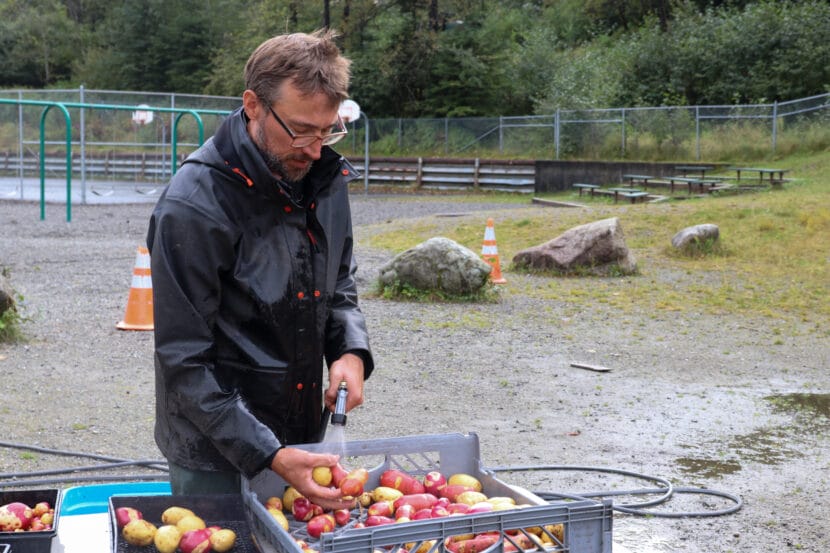
Joel Bos stands outside Sayéik: Gastineau Community School, rinsing tray after tray of freshly harvested potatoes with a hose. He’s a naturalist with Discovery Southeast, a nonprofit that connects Juneau residents to the outdoors. They partnered with the school to build and maintain a garden.
Bos has been working with students on the project. He said they participate in every part of the process, from planting seeds to eating the crops.
“Now this is not just something that one person is doing here as, like, kind of on the side, this is an entire school event, and that, to me, is really special,” Bos said.
There’s still more to harvest, including several beds of carrots. Bos said those are his favorite vegetables to grow in Juneau.
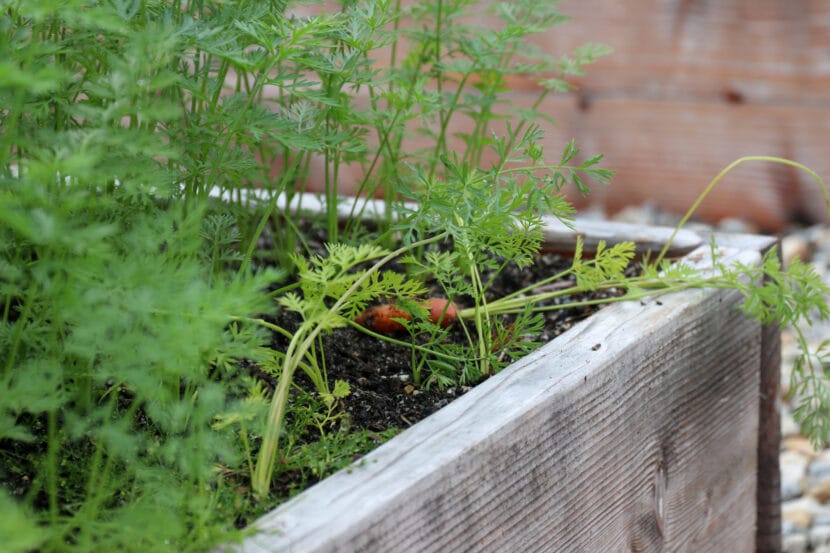
“They’re super sweet if you grow them up north,” he said. “The kids just absolutely go bananas for them. I think we all do. Everybody who’s had a carrot that was picked and washed and eaten in the same day understands the difference in sweetness and flavor.”
Sayéik: Gastineau Community School librarian Monika Haygood walks through the school garden, pointing out the different crops separated by type.
“This side, the left side here, we have, of course, onions, kale,” she said. “And so they’re just dedicated to one crop, because you can just get so much more out of it.”
The garden is a project for the Ocean Guardian School program run by the Office of National Marine Sanctuaries. Schools commit to protect local watersheds and the ocean through various conservation projects and schoolwide practices. Schools can also get start-up funds for projects like a school garden.
Sayéik has been an Ocean Guardian School for the past seven years. Haygood is also the lead teacher for the program. She says the school garden in particular teaches students more beyond math and reading in the classroom.
“It’s science. It gets them outside. It gets them working together, gets them thinking and talking, and all those pieces are just such an important part of learning as a whole picture,” she said.
Building and maintaining the garden is a school and community-wide effort. Teachers incorporate the garden into the curriculum: students might try their hand at scientific illustrations or calculate the volume of a garden bed to find out how much soil it needs. Local businesses also donated materials for the garden.
The garden even runs when school is out. Haygood said teachers and some families water the plants through the summer. Bos also brought students from a summer camp to maintain the garden.
Haygood said she’s proud of the garden the school has created.
“I love to just see kids out here and learning and digging and, yeah, just making those connections,” she said. “I think that is the most powerful, just seeing the kids out here, and how inspiring that is for me. But it’s also so inspiring for them.”
Most of the vegetables will go toward a schoolwide dinner next week. The garden activities will continue to run after the big harvest. Students will start growing different plants indoors from seed under grow lights through the winter. The garden will also continue to grow. Next to it is a field peppered with dirt and weeds. Haygood said they’ll fill the area with native plants.
“We’ll develop this trail over here with some signage so that we have some plants that students can learn about, that are local, that grow here,” she said.
As for the remaining uneaten veggies, Haygood said they won’t go to waste. Students and teachers will take the leftovers home to their families.