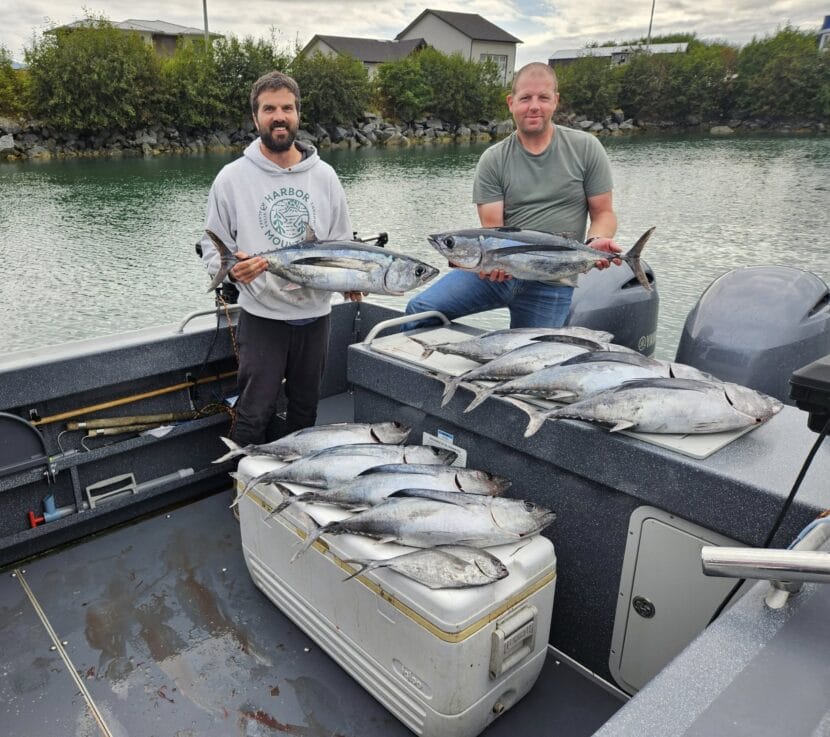
In Alaska, a state famous for abundant salmon and huge, cold-water-loving crab, another type of fish is making a splash: tuna.
Incursion of warm waters into Southeast Alaska coastal areas off Sitka and Baranof Island created a brief tuna jackpot earlier this month for sport fishers.
One of the first of those anglers was Troy Tydingco, who happens to be the Sitka sportfish area management biologist for the Alaska Department of Fish and Game.
He took a day off from work when conditions were just right to search for tuna, a type of fish suited to more southern latitudes: beautiful weather, with calm waters and water temperatures that reach 60 degrees.
About 30 miles offshore, the search was successful. Tydingco and his six companions caught 44 albacore tuna in all. Other fishers followed.
“I think this is probably the first time sport anglers have really successfully targeted them and harvested them out of Sitka,” he said.
Another successful Sitka tuna angler was Adam Olson, operations manager at the Northern Southeast Regional Aquaculture Association.
What makes it fun, he said, is that it is “incredibly unique and unusual.” It is a big change for Sitka, he said. “We’re very salmon-centric here in Southeast Alaska,” he said.
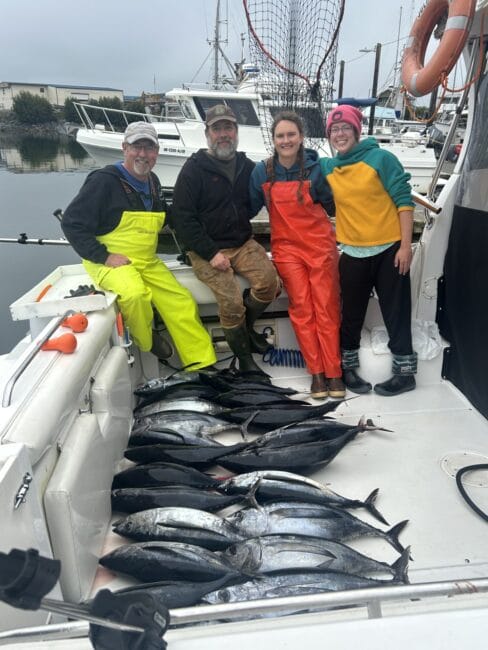
Olson enjoyed eating the tuna as well as catching it, grilling it with a little salt and pepper. “It was phenomenal,” he said.
Tydingco said there is no precise count for the tuna haul. Based on anecdotal reports, social media posts and general talk around town, he estimates that there were 200 caught out of Sitka.
Anyone with a sportfishing license is allowed to harvest tuna in Alaska, as long as they use legal means. Most anglers use rod-and-reel gear that would typically be used to catch salmon. It is also legal to use a spear gun, which one man employed successfully to get a skipjack tuna in the Sitka harbor.
Commercial opportunity?
The Sitka tuna flurry generated enough interest to prompt the Department of Fish and Game to issue an advisory on Friday laying out the rules for a commercial harvest.
There is no federal fishery for tuna in Alaska, so it is up to the state to regulate catches if they occur, said Rhea Ehresmann, a Sitka-based groundfish project leader for the Department of Fish and Game.
Though no one may have tried it yet, commercial tuna fishing is legal in Alaska. There are requirements for permits, gear types and record-keeping. Trolling and jigging gear, which uses hooks to catch fish, is allowable for tuna, but nets are not.
So far, the department has issued a couple of permits to interested fishers, Ehresmann said.
Any commercial catch of tuna – whether deliberate or accidental bycatch during a harvest targeting another species — is required to be reported to the state. There had been no such reports as of Monday, said Grant Hagerman, a Sitka-based troll management biologist for the Department of Fish and Game.
The Sitka tuna bounty may be new. But the occasional presence of tuna in Alaska waters is not.
Up to now, Prince of Wales Island, at the far southern tip of Southeast Alaska, has been the site of most of the state’s tuna fishing, Tydingco said.
There are also isolated cases of tuna catches farther north, such as a skipjack tuna fished off Yakutat in 2015.
History indicates that the presence of tuna in Alaska waters is ephemeral. They might linger for a few weeks if waters are warm enough, then swim south.
Excitement over tuna in Alaska and rumors of their appearances date back to the 1920s, according to a 1949 report by the U.S. Fish and Wildlife Service. There was a Ketchikan-based commercial harvest in 1948, though that tuna appears to have been caught off British Columbia’s Queen Charlotte Island, according to the report.
Whether tuna fishing will become a trend in Alaska is yet to be determined.
Tydingco said this year’s successes are likely to encourage more fishers to look for tuna, but that people should not count on having tuna-friendly conditions every year.
“That warm water temperature doesn’t even always make it up this far,” he said.
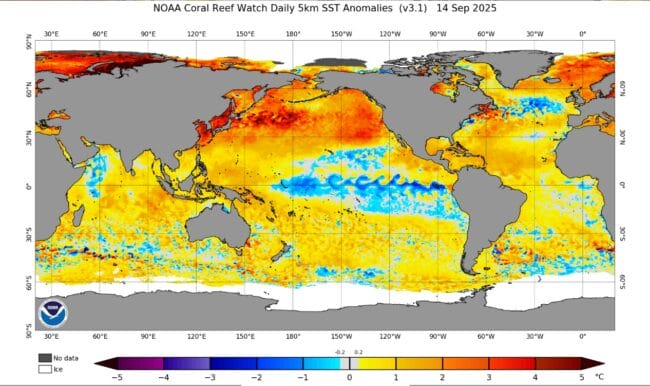
There are signs that Alaska will be more hospitable to tuna in the future, due to warming waters caused by climate change and other factors.
While sea surface temperatures have increased in almost all of the world’s marine areas, temperatures in the North Pacific Ocean are rising faster, according to National Oceanic and Atmospheric Administration scientists. That includes the Gulf of Alaska, which has had recent marine heat waves.
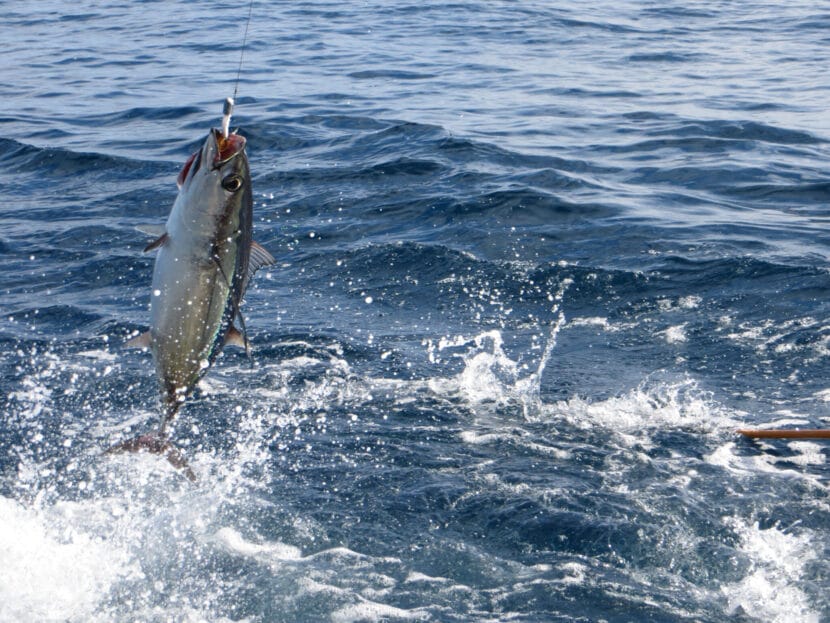
Offshore in Oregon