Listen to this story:
Invasive species are everywhere, but the people who dedicate their lives to battling them believe they can win, especially in Alaska.
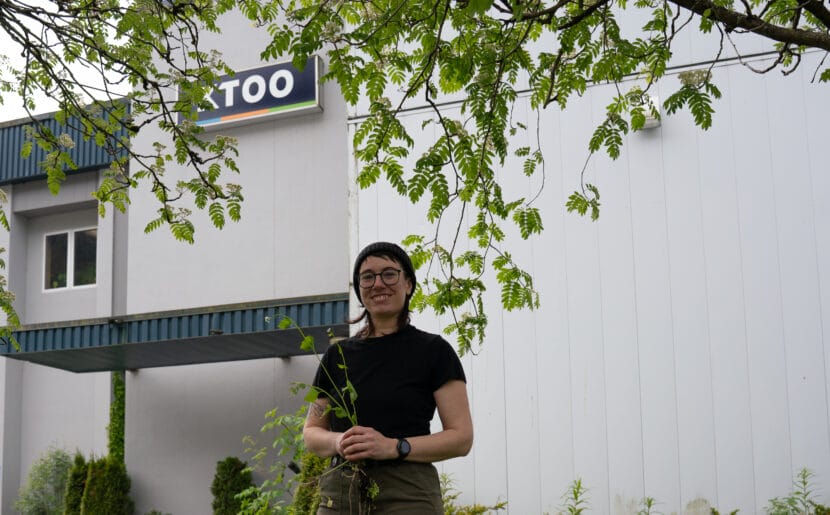
Last week was the state’s invasive species awareness week. On a walking tour around downtown Juneau, Emily Reed, the regional invasive plant coordinator at the Southeast Alaska Watershed Coalition identified some of the pesky plants that have taken root in the region.
She started with a tree just a few steps outside KTOO’s front door. It’s an invasive European mountain ash and it’s blooming with small white flowers that will give rise to bright orange and red berries in the early fall.
Reed said that birds choose to eat these berries over native berries.
“Because the birds fly long distances and the seeds can germinate after being pooped out, we’re finding these in really kind of more natural areas,” she said.
There are thousands of European mountain ashes around Southeast, she estimates. They are still planted ornamentally here, and are hard to get rid of because they can resprout from a stump. Reed says the best way to kill the tree is to apply a bit of herbicide to the stump after chopping it down.
A non-native species becomes ‘invasive’ when it throws off the balance of an ecosystem and starts taking over. Alaska’s geographic isolation and low population make Reed optimistic that invasions can be kept at bay, since the state isn’t completely overrun by noxious weeds yet — unlike most of the U.S.
She walks down Egan Drive to the back of the Four Points hotel parking lot, where the hillside is covered in one of the most invasive plants in the world: Japanese knotweed. The plant mainly reproduces by spreading underground rhizomes, which are modified stems that are known to crack roads and building foundations.
“They go pretty deep, and a new plant can regenerate from a piece of rhizome as small as your fingernail,” she said.
That makes ripping the plant out of the ground futile and controlling it extremely difficult. She and her colleagues return to the same patches year after year to apply herbicide to the plants.
Reed continues up Main Street and takes a left on Fourth Street, where creeping buttercup blooms along the sidewalk with yellow flowers reaching toward the sun. This invasive plant has spread through most of Southeast Alaska, and it does well wherever there is bare ground.
“We’re in this kind of final stage of invasion, where it’s more like we’re not going to get rid of it,” she said.
So instead of trying to get rid of it, Reed says she’s focused on keeping it from creeping into new habitats. She’s particularly worried about uplift meadows, which are tidal flats and marshes that are now rising above the seawater as the land sheds the weight of melting glaciers. They offer a lot of bare ground for buttercup to take over.
Reed disappears into the brush behind an old, broken-down truck on Village Street and emerges with a long stalk that has small white flowers on top.
“Yeah, they can be quite satisfying to pull, you just have to be really on top of it,” she said, gesturing to the long taproot.
It’s garlic mustard, and it’s on the opposite end of the invasion spectrum. So far, Reed says Juneau is the only place in Alaska where garlic mustard has been found, though it has invaded much of the lower 48 already.
“It’s also what we call allelopathic, which means that it puts out chemicals into the soil that prevent other plants from growing,” Reed said.
That gives it a competitive advantage over native plants.
But she has hope about managing invasive plants in Alaska because many of them, like garlic mustard, are in the early stages of invasion.
“An ounce of prevention worth a pound of cure,” Reed said. “We’re in a place where we can be thinking about prevention and rapid response, which is very different than anywhere else I’ve lived or studied invasive species.”
The more people know what to look out for, the better those efforts can succeed. Reed recommends learning to identify the invaders near you, washing your shoes and brushing your dog when leaving an area and taking pictures and GPS locations to report invasives when you get home.
As for aquatic invaders, Juneau has not yet seen European green crab, but appearances in the Metlakatla Indian Community and Ketchikan have confirmed that it is spreading north. The Alaska Department of Fish & Game recommends Alaskans keep an eye out for green crab and other potential aquatic invaders like zebra and quagga mussels, and to report sightings so that ecosystem managers can quickly respond.
Reports can go to the Alaska Invasive Species Partnership, the Alaska Department of Fish & Game, or the Southeast Alaska Watershed Coalition. Reed says it’s helpful to use an app called iNaturalist to make sure you include all the information needed to make a report.