
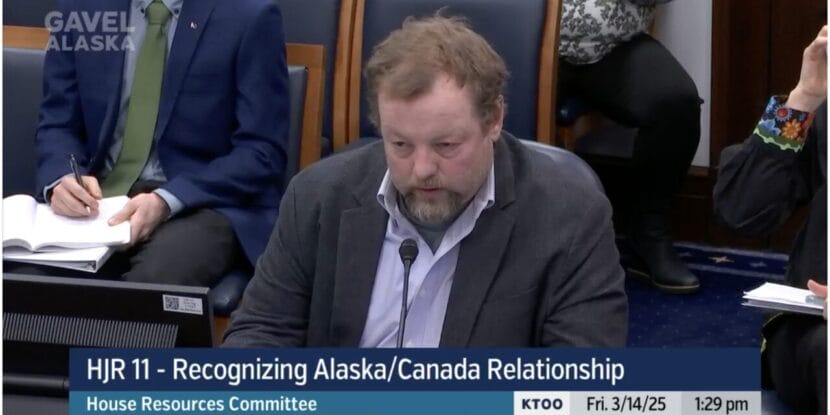
The Alaska House Resources Committee met on Friday to hear testimony on a resolution recognizing the longstanding partnership between Canada and the United States. It also acknowledges Canada’s sovereignty.
Two of Skagway’s elected officials participated and outlined how a trade war with Canada could, and perhaps already is, harming the Upper Lynn Canal.
Skagway Vice-Mayor Deb Potter had just two minutes to articulate her support for House Joint Resolution 11. She participated in the hearing telephonically.
“We are seeing very real effects here in Skagway,” she said. “One of our local restaurants, one of the few of them that is able to stay open year-round, received some calls from folks in Whitehorse expressing that because of actions that are being taken in Washington, D.C. they will be boycotting and no longer supporting our locally-owned restaurant that’s owned by a fantastic year-round family with a couple of young kids.”
Potter said that the Skagway Borough Assembly has received letters expressing a similar sentiment.
Assembly member Orion Hanson, who is also a builder, made the trek to Juneau to testify in person.
“We need our Canadian neighbors,” he said. “We need each other.”
Hanson shared numbers to illustrate how intertwined Skagway’s economy is with Canada.
“Skagway welcomes 1.2 million cruise ship tourists,” he said. “Nearly half of those tourists originated their cruise in Vancouver. At least half of the cruise ship tourists that come to Skagway take a shore excursion … Since the Gold Rush, millions and millions of tons of Canadian ore have traveled from the mines of the Yukon through Skagway and onto the world marketplace. In 2024, 24 million gallons of fuel was transported from Skagway’s Ore Dock to Whitehorse.”
Hanson, who often gets building supplies from Whitehorse, said that Skagway families rely on Whitehorse dentists, vets and grocery stores due to the remote location of his hometown.
“If a trade war ensues between the United States and Canada, the cost of living in Skagway will go up,” he said. “It’ll spiral up very fast.”
State Representative Chuck Kopp is a Republican from Anchorage and a co-sponsor of the resolution.
“What we are saying is that we recognize that there is a lot on the line here, besides a dollar value in a partnership that goes back thousands of years,” he said. “And that the mutual trust and support that Alaska and Canada specifically have with each other is unparalleled in modern times within a shared 1,100 mile border.”
Anchorage Republican Julie Coulombe is a member of the House Resources Committee. She asked Kopp about the purpose of the tariffs.
“The context in which these tariffs are being put forward, though, is in relation to border security and drugs,” she said. “Do you have any concerns about — maybe Canada is not doing all it needs to do to stop drugs coming through their border? Or is that not a concern for you?”
“I don’t have any such concern,” Kopp said. “So, the U.S. Border Patrol itself reports that less than 1% of all fentanyl comes across the Canadian border.”
Coulombe said she supports the partnership between the two countries, but has a “problem” with Canada’s leadership.
“I want to support that partnership, but this is basically, running against our own leadership and supporting the leadership of Canada, and that’s not something I’d like to do,” she said.
“Just in response, I would say this isn’t about the leadership of two countries,” Koff said. “This is about the people of two countries and standing together.”
The premier of Yukon, Ranj Pillai, also spoke telephonically. He introduced his location distinctly.
“In Canada, a country that is not and will never be the 51st state,” he said.
Pillai praised the relationship between his territory and Gov. Mike Dunleavy’s administration, calling it the strongest he can remember.
“We are pleased to be working with this administration on important issues like salmon conservation, justice for missing and murdered Indigenous women, as well as building up northern infrastructure, trade and tourism,” Pillai said.
Besides trade, Alaska has agreements with Canada for help with search and rescue and fire incidents near the borders.
The resolution’s next stop is a full House vote. It’s not yet clear when it might come up for debate.
A similar resolution is awaiting a floor vote in the Senate.
