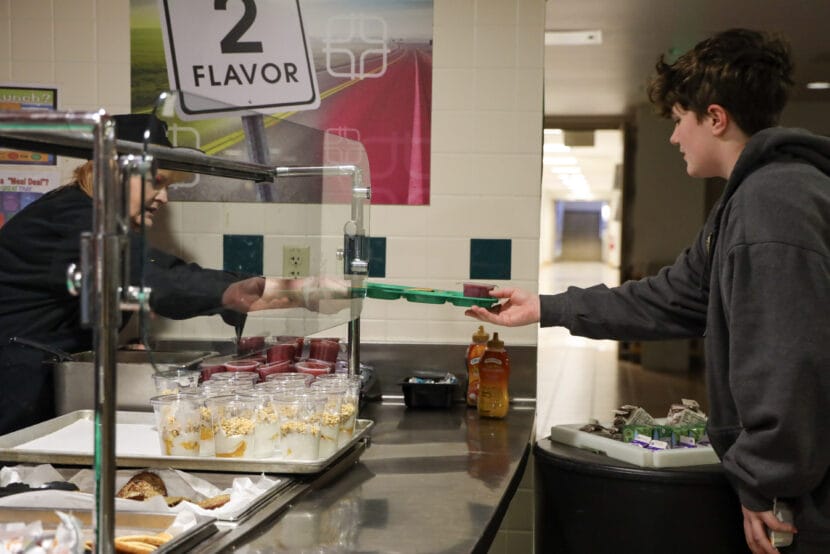
The Alaska Legislature is looking at a bill from Rep. Maxine Dibert, D-Fairbanks, that would fund free breakfast and lunch for all public school students. Juneau student nutrition service employees said it would keep students fed and take the financial burden off districts across the state. But lawmakers want more information about the cost.
The state Department of Education and Early Development, or DEED, estimates the bill’s price tag comes in at $28.7 million.
Despite the costs, supporters like the Food Research and Action Center’s Clarissa Hayes told lawmakers about the benefits of providing meals for all students in public testimony on Monday.
“We know that hungry children do not have the concentration and energy they need to thrive at school,” she said. “Studies have shown participation in school meals improve students’ attendance, behavior and academic achievement, and also reduces absenteeism and tardiness.”
House Education Committee members grilled DEED’s staff about the exact cost of carrying out the program, and found there’s a good deal of information missing. For starters, DEED’s director of finance and support services Heather Heineken said the cost estimate doesn’t include the cost to carry out the program for schools that don’t already participate in the National School Lunch Program and School Breakfast Program. She told the committee that about nine districts aren’t currently in the programs.
Glennallen Republican Rep. Rebecca Schwanke said she wants to see what other programs are already in place that could help to bring costs down for the state.
“I would definitely like to to have a follow up consideration, really, of all the possible ways that we can really bolster the good things that are happening across the districts, especially when it comes to getting food to the children that really need it, and not creating a free program that’s too broad, that puts the onus on on the state to provide food that’s not necessarily needed,” Schwanke said.
In Juneau, Nutrition Service Supervisor Elizabeth Seitz said in an interview Tuesday that the bill would be a game changer for families that struggle financially, but don’t qualify for free and reduced lunch. Her district has offered universal free breakfast for close to 10 years, but it’s currently not included in next year’s proposed budget. That would mean some students will have to start paying for meals.
Seitz said the issue is twofold. Some families don’t qualify for free and reduced lunch but struggle to pay for meals. And Federal reimbursements aren’t enough to cover the full cost of meals for the Juneau School District. She said 77 families in the district have had their free and reduced lunch applications denied so far this school year.
Seitz said the program would feed a lot of these students.
“If this bill were to go through, it would be a significant relief,” she said. “For districts and students across the state.”
Love Ann Truitt is an administrative assistant for the Juneau School District’s nutrition program, and fills in at schools that need food service workers. She told KTOO some of these families just don’t meet the requirements set by the federal government.
“We unfortunately have to turn down a lot of people who apply. It’s not up to us, but they don’t hit the income limit, and it’s so close,” she said.
The regular price for lunch is $5.50, and the district gets reimbursed for just 69 cents. But each lunch costs $7.44. That means it also costs the district more than a dollar for every lunch it serves to students paying full price.
Truitt said many students rack up negative balances with schools to get lunch. She said there’s about $12,000 in school meal debt for the district this year, and it’s costing the district money.
“I know several schools have paid off debts out of donations, but at this point, right now, the school district is feeding kids regardless of whether or not they can pay, she said.“
The committee held the bill so that lawmakers could get more information.
Correction: A previous version of this story misattributed a quote from Love Ann Truitt to Elizabeth Seitz.