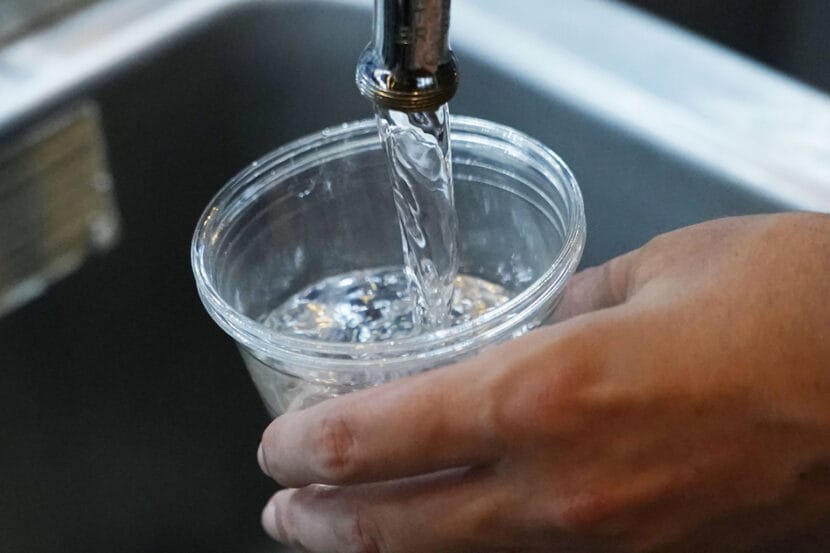
The Environmental Protection Agency announced new drinking water standards Wednesday to limit exposure to a class of chemicals called PFAS.
“There’s no doubt that these chemicals have been important for certain industries and consumer uses, but there’s also no doubt that many of these chemicals can be harmful to our health and our environment,” said EPA administrator Michael Regan in a call with reporters.
This is the first time the agency has set enforceable limits on PFAS in drinking water.
PFAS stands for perfluoroalkyl and polyfluoroalkyl substances – a large group of man-made chemicals that have been used since the 1940s to waterproof and stainproof products from clothing, makeup and furniture to firefighting foam and semiconductors.
Manufactured by several large companies including Dupont and 3M, PFAS have strong molecular bonds that don’t break down for a long time, which is why they’re known as “forever chemicals.”
PFAS from the 1940s “are still in our environment today,” says Anna Reade, lead scientist on PFAS for the Natural Resources Defense Council. “The levels of these chemicals keep building up in our water and our food and our air.”
Evidence for their harmful effects on human health have also accumulated. “Long term exposure to certain types of PFAS have been linked to serious illnesses, including cancer, liver damage and high cholesterol,” the EPA’s Regan said.
The EPA also noted PFAS exposure has been linked to immune and developmental damage to infants and children.
That’s why the EPA has finalized a rule restricting six PFAS chemicals in the water – individually, or in combination with each other or both – meaning water systems are required to monitor for these chemicals and remove them if they’re found above allowable levels. While some states have instituted their own PFAS limits, this is the first time it’s happening on the federal level.
Public water systems will have five years to address their PFAS problems – three years to sample their systems and establish the existing levels of PFAS, and an additional two years to install water treatment technologies if their levels are too high, senior government officials told reporters.
The EPA expects that excess PFAS levels will be found in around 6-10% of water systems, affecting some 100 million people in the U.S.
“This is historic and monumental,” says Emily Donovan, co-founder of Clean Cape Fear, an advocacy group working to protect communities from PFAS contamination. “I didn’t think [the EPA] would ever do it.” Donovan lives in an area of North Carolina which has been contaminated with PFAS from the Chemours chemical manufacturing plant.
She says seeing the EPA set limits is “validating.” Six years ago when her group first raised the issue of PFAS, she says they were told that the water met or exceeded state and federal guidelines. “And that’s because there weren’t any,” she says. “It really broke public trust for so many people in our community.”
“The final rule is a breakthrough for public health,” says Erik Olson, a senior director with NRDC. “We believe it’s going to save thousands of lives as a result of reduced exposure of tens of millions of people to these toxic chemicals in the tap water.”
There are more than 12,000 known PFAS chemicals. The six that the EPA is restricting “have had many animal and, in many cases, human studies, so [the EPA] feels confident that they have estimated the safe levels of these chemicals,” says Elizabeth Southerland, a former EPA official in the Office of Water, who left the agency in 2017.
Southerland says the new limits are a bold first step towards addressing the PFAS problem. And while the EPA has focused on only six chemicals, the treatments that water utilities use to remove these chemicals will also remove other chemicals of concern from drinking water.
In addition to other PFAS, “they will also be taking out all kinds of pesticides, pharmaceuticals and personal care products that are unregulated now under the Safe Drinking Water Act, but [which] we know have serious health effects,” Southerland says.
The agency estimates that it will cost $1.5 billion a year for water companies to comply with the regulation – for as long as PFAS continues to show up in the drinking water. “The costs are not just for a one time sampling and then putting in the treatment,” Southerland says. They include ongoing monitoring and maintaining equipment, for instance replacing carbon filters on a regular schedule.
The EPA says the benefits will equal, if not exceed the cost, in terms of less cancer, and fewer heart attacks, strokes and birth complications in the affected population.
The announcement comes with $1 billion in grants to help water systems and private well owners conduct initial testing and treatment. It’s part of a $9 billion funding package for PFAS removal in the Bipartisan Infrastructure Law. Companies that made these chemicals are also on the hook for more than $10 billion from a class action lawsuit – money which will go to public water systems to remove PFAS.
If water systems can’t access those funds, or if the funds run out, some of those costs may eventually get passed on to consumers, says the NRDC’s Olson.
9(MDEwMjQ0ODM1MDEzNDk4MTEzNjU3NTRhYg004))
Transcript :
STEVE INSKEEP, HOST:
For the first time, the Environmental Protection Agency is putting limits on chemicals called PFAS in drinking water.
MICHEL MARTIN, HOST:
They’re known as forever chemicals because of how long they last. They’re useful. They’re often used to waterproof and stain-proof products, but that comes at a cost to human health.
INSKEEP: NPR’s science correspondent Pien Huang is covering the story. Good morning.
PIEN HUANG, BYLINE: Good morning, Steve.
INSKEEP: OK. Why set limits on these chemicals now?
HUANG: The EPA is acting to end what has seemed like a forever debate over forever chemicals. Here’s EPA administrator Michael Regan.
(SOUNDBITE OF ARCHIVED RECORDING)
MICHAEL REGAN: There’s no doubt that these chemicals have been important for certain industries and consumer uses. But there’s also no doubt that many of these chemicals can be harmful to our health and our environment.
HUANG: Now, this follows what some states, including New Jersey and Washington, have already been doing, but it’s the first time that it’s happening on the federal level. The EPA is now putting limits on six of these chemicals in the drinking water, saying that every water system now needs to look for them. And if they’re found over a certain amount, they have to be taken out.
INSKEEP: What are these chemicals, and where do they come from?
HUANG: PFAS is a group of man-made chemicals – a rather large group that have now been around since the 1940s. They were manufactured by companies like DuPont and 3M, and they’re used to make things resistant to stains, to water and to grease – you know, everything from clothing, furniture to firefighting foam and electronics and semiconductors.
INSKEEP: Wait a minute. I’ve sometimes had pants – that the water rolls off the pants. They might have those chemicals in them. Is that right?
HUANG: Probably. Although there are a few brands now that have committed to not using PFAS in their clothing, but probably, Steve.
INSKEEP: What makes these so effective?
HUANG: Yeah. Well, the thing about them is that they have these really strong molecular bonds, which means that they really don’t break down for a long, long time. You know, PFAS from the 1940s – it’s still around today. And that’s where they get the name forever chemicals. But as they’ve accumulated, so has evidence for how they can harm human health. You know, there are now links between PFAS and certain cancers, liver damage, high cholesterol, immune problems. And now there are more than 12,000 PFAS chemicals out there. And the EPA is putting limits on six of them in the drinking water.
INSKEEP: When you say 12,000 chemicals and six of them are to be limited, that doesn’t sound like much.
HUANG: But experts like Elizabeth Southerland, who’s a former EPA official, says that it is a strong first step.
ELIZABETH SOUTHERLAND: The six that they have here have had many, many both animal and human studies in many cases so that they feel confident that they have estimated the safe level of these chemicals.
HUANG: The limits are set around four to 10 parts per trillion depending on the chemicals. And she also says that the filters or chemical treatments that water utilities are going to have to use to deal with these six chemicals are also going to remove a lot of other chemicals that people are concerned about.
INSKEEP: How much does it cost to install the better filters and take the other steps that water systems will need to take?
HUANG: Well, in total, the EPA estimates that this will cost around $1.5 billion a year for water companies to comply. And, Steve, that’s $1.5 billion every year until these chemicals stop showing up in the drinking water. The EPA does say that the benefits will exceed that cost. They say about a hundred million people are affected. And in that population, there will be less cancer, fewer heart attacks and fewer birth complications.
INSKEEP: Does my water bill go up?
HUANG: Well, maybe eventually, but there is funding that the government intends as a first resort. So the Bipartisan Infrastructure Law includes billions of dollars for PFAS removal. And companies that made these chemicals are also on the hook for more than $10 billion from a class-action lawsuit. But if water systems can’t access those funds or if those funds run out, then some of those costs might eventually get passed on to consumers.
INSKEEP: NPR’s Pien Huang. Thanks so much.
HUANG: You’re welcome. Transcript provided by NPR, Copyright NPR.