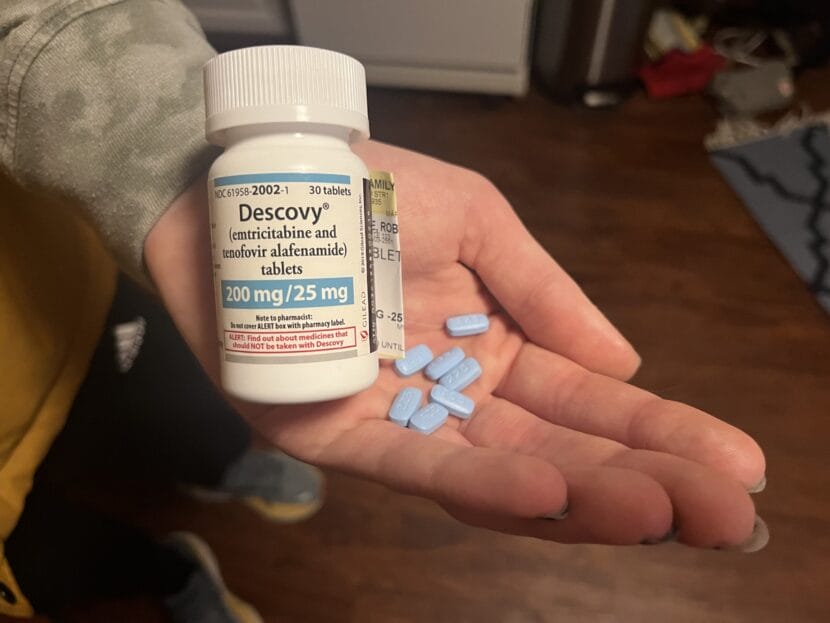
Robin O’Donoghue grew up in Fairbanks and first heard about pre-exposure prophylaxis, or PrEP, for preventing HIV transmission when he was in college. PrEP is a daily pill or injection that dramatically reduces the risk of HIV transmission. A few years after learning about it, O’Donoghue got a prescription.
“[After] becoming more educated, getting older, [I] wanted to be more health conscious,” O’Donoghue said. “And, statistically, if you’re a sexually active gay man, you probably should be on PrEP, if you can.”
At first, O’Donoghue didn’t have insurance, so he used a free online service called Mistr to get a prescription. His prescriptions were sent through the mail, and he would send his required samples for lab tests back in the mail. When he later got health insurance, he started accessing PrEP through a clinic in Juneau. Under the Affordable Care Act, sometimes called Obamacare, PrEP is supposed to be free under almost all insurance. But O’Donoghue quickly started hitting snags with his prescription.
“Normally it’s fully covered, zero dollars out of pocket, but then I would get billed almost $500,” O’Donoghue said. “The pharmacy would say it’s insurance, insurance would say it’s the pharmacy’s fault. It wouldn’t get resolved.”
He said sometimes he had to choose between paying out-of-pocket or missing pills. Over two years he said he spent about $1,500 on incorrect charges. When he couldn’t pay, he said he sometimes missed taking his prescription. There were months where he wasn’t protected from HIV.
Just like with birth control pills, PrEP takes up to a few weeks to become effective. You need to take it consistently, and if you skip pills, you have to restart that waiting period. Once it’s working, PrEP is 99% effective for preventing HIV transmission through sex and about 70% effective for preventing HIV when sharing needles.
Ultimately, O’Donoghue said, he switched back to getting his prescriptions online through Mistr because it was always free.
But not everyone can safely use online prescription services. If someone doesn’t have a home or consistent mailing address or they’re not out to people they live with about being on PrEP, they may not feel safe getting pills in the mail.
Robin Lutz, executive director at the Alaskan AIDS Assistance Association, or 4As, said the organization has been talking with people newly diagnosed with HIV. O’Donoghue, who had trouble accessing PrEP, is a board member of 4As and his experience is one Lutz is familiar with. She said Alaskans face many barriers to accessing PrEP.
“We heard about people who were given misinformation about PrEP, people who had a visit with their provider at a time when it would have been appropriate to recommend or discuss PrEP, and that opportunity was missed,” Lutz said. “We had people who got a prescription to PrEP but weren’t able to fill it, because of issues around insurance coverage and misinformation, and cost.”
Lutz said none of these barriers come as a surprise, and many of them have to do with the discomfort people feel talking about sex and HIV. But, Lutz said, when people can access it, PrEP is a game-changer for preventing HIV transmission.
Before PrEP, condoms and other types of barriers were the main method of prevention.
“Condoms don’t work for everyone,” Lutz said. “It requires some communication and depending on the kind of sex you’re having, you might not be the person wearing the condom. So then, it includes some negotiation. The great thing about PrEP is that it’s something that you have control over as an individual to protect yourself.”
The Alaska Division of Public Health recently investigated an HIV cluster originating in the Interior region that has included 24 connected cases over the past two years. Joe McLaughlin, epidemiologist for the division, said assessments done about the HIV cluster helped the division learn more about barriers to HIV testing and prevention.
“We’re going to be looking at how can we improve access to testing, the increased strategic messaging to promote awareness and uptake of PrEP, HIV, STI testing and other prevention strategies to gain bisexual men and other populations who may benefit from this information, develop and disseminate information that healthcare providers can use to quickly assess prep needs among their patients,” McLaughlin said.
To address some of the barriers to access, Lutz said 4As is launching a same-day PrEP program starting Dec. 4 at their clinic in Anchorage, so patients won’t have to wait to get their prescription. She said same-day programs have been very effective in the lower 48 states, and if the program works well in Anchorage, they may offer it in their other clinics in Juneau and the Mat-Su Borough. 4As is also launching a statewide support program to help people when they hit snags like O’Donoghue did while trying to access PrEP.
“Someone can call and say, ‘Hey, I’m trying to fill my PrEP prescription, my pharmacy is saying I have a $500 payment for it,’” Lutz said. “And we have the expertise to know ‘Oh, that’s not right… Let’s solve this problem for you in real time so you don’t have an interruption in your prescription.’”
Starting Dec. 4, Alaskans can call any 4As office–in Anchorage, Juneau, or Mat-Su Borough–for support accessing PrEP.
You can also find out about HIV testing and prevention from a healthcare provider or through health.alaska.gov.
This is the second part of a story looking at how Alaska is responding to a cluster of new HIV diagnoses originating in the interior. You can find the first part of the story here.