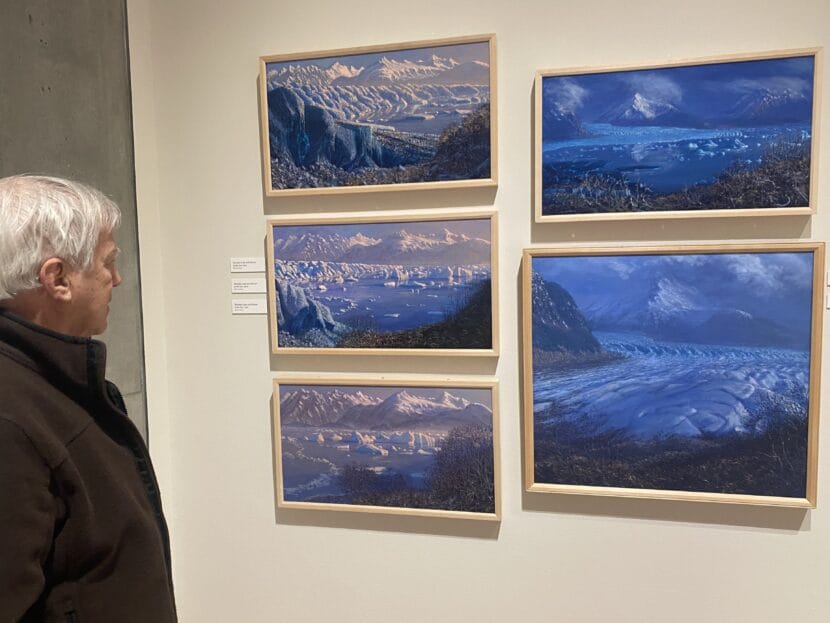
When painter David Rosenthal came to Alaska nearly 50 years ago, he was captivated by the expansive glory of the icy landscapes. Over his career he’s painted ice, snow and glaciers in Alaska, the North Pole, Greenland and even Antarctica, inadvertently capturing climate change in his brushstrokes.
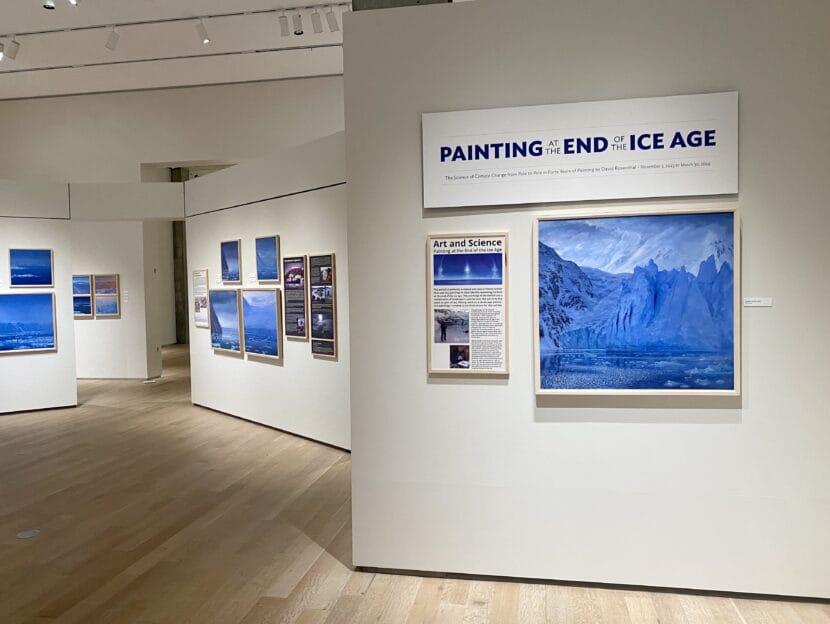
The Cordova-based artist’s showcase, “Painting at the End of the Ice Age”, is a retrospective which places his paintings in the context of human-caused warming and glacial retreat, seamlessly blending science and art. It opens Friday, Nov. 3 at the Alaska State Museum, followed by a lecture from Rosenthal.
He sat down with KTOO’s Anna Canny to talk about his experiences capturing the last remnants of Alaska’s glaciers.
This interview has been edited for length and clarity.
Anna Canny: So you’ve been a painter for decades, and you’ve always painted landscapes. But as this exhibit showcases, you have an affinity for icier landscapes. Can you kind of tell me how you found that focus?
David Rosenthal: I grew up in Maine, the Ice Age was over. But we used to always hear about it, because, you know, we’d be driving by a field with these boulders everywhere and my parents would go ‘Oh, the glacier left those,’ you know? And it was really something that I used to think about and was fascinated by. And, you know, I was in Maine, doodling and, you know, doing these paintings. And some of them were pretty good, but I barely sold anything. I had just graduated with an interdisciplinary degree, which doesn’t prepare you for anything. So just by chance, I got this job at a cannery up in Cordova, thinking oh I’ll just go up there for a job. Because, you know, compared to Maine it sounded like a lot of money. So, I go up to South central coast, Alaska, basically, which is surrounded by some of the remnants of the Ice Age. They’re all these glaciers and icefields, you know, some, this is some of the biggest glaciation in North America. And this is where basically, this is my playground for years. And so that’s how I, I mean, all during this time, I did other things, besides ice. But I just, ice, glaciers are just so, the colors and the way the light hits them. I mean, they’re just a beautiful subject for painting.
Anna Canny: What were some of your earliest glacier paintings?
David Rosenthal: Well, in Cordova, we have these glaciers, Childs and Miles, about, oh, 52 miles out of town. And when I first saw it in ‘77, there was a little area in this brush and you could just kind of sit there and watch, the face of this, the active face, was about a mile long and it was about 300 feet high in places. And you just go out there for the afternoon and watch these calving chunks, you know, 300 feet high and 200 yards wide and it would actually throw waves across the river. You had to be careful, you had to run sometimes. It was just the wonder of the world.
Anna Canny: So you’ve been painting these landscapes, obviously, for years, you’ve been painting ice for years. But when did you realize that taken altogether, these paintings say something about climate change?
David Rosenthal: It was funny because I’d see everywhere, these exhibits and journalists writing about climate change, you know? And a lot of them were ‘Oh yeah, I’m so and so, I have five years on the ice, you know, or studying this ice and, this one glacier has retreated 100 meters,’ you know, that sort of thing. And I’m thinking, wait a second, I’m living around for the last 40 years, glaciers that have retreated 15, 16 miles. And, so I’ve never been any kind of activist, but there was a lot of times that I would think about what I was doing, and, well, you know, you’ve spent your life making pretty pictures, you know? What good is that, you know? And so then it dawned on me, well, wait a second, this is my chance to give back something.
Anna Canny: I mean, and one thing this exhibit really drives home is that we’re seeing change happening so fast, that in one painter’s lifetime you can catch all of this.
David Rosenthal: Yeah, yeah, you know this, uh in geological time my, well now it’s almost 47 years painting glaciers — in geologic time, that’s nothing. But with glaciers, you get significant changes. So it’s one of the best ways to illustrate these changes. And it’s sad like, uh for my first years in Cordova I used to just go up for the summer, but in ‘81 I moved there full time. And one winter day some friends invited me to go out to the Saddlebag Glacier. It’s a relatively small one. But that memory is etched in my head. Because you come around this corner in the stream and you just like, there was just this wall of ice. And it was around the solstice. So the yellow sun even at noon time made the ice look this incredible emerald green. And then in 2018, there’s not even ice, it’s just gravel in this canyon. And it’s so sad to see these young people, like, you used to just drive out and watch it calve or you could hike up for miles. And you can’t do it anymore.