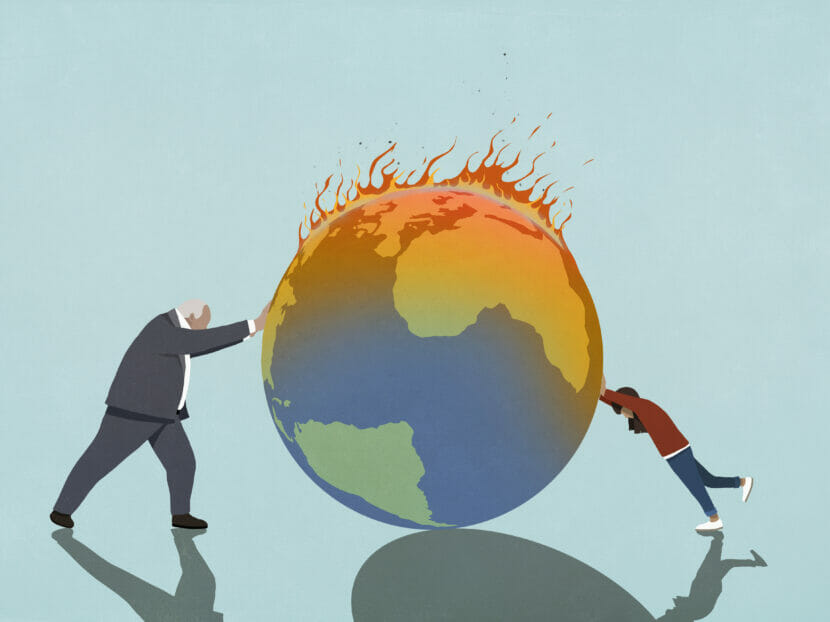
Communities big and small are trying to rein in climate change. But many people working on these climate solutions are running into a big obstacle: falsehoods and conspiracy theories about their work. So what does this mean for fighting global warming?
To talk about the current state of climate disinformation, we checked in with three NPR reporters who have reported on climate, disinformation and the media — and they can answer our questions: Climate solutions reporter Julia Simon, media correspondent David Folkenflik, and reporter Huo Jingnan, who writes about conspiracy theories among other things.
This was adapted from a roundtable discussion on All Things Considered.
What kind of false narratives about climate are we talking about?
Julia Simon: Climate disinformation in the past — sometimes paid for by fossil fuel interests — often related to false ideas that global warming is a scam or that the threat is overblown. Those falsehoods are still around, but what we’re seeing a lot more of these days are attacks on climate solutions even if we don’t always know who funds them. Think attacks on renewables. False ideas that wind turbines cause cancer or cause birth defects in animals. Disinformation may be spreading because solutions are really spreading.
For instance, this weekend we’ll have a story about a trend in urban planning called 15-minute cities — designing cities so that you access amenities in a short walk, bike ride or trip on public transport. Now there’s a conspiracy theory saying that this is a way to restrict people’s movement or to trap people in an open-air prison.
Podcaster Joe Rogan spoke about it on his show last month. “You’ll essentially be contained unless you get permission to leave,” Rogan said, “That’s the idea they’re starting to roll out in Europe.”
That is false.
Earlier this week the U.K. transport minister Mark Harper used some of the language of conspiracy theories when talking about 15-minute cities at the conservative Tory party conference. “What is sinister and what we shouldn’t tolerate,” Harper said, “is the idea that local councils can decide how often you go to the shops.”
It is false that local governments in the U.K. are deciding how often citizens can go shopping.
Huo Jingnan: The false narrative surrounding 15-minute cities is but one part of a larger sprawling conspiracy theory called the Great Reset. The theory goes that a shadowy global elite — often Jewish — wants to strip away ordinary people’s freedoms and make us live a life of deprivation. Under this theory, 15-minute cities are a ploy to take away people’s freedom to move around.
More about false narratives about climate change:
- An activist group is spreading misinformation to stop solar projects in rural America
- Misinformation is derailing renewable energy projects across the United States
- How rumors and conspiracy theories got in the way of Maui’s fire recovery

What is the role of the media in all this?
David Folkenflik: Different kinds of false information spread in different ways. But if you’re considering misleading claims about climate — that’s predominantly on the right. And that involves an information ecosphere defined by Joe Rogan, as we heard above, but also Alex Jones, Breitbart, the Daily Wire, the Daily Mail, the New York Post, and above all Fox News.
The funny thing is they are at once testers and popularizers of things that have gotten some traction online, and then you hear prominent figures on the right picking up the melody.
Back when he was on Fox earlier this year, Tucker Carlson made utterly unsubstantiated claims about dead whales coming ashore on New Jersey, New York and Massachusetts beaches.
Tucker Carlson: The government’s off-shore wind projects, which are enriching their [read: Biden] donors, are killing a huge number of whales, right now.
Folkenflik: But you hear versions of it from former President Donald Trump, Rep. Marjorie Taylor Greene, presidential candidate Robert F. Kennedy Jr. — once it passes audition, it makes the rounds.
More about the role of media:
- After a deadly Capitol riot, Fox News stays silent on stars’ incendiary rhetoric
- Tucker Carlson built an audience for conspiracies at Fox. Where does it go now?
- Conspiracy theories are having a moment. It’s bad for democracy
How does fear-mongering affect the actual implementation of climate solutions?
Huo: It is a distraction from the issues we need to work on. If these narratives ring true to you, you might think that climate activists aren’t really talking about climate but about something else, so much so they could be secret agents of the government trying to take away your freedom.
One interesting example of a strawman here is one of the subplots of the great reset conspiracy theory, which is that the government wants to force people to eat insects. Including insects in the human diet has been an idea on the edges of climate circles. The mainstream idea is simply to eat less meat. But it attracted more attention over the years because many news outlets — including NPR — are easily intrigued by the idea of eating something seen as exotic.
And that gets turned into raw material for conspiracy theorists like Alex Jones in March 2022:
Alex Jones: Coming food crisis recommends more sustainable diets of – wait for it – fly larva, fly larva, fly larva.
Simon: And a muddied information landscape about climate solutions can sometimes complicate the process of getting them enacted, says Jennie King, head of climate research and policy at the Institute for Strategic Dialogue.
“In the end, it actually doesn’t matter if 99% of the public believe in climate change,” King says, “if you’re able to embed real fear and seeds of doubt about the solutions that are on the table you end up with the same outcome, which is no legislative agenda, no meaningful policy proposals, no local action.”
More about how fear-mongering affects solutions:
- From 4chan to international politics, a bug-eating conspiracy theory goes mainstream
- Gas stoves became part of the culture wars within a week. Here’s why
What sort of impact do these conspiracy theories have on the people in the field trying to work on climate solutions?
Simon: I met with Carlos Moreno, a Franco-Colombian professor who developed this idea of the 15-minute city — these more walkable, bikeable neighborhoods that conspiracy theorists think are preludes to open-air prisons. Moreno says he’s gotten death threats, and so have other scientists and researchers.
Moreno says the attacks give his colleagues a reluctance to publish articles about their work. And he says this is what the conspiracy theorists want: to silence them. And we’ve seen harassment and threats based on conspiracy theories targeting climate scientists and meteorologists for years.
More on the impact of conspiracy theories:
- Maui residents grapple with rumors about the fire and aid as they try to rebuild
- A meteorologist got threats for his climate coverage. His new job is about solutions
Can anything break the cycle of disinformation or rumors?
Folkenflik: It’s not in the interest of Fox News and others who benefit financially from stoking outrage and, by and large, also have partisan rooting interests. In a few instances, there have been defamation cases against those media outlets — but those all come from specific people and institutions who claim they’ve been knowingly harmed and defamation law isn’t going to solve the wider issue of spreading false claims about climate research and solutions.
For other journalists and others, it’s tricky — you do need to address falsehoods and fact-check them. But by fact-checking, you’re also sometimes elevating these ideas that may not get widespread currency. News organizations, including NPR, generally try to balance those imperatives as they plan out coverage.
Huo: When it comes to social media, the platforms can change how they label, recommend and moderate content to change what users see and how they interact with platforms. Studies by researchers who were able to run experiments on Facebook and Instagram during the 2020 election showed that changing the algorithm changes user behavior, sometimes leading to less time spent on the platforms.
There’s also a practice called pre-bunking, like a form of inoculation against bad information, which has two strands. One way involves preventatively unraveling specific false claims before they reach a critical mass. Another is essentially news literacy training, to help equip people with tools to evaluate such claims critically. These things have to be done in a way that appeals to the people they’re trying to reach, not patronize them, and also acknowledge that known facts sometimes change, as they have for COVID-19.
While we do not have enough experimental studies on altering platform design to draw conclusions beyond specific interventions, experts in the field place hope in them. A lot of people put stock in hearing from those they trust (like friends) and those they admire (like influencers and celebrities). And they need to absorb it in settings where they seek such content out. That said, some major platforms are dialing back how much news they serve up and how much attention they want to spend on moderating. There’s no single easy or widely embraced answer yet.
More on disinformation and rumors:
- False information is everywhere. ‘Pre-bunking’ tries to head it off early
- Seth Rich’s killing was exploited on Fox News and online. His parents are fed up
- Fake news: How to spot misinformation
9(MDEwMjQ0ODM1MDEzNDk4MTEzNjU3NTRhYg004))
Transcript :
ARI SHAPIRO, HOST:
Here’s one obstacle to communities that are trying to fight climate change – falsehoods and conspiracy theories about the groups that are fighting global warming. As part of our week exploring climate solutions, three of our reporters have been looking into the impact of disinformation on climate. NPR climate solutions reporter Julia Simon, reporter Huo Jingnan, who writes about conspiracy theories, and media correspondent David Folkenflik, good to have you all here.
JULIA SIMON, BYLINE: Hi, Ari.
DAVID FOLKENFLIK, BYLINE: Hey, Ari.
HUO JINGNAN, BYLINE: Hey, Ari.
SHAPIRO: Julia, let’s start with you. What are some of the most common false narratives about climate change?
SIMON: Climate disinformation in the past would frequently put out this false idea that global warming is a scam or that the threat is overblown. That disinformation was often paid for by the fossil fuel industry. Those falsehoods are still around. But what we’re seeing a lot more of today are these attacks on climate solutions, even if we don’t always know who funds them. Think things like attacks on renewables, wind turbines cause cancer or cause birth defects in animals. These are false ideas. And this weekend we’ll have this story about a trend in urban planning called 15-minute cities – these denser developments, more walking, less cars. Now there’s a conspiracy theory saying this is a way for global elites to trap people in open-air prisons. Here’s podcaster Joe Rogan talking about it on his show earlier this month.
(SOUNDBITE OF PODCAST, “THE JOE ROGAN EXPERIENCE”)
JOE ROGAN: You’ll essentially be contained unless you get permission to leave.
UNIDENTIFIED PERSON #1: That’s true?
UNIDENTIFIED PERSON #2: Are they?
ROGAN: Yeah. That’s the…
UNIDENTIFIED PERSON #1: How are they going to put us in there?
ROGAN: The idea they’re starting to roll out in Europe.
HUO: Ari, if I might jump in here.
SHAPIRO: Go ahead, Jingnan. Yeah.
HUO: Yeah. So this false narrative surrounding 15-minute cities is just one subplot of an even larger, sprawling conspiracy theory called the Great Reset. So the main gist is that a shadowy global elite, often Jewish, wants to strip away ordinary people’s freedoms and make us all live a life of deprivation. So under this theory, 15-minute cities is a ploy for open-air prisons.
SHAPIRO: So many of these false narratives are interconnected in the way that you describe.
HUO: Absolutely.
SHAPIRO: David, talk about the role of the media in all of this. Beyond podcasters like Joe Rogan, how are these ideas spreading?
FOLKENFLIK: Well, so different kinds of false information’s spread in different ways depending on what it is, who takes an interest of it. But if we’re talking about misleading claims about climate and climate change, that predominantly comes from the right, and that involves an information ecosphere defined by Joe Rogan, as we just heard a moment ago, but also folks like Alex Jones. There are sites like Breitbart, The Daily Wire, and then you get closer and closer to kind of mainstream-like outlets like the Daily Mail, the New York Post, and above all, of course, Fox News. And the funny thing is that these outlets and figures are at once testers and popularizer of the things that get some traction online and on social media. And then you hear these prominent figures on the right picking up the melody. Let’s take the question of dead whales coming ashore in New Jersey, New York and Massachusetts beaches. That’s a real thing. That’s been happening in recent years, and it’s been unclear why. Here’s an influential voice making what are, on the other hand, utterly unsubstantiated claims about them.
(SOUNDBITE OF TV SHOW, “TUCKER CARLSON TONIGHT”)
TUCKER CARLSON: The government’s offshore wind projects, which are enriching their donors, are killing a huge number of whales right now.
FOLKENFLIK: That’s Tucker Carlson back when he was on Fox earlier this year. And again, federal and state agencies have looked in this and found there’s no evidence to support that. But you hear strong versions of it from former President Donald Trump, from Republican Representative Marjorie Taylor Greene, presidential candidate Robert F. Kennedy Jr., a Democrat, who’s taken steps to consider a run as an independent. Once those things kind of pass auditions in, like, the minor leagues, they hit the bigs.
SHAPIRO: Jingnan, how does the fearmongering we’re hearing about affect the actual implementation of climate solutions?
HUO: It’s a distraction. It’s like when – like, we need to work on real issues. But if this narrative rings true to you, you might think that when climate activists talk about climate solutions, they aren’t really talking about climate solutions. They are actually just trying to take away your freedom. So that is, like, really distracting. I mean, one other interesting example of such a straw man-esque distraction is another subplot of the Great Reset conspiracy theory that we just talked about. So in this subplot, the government is trying to force people to eat insects, like, eating bugs. So including insects in human diets, that’s been kind of an idea on the edges of climate circles. The mainstream idea is just to eat less meat. But as we all know, it attracted more attention because many news outlets, including NPR, are very easily intrigued by the idea of eating something seen as exotic to potentially save the planet.
SHAPIRO: I confess I did a story about eating bugs from South Korea.
HUO: I mean…
SHAPIRO: Larva.
HUO: Right. Of course. Of course. And I grew up eating silkworms. So, you know, that gets turned into raw material for conspiracy theorists like Alex Jones.
(SOUNDBITE OF RADIO SHOW, “THE ALEX JONES SHOW”)
ALEX JONES: Overcoming food crisis recommends more sustainable diets of – wait for it – fly larva. Fly larva. Fly larva.
SHAPIRO: It’s a catchy refrain.
SIMON: It is. And, Ari, if I may, a muddied information landscape about these climate solutions – the real ones, like renewables and urban planning ideas especially – can really complicate the process of getting them enacted. We see that with these falsehoods hindering the implementation. Here’s Jennie King. She studies climate misinformation at the Institute for Strategic Dialogue in London.
JENNIE KING: In the end, it actually doesn’t matter if 99% of the public believe in climate change. If you’re able to embed real fear and seeds of doubt about the solutions that are on the table, you end up with the same outcome, which is no legislative agenda, no meaningful policy proposals, no local action.
SHAPIRO: Julia, what kind of impact do these conspiracy theories have on the people in the field trying to work on climate solutions?
SIMON: Yeah. I met with Carlos Moreno. He’s a Franco Colombian professor, and he’s developed this idea of the 15-minute city. That’s these more walkable neighborhoods that conspiracy theorists think are preludes to open-air prisons. Moreno says he’s gotten death threats, and so have other scientists and researchers. Moreno says the attacks give his colleagues a reluctance to publish articles about their work. And he says this is what the conspiracy theorists want – to silence them. And we’ve seen harassment and threats based on conspiracy theories targeting climate scientists and meteorologists for years. It has an impact on their work.
SHAPIRO: OK. So in the spirit of solutions, David, what can break the cycle of disinformation and rumors?
FOLKENFLIK: Well, you know, if you’re talking about trying to reach the audiences that are grabbing on to them, you know, it’s not in the interest of Fox News or of Alex Jones or others who benefit from stoking outrage to say, folks, don’t pay so much attention to this. The financial model and the partisan rooting interests are already there. So you’ve seen some lawyers spring up and say, let’s do this through the courts and file defamation cases. And in some ways, that has helped. But those typically involve claims against specific people. And, you know, when you’re talking about whales writ large, you know, and windmills writ large, that’s harder to file a defamation case.
For journalists, they’ve looked at fact-checking in, you know, in the last decade or so. That is an important journalistic tool but doesn’t seem to solve the problem. You’re also hearing people bring up the idea of inoculation – some people call it prebunking (ph) – by giving people the tools to process some of these claims as they come in, as opposed to addressing specific claims along the way. And that seems to have some promise. But the real question is, how do you reach the people you want to reach without, in some ways, patronizing them but bringing them in? It’s a real question. These aren’t slam-dunks. These are tools.
SHAPIRO: That’s NPR’s David Folkenflik, Huo Jingnan and Julia Simon. Thank you all three of you.
HUO: Thanks so much, Ari.
FOLKENFLIK: You bet.
SIMON: Thank you, Ari. Transcript provided by NPR, Copyright NPR.