
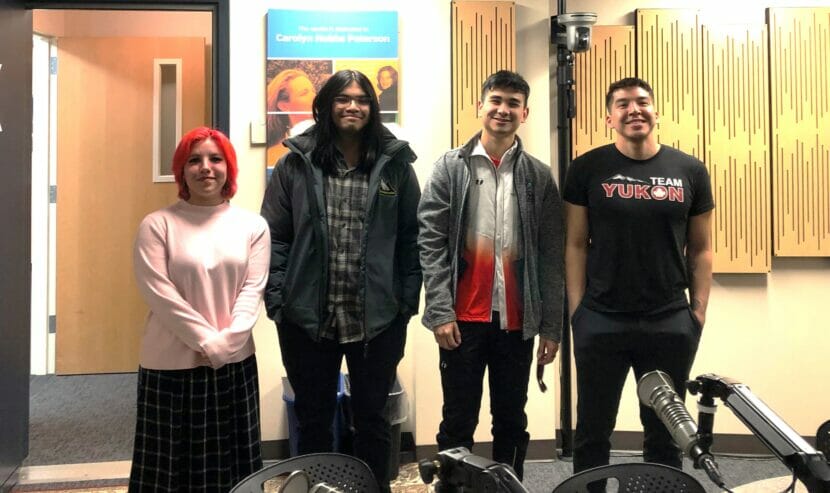
The Arctic Winter Games were held earlier this month in Northern Alberta for the first time since 2018. Team Alaska placed second overall in terms of both wins and gold medals, or “ulus.”
Four Alaska athletes traveled from Juneau and sat down with KTOO’s Chloe Pleznac upon their return to discuss their experience competing in the 2023 games.
This interview has been edited for length and clarity.
Chloe Pleznac: Joining me today to talk about team Alaska’s recent involvement — and victories — at the Arctic Winter Games are Matthew Quinto, Ezra Ellisoff, Kyle Worl and Lyric Ashenfelter. So, Kyle, I’m going to start with you. You scored gold for Team Alaska in the Airplane Open Male. I was really impressed to learn exactly what the airplane event is because it’s even more incredible that you did it for that long. So, could you explain to me how you compete in the airplane event?
Kyle Worl: The Airplane is one of 10 games in the Arctic sports division. It’s a traditional Inuit game. You start by laying on the floor in an iron cross position, your arms are out, your legs are straight. And you’re lifted up by the wrists and your ankles and you’re lifted about a couple of feet off the ground, and you have to hold that iron cross position as long as possible.
Chloe Pleznac: Wow. And you held it for, was it a minute and three seconds?
Kyle Worl: Yep. A minute and three seconds. Matthew here was the one counting it off for me.
Chloe Pleznac: Ezra, you placed gold for Team Alaska in the Alaskan High Kick Open Male. Could you tell me a little bit about the traditional history surrounding that event?
Ezra Elisoff: Okay, yeah. It’s more for staying in physical shape for long, harsh winters. So I learned this from Matthew actually, where they would grab ash and they rubbed it on their moccasins or mukluks. And they try to kick as high as they can to the ceiling and whoever could get their footprint on the same ceiling would basically win. And so that game was just more or less played for like, you know, say it was like -60 or something like that. You wouldn’t go hunting in that, you would just stay inside and wait out the winter.
Chloe Pleznac: Matthew, you placed bronze for the Alaskan High Kick Open Male. This was your first year attending. It was a lot of your guys’ first year attending. What was the experience like?
Matthew Quinto: It was a lot of fun. I think my favorite part was probably just meeting all the people from the different countries and making friends there. And the camaraderie that happened through all of us staying on the same floor and different, you know, different rooms, but we were all on the same floor every night, same place a lot of bonding to happen there.
Chloe Pleznac: Lyric you placed bronze for the Arm Pull 2005 or later. What was it like when you were up there in that moment competing?
Lyric Ashenfelter: Oh, I was really nervous at first. But I also had a lot of confidence in myself, because I knew that I could get somewhere far if I really was determined to. It was really cool, though. All the other girls from the other teams were really nice, very supportive. So overall, it makes for a very fun experience. And when you’re all cheering each other on it. It’s really great. And so that got me to where I was, and it was, it was awesome.
Chloe Pleznac: How do you guys prepare for these events? Some of them, like with the airplane, require multiple people holding you up, right? What did the process look like for you guys preparing?
Kyle Worl: Well, I would say they’ve been preparing for a long time. Well, at least Matthew and Ezra here, were on the 2020 team. And they were training for that. And that ended up being canceled about a week out. And so three years later, they finally get their chance to go again. So at least three years, but really their training started for Ezra, his freshman year of high school. He’s now one year out of high school and then Matthew junior year. So yeah, they go back quite a few years of training in these games. Training really just involves doing the games. All around fitness is important. A bit of cardio and weight training and plyometrics are always helpful, but nothing’s gonna get you high in the games like actually practicing the events themselves. So it just takes time and practice.
Chloe Pleznac: So Kyle, you started Juneau’s Native Youth Olympics team up again in 2018 after a long hiatus. Tell us about the relationship between Native Youth Olympics and the Arctic Winter Games.
Kyle Worl: Native Youth Olympics specifically refers to the sport in the K-12 level. And there’s many overlapping games. Native Youth Olympics are all based on Indigenous northern games and so is Arctic sports, but there’s a variety of different games you’re gonna find at different events and` Arctic Winter Games is the kind of the highlight event for this sport. I think of it similar to in basketball you have the NBA like that’s the highest achievement of the sport. For Native Youth Olympics, it’s Arctic Winter Games to be able to represent your state or really we’re representing our country. Arctic Winter Games is a huge honor and it’s a huge event that takes an amazing amount of coordination between many different nations. So it’s an amazing honor and experience for us to all have been there.
Chloe Pleznac: Ezra, you participated in the Native Youth Olympics and placed first in the Alaskan high kick statewide in 2020. What was it like to finally get to compete internationally,
Ezra Elisoff: It was pretty cool. Trying to converse with some of the athletes who don’t necessarily speak English very well was a bit difficult, but we generally got the same message across it was pretty cool. It was like state NYO, but basically bigger, because we were in the open division. So everyone was older and experienced. And at first, it was intimidating. But then as time went on, we all started warming up to each other and joking around, and it was actually pretty great.
Chloe Pleznac: Who were some of the other countries that were involved?
Ezra Elisoff: So there was Greenland, Northern Alberta, most of the provinces in Canada. There’s one team that was, I guess, banned from this year.
Kyle Worl: Normally, Russia is a participant in the Arctic Winter Games, but because of the war in Ukraine, they were not invited this year.
Chloe Pleznac: Competitors in traditional gaming events, like the Native Youth Olympics, and the Arctic Winter Games come from all kinds of backgrounds. Do you think that helps raise the profile of these sports among a wider audience?
Kyle Worl: I think a big misconception about traditional games or Native Youth Olympics is that it’s only for Native people. But the majority of the events are open to anybody to participate in. All backgrounds are welcome. And I think it’s a great cross-cultural learning opportunity for anybody, even if you’re not from an Alaska Native culture to learn about our northern indigenous people through the games is really powerful. I would like to see the continued growth of traditional games beyond just the Arctic. And I think Juneau is an example of that. We’re pretty far from the Arctic here in Southeast Alaska. But the games have spread down to this region from Yakutat to Metlakatla. And we have an upcoming event — April 1 and 2, the Juneau Traditional Games — and we’re going to be seeing a team from Santa Fe. So there really is no limit to where the games can go, in my mind. I think the ultimate dream is to see it at the world Olympics, this sport from here in the Arctic, being on the world stage.
You can find a complete list of Team Alaska’s medal winnings here.
