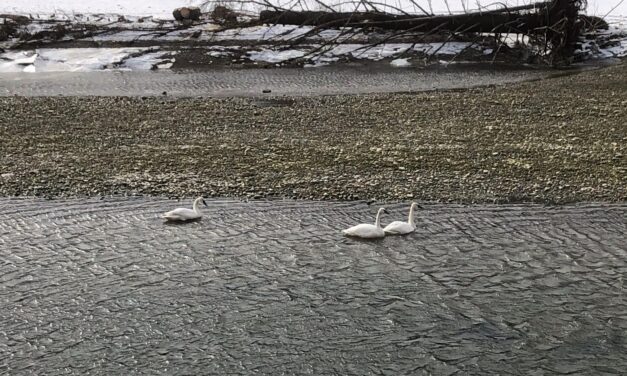
The arrival of the trumpeter swans is a signal that spring is here, whether or not the weather agrees. Klondike Gold Rush National Park biologist Elaine Furbish says more than 20 have been seen on the Taiya River in Dyea this week. They’re on their way north.
“Every spring, we have swans passing through Skagway on their way back north to their breeding grounds up in the boreal areas of Canada and Alaska. And the two species that could come through here are trumpeter swans and tundra swans. By far the most common species that I’ve seen are the trumpeter swans,” said Furbish.
Furbish admits the two are exceptionally difficult to distinguish from each other. They are almost the same size. Tundra swans have a tiny yellow coloration on their beaks next to their eyes, slightly different beak structure and a higher-pitched “whooping” call. Trumpeter swans tend to have a lower-pitched call that sounds a bit like a French horn.
The park service hosts a waterbird monitoring program that runs most years, though it was paused in 2020. The program will start again at the end of this week to monitor water-related migrating birds that come through Skagway and Dyea.
According to Furbish, the trumpeter swans will typically land in Dyea this time of year and briefly feed on vegetation in the Taiya River. When the water is at a high level, it’s a curious sight.
“It’s called dabbling. They’re reaching for the vegetation under the water. And they stick their butts up in the air and they look like little white pyramids on the water,” said Furbish.
The trumpeter swan is the world’s largest waterfowl, with adult males typically in the 28 lb range and some growing in excess of 35 lbs. They are monogamous and breed once a year, with their eggs reaching up to five inches in length.
The swans aren’t expected to stay for long. Furbish says many of them are headed north to Marsh Lake, near Whitehorse, for an extended rest. There is a viewing area at the lake called Swan Haven where they tend to congregate by the hundreds.
But before they head up and over the pass from Dyea, they typically wait for favorable weather.
“A lot of it has to do with the weather. They don’t want to fly into a gale force headwind any more than we would. So they’ll wait for the good weather before they pick up their journey again,” said Furbish.