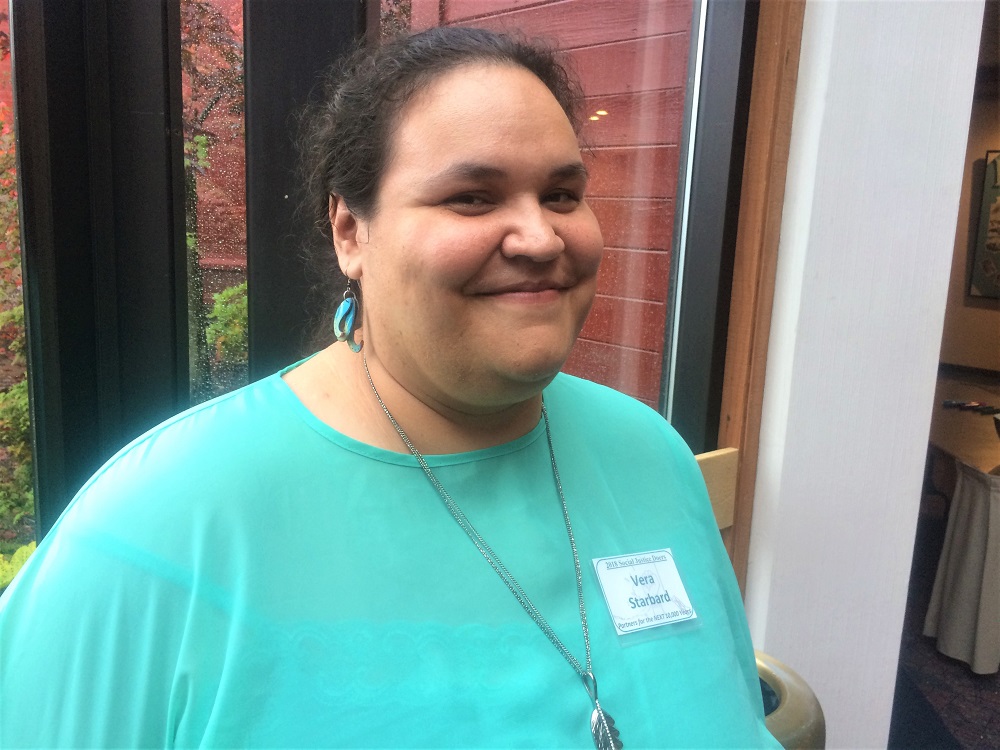
“I more often have it imposed on me as a Native writer of what I should be writing,” said Vera Starbard to a ballroom of 70 people at a recent social justice summit in Juneau. Starbard is an Anchorage-based playwright and writer who is Tlingit and Dena’ina.
“And it either needs to completely conform to a dominant society norm, or it needs to be completely what they consider cultural acceptable traditional,” continued Starbard.
The summit, Social Justice Doers: Partners for the Next 10,000 Years, was hosted by the First Alaskans Institute and gathered diverse community members who worked to make Alaska a more equitable and just place. Among the discussions was social justice and the arts that brought together four prolific indigenous artists.
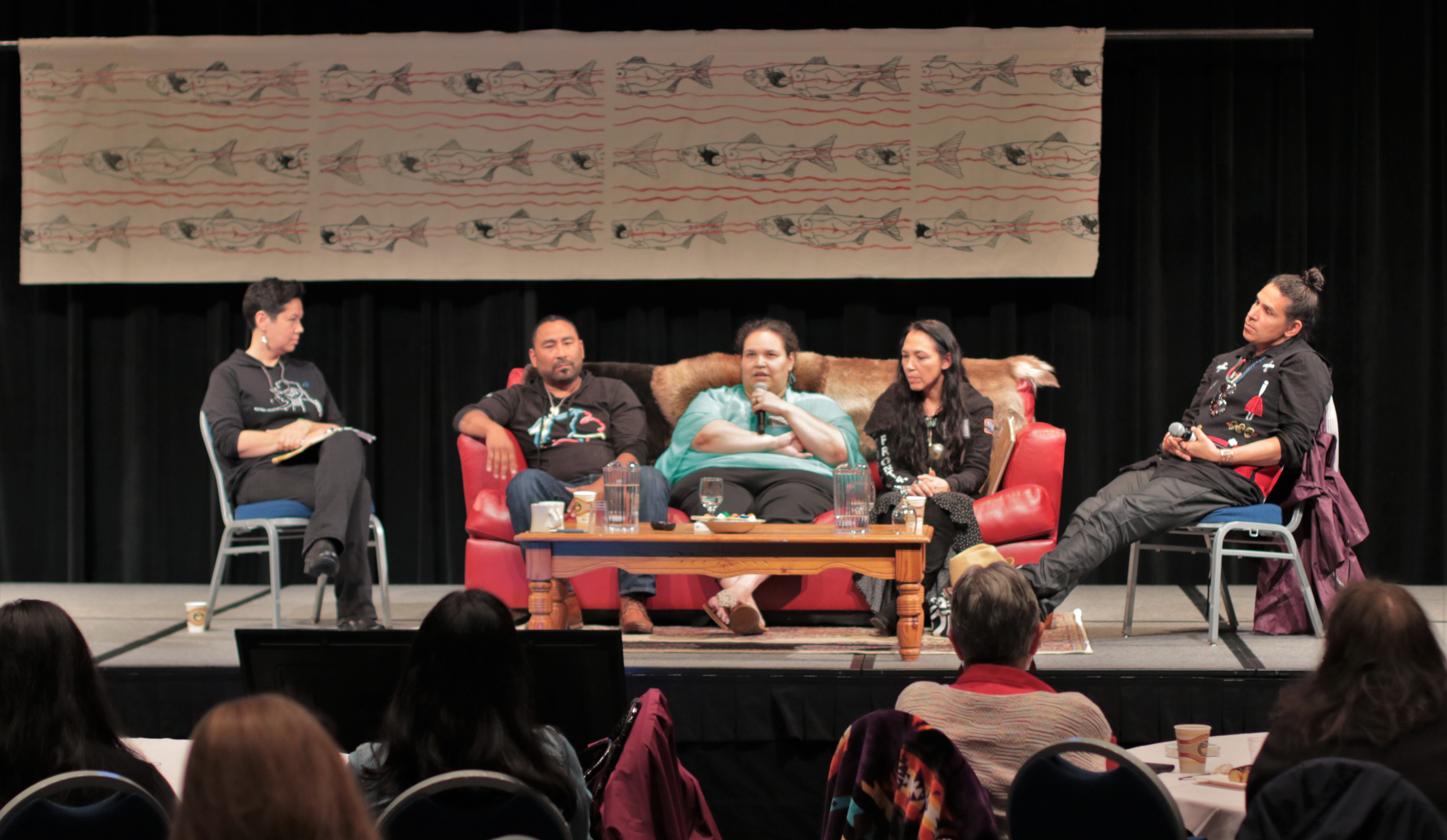
Listen to the story here:
In 2016, Perseverance Theatre staged Starbard’s play “Our Voices Will Be Heard.” As that play was being developed she allowed others to compromise her vision.
“There is a huge section I feel was just completely lost, because in the end, I got told over and over and over again by non-Native audiences that this didn’t make sense, or it wasn’t quite that way. And I look at it now, and I’m like, I lost the most pure part of my heritage in that,” said Starbard.
She said the institutions of art, and the decision makers are generally white, upper class, often male. These are what she refers to as gatekeepers.
“So, we as artists of color, often female, have to navigate that and have to sort of go, well I know you don’t understand my perspective at all, but trust me, it’s a story that will relate to an awful lot of people,” said Starbard.
Starbard’s next story is a play called “Devilfish” set to stage in the fall of 2019. She says what happened to her previous play will not happen again.
“It’s different from ‘Our Voices’ in that I’m standing much more firmly in what I know is good storytelling practices told from a Tlingit perspective,” said Starbard.
“Devilfish” was inspired by a traditional clan story, set in a backdrop imagining the beginning of the Tlingit people.
“It needs to be grounded in Tlingit history, Tlingit culture, Tlingit arts, Tlingit sensibilities and Tlingit values,” said Starbard. “Much more than it needs to be a Western piece of art. A Western stage piece.”
For the gatekeepers reading, Starbard has this request.
“I would say just starting with helping us tell our own stories. … Share the power,” said Starbard. “This is a pretty strong social justice concept of power. Where does the power lie? Not with people of color. Not with women of color certainly. … Sharing the power is such a huge one and something that as people of color we can’t make you do. You just have to do it.”
Watch the one-hour discussion here:
Editor’s note: 360 North was under contract with First Alaskans Institute to produce video coverage of the summit.