Updated | 1:15 p.m.
For the third time in as many days, Bogoslof volcano has erupted. The Alaska Volcano Observatory has issued its highest alert level for air travel.
The volcano is on a uninhabited island 60 miles northwest of Unalaska.
Friday’s eruption blew ash 30,000 feet into the air and ejected lava.
Experts cannot predict how long the eruption might last because there is no monitoring equipment on Bogoslof.
The last time this volcano erupted was in 1992 lasting a month.
Original story | 10 a.m.
After two eruptions in as many days, scientists are closely watching a volcano in the eastern Aleutians.
There’s no equipment on Bogoslof volcano, but Alaska Volcano Observatory is keeping tabs with satellite imagery and nearby seismic monitors.
Bogoslof volcano is tiny — like city park tiny.
The uninhabited island is less than a quarter of the size of Central Park in New York City.
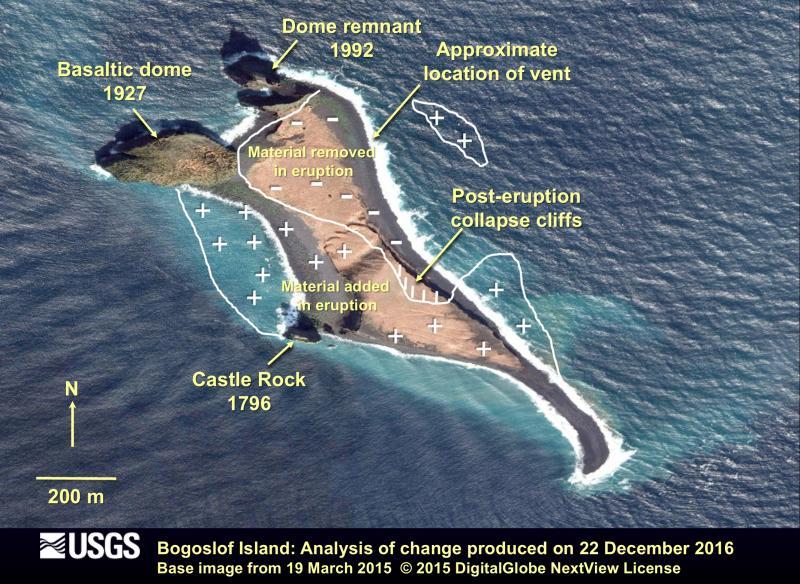
The recent Bogoslof eruptions have produced some new land, observatory scientist Michelle Coombs said.
“We have observations from today that suggest the new vent is offshore of the little island,” Coombs said. “(The eruption) has destroyed part of Bogoslof Island, but also has produced new land.”
Because the new vent is underwater, interpreting seismic activity is more difficult, she said.
Typically when there’s an eruption, seismic waves move through the ground.
With underwater vents, scientists get two sets of waves — the expected waves moving through the ground and another set of distorted waves that travel through the water.
At this point, Coombs saidit’s hard to predict how much longer the Bogoslof eruption will last.
“I wish we had a crystal ball and could say the exact sequence,” she said. “We definitely don’t have that capability. We’re even more limited in this situation because it’s such a small island. We do not have any local seismic monitoring instruments on the island.”
Bogoslof could be active for weeks or even months based on past eruptions on the island.