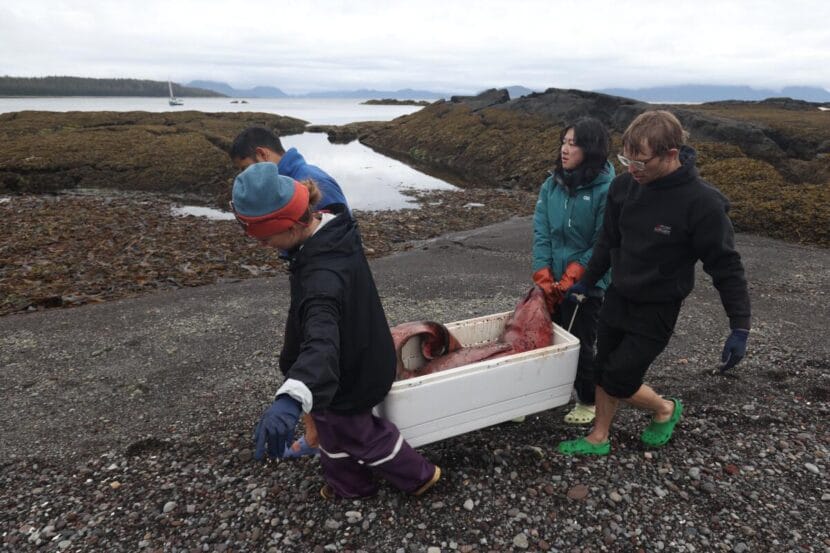
Ellie Schmidt and a few of her friends were camping at Fred’s Creek Cabin on Kruzof Island in early June. On a rainy Saturday morning at low tide, they took a walk on the beach.
“And we came across a weird object, which I thought was part of a boat,” Schmidt said. “[My friend] thought maybe it was a very weirdly colored log. It was very white and gleaming.”
As they got closer, they realized it was a whale. Closer still, a very unusual one.
“It was the weirdest whale I’ve ever seen,” Schmidt said. “It had the shape of a dolphin, but it was so much bigger than a dolphin, and it was really striking.”
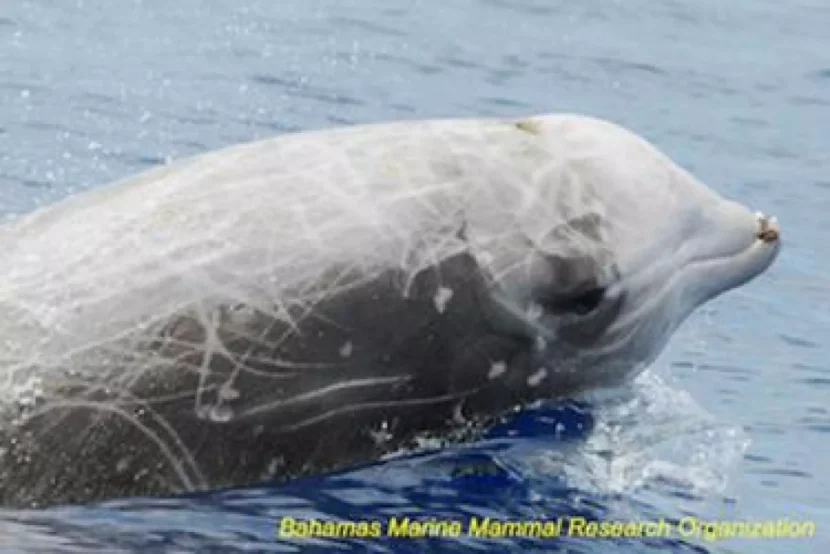
The whale was about 20 feet long. But it wasn’t just one. Schmidt said they also saw a fetus protruding from the adult whale’s body. They identified them as Cuvier’s beaked whales, sometimes called “goose-beaked whales”, a deep-sea species rarely seen in Southeast Alaska.
They tied the mother up on the beach, anchoring her body to drifted logs, and they called the National Oceanic and Atmospheric Association’s regional marine mammal stranding network coordinators, who asked them to remove the fetus and take it back to Sitka on their eight-foot dinghy.
“So we basically found whatever gloves we had around, whatever sharp things we had around, and then carefully cut open the whale, and then put this beautiful whale fetus into a cooler,” Schmidt said. “We estimated it was 150 pounds, around six feet long, and very beautiful. We put the cooler in the boat, and brought it back to town.”
Lauren Wild, a whale biologist and assistant applied fisheries professor at University of Alaska Southeast, met them at the dock, put the whale fetus into a white body bag, and put it in the freezer at the local university campus.
“And then it sort of became, ‘Should we go out and do a necropsy on the mom? Is there information we can find out?'” Wild said.
Goose-beaked whales are found in deep offshore waters in most oceans and seas worldwide, but their migration patterns still aren’t known. They’re the deepest and longest-diving mammal in the world, capable of diving at least 3,300 feet for 20 to 40 minutes to feed on cephalopods like squid and octopus. The deepest known dive for a goose-beaked whale was nearly 2 miles and the longest known dive lasted 222 minutes, according to NOAA.
“It’s sort of a very unusual thing for a beaked whale to wash up, because they live offshore and they’re deep divers,” Wild said. “So for it to have somehow floated in, the currents must be quite interesting there for it to have gotten into that cove.”
Beaked whales use echolocation for navigation and foraging, and are particularly sensitive to underwater sounds.
“They’re typically the species of whale that is associated with Navy sonar,” Wild said. “So when you hear about mass strandings, often those have been beaked whales.”
The Kruzof stranding wasn’t the only one this summer. A second beaked whale was found beached in Yakutat in early June. Wild said this is rare. Previously, only two were reported in the area in the past 40 years.
“It would be great to see it alive, but it’s cool to [have] a specimen wash up dead, because you can kind of poke into it a little bit more and learn more about it,” Wild said.
Wild put a small response team together and returned to the stranding site two days later to perform a partial necropsy, or animal autopsy, on the mother. She said they were able to retrieve the head, get skin and blubber samples for genetics and hormone testing, and fecal samples to test for harmful algal blooms. They also looked in the whale’s stomach, which was full of squid beaks, meaning she likely didn’t starve to death.
“We weren’t able to definitively say what the cause of death was, unfortunately,” Wild said. “Because the carcass was in kind of a moderate decomposition stage, we weren’t really able to get all the things that we would want to get that might help us understand cause of death.”
Wild said if the whale had been more intact, they would have investigated the whale’s brain to look for signs of barotrauma, widely known as “the bends,” from coming back up to the surface too quickly. They also would have wanted to look at her bones, blubber, and muscle for any signs of blunt force trauma that could have contributed to her death.
“Every piece of a whale is a puzzle piece to sort of put together what its life looked like,” Wild said. “I can’t say right now that we will never know [the cause of death], but we’ll see.”
They brought the whale’s head back to town with them to freeze and use for education purposes in the future. Wild said while she had hoped they could retrieve more, she’s grateful they got the opportunity to do the necropsy at all.
“Beaked whales are so poorly understood — exactly what they’re doing and what they’re eating, and all the different life history parameters that are so difficult to study on these really seldom seen offshore deep diving species,” she said. “So I mostly just think it’s a cool experience to be able to have been able to get what we did.”
Wild said they scanned the fetus at the local hospital on June 25. And she said they plan to perform a public necropsy on the fetus at Sitka Whalefest this fall, which could shed light on what caused them to wash ashore on a remote Southeast Alaska island.