Juneau residents in the glacial lake outburst flood zone are rallying around a single, long-term solution: a tunnel. At a community-led meeting, a local mining expert presented an alternative tunneling method that could cut the cost of the U.S. Army Corps of Engineers’ proposed project in half.
More than a hundred people sat in pews at the Chapel by the Lake on Thursday evening for a presentation hosted by the Juneau Flood Solution Advocates, a grassroots group of Mendenhall Valley residents whose homes were hit in the disastrous 2024 flood.
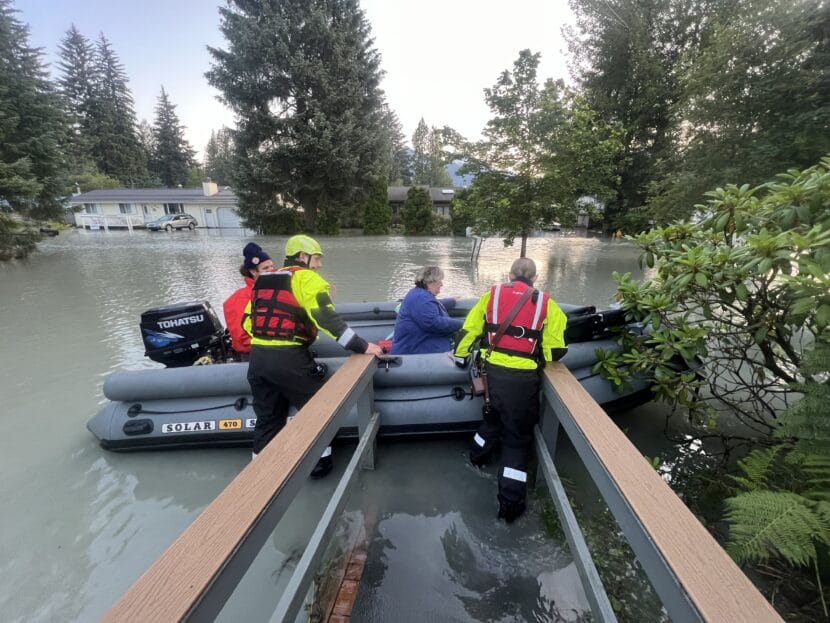
Debbie Penrose Fischer formed the organization after she was rescued in a raft during that flood. She said she wants the Army Corps to concentrate on putting a stop to the annual flood at its source.
“Stop managing the problem and start solving it, please,” she said.
Penrose Fischer called the flood wall, made of sand-filled blocks called HESCO barriers, a “Band-Aid.”
Last summer, the wall protected hundreds of homes from a record-breaking flood, but it leaked and nearly 50 households reported damage. This year, the City and Borough of Juneau and Army Corps are expanding the flood wall to handle a flood around 30% larger. That’s costing the city $14.8 million this year, and an estimated $12 million each year going forward.
The flood wall is not designed to last the multiple decades that glacial outburst flooding could continue. In the meantime, the Army Corps is looking at midterm solutions like bolstering the flood wall with metal sheets.
But Penrose Fischer said that’s not a solution. She’s advocating for a tunnel.
“Blast the tunnel, drain the basin, save Juneau and do it now,” she said.
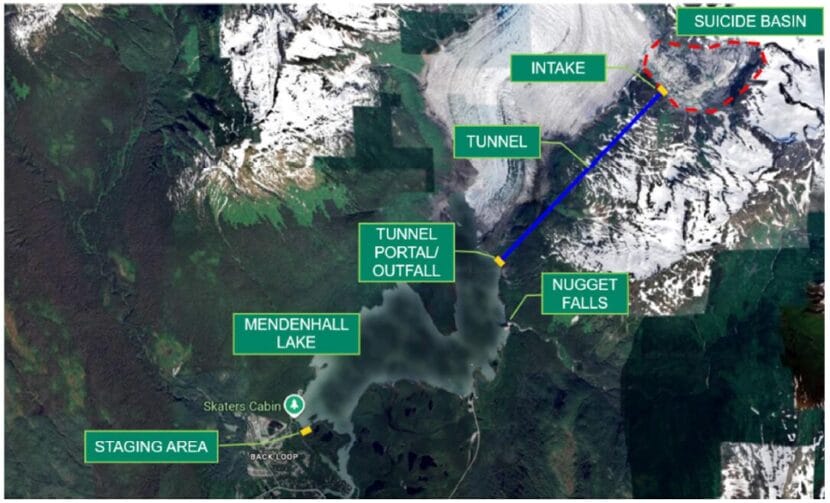
Late last year, the Army Corps selected a tunnel through Bullard Mountain as the best option after a three-day, closed-door meeting with federal and local agencies in Juneau. The tunnel, also called a lake tap, would steadily channel water out of Suicide Basin — the source of the flood — like a bathtub drain, so it couldn’t rise to a level that would create a catastrophic flood.
Local leaders voiced their support for the tunnel plan.
But in February, city leaders announced at a Juneau Assembly meeting that the Army Corps backed out of that plan. At a press conference the following month, Assistant Secretary of the Army for Civil Works Adam Telle rejected that claim, saying the tunnel is still the Army Corps’ preferred solution, but the agency has turned its attention to short and medium-term flood control efforts.
The Army Corps contracted with AECOM, a consulting firm that specializes in civil engineering, to come up with a preliminary plan for the tunnel. The firm estimated that a 2-mile-long, 10-foot-wide tunnel would cost between $613 million and $1 billion.
But Brian Erickson, a local mining expert, said at his presentation in the chapel on Thursday that he can reduce that sticker price, and told Army Corps staff as much when they bought him a beer on Tuesday.
“So this is somewhere between $220 and $323 million project,” Erickson said. “I cut this project down in half, which makes it a little more palatable for people.”
Erickson is vice president of operations at Hecla Mining Company, which owns Greens Creek mine on Admiralty Island, the largest silver mine in the U.S.
He lives in the Mendenhall Valley and independently authored a report in his free time that lays out a cheaper plan for the tunnel.
His plan is different from the Army Corps’ proposal in two key ways.
First, Erickson said the Army Corps should choose the drill and blast method that’s used in metals mining at Greens Creek and Kensington, and in hydropower construction. It involves blasting explosives into small holes drilled into the rock in a grid formation.
“This methodology has broken into two basins at the local utilities with Lake Dorothy and Lake Snettisham in the past, so we can do this whether the basin is full or empty,” Erickson said.
He advocates against using the tunnel boring machine outlined in the Army Corps’ proposal, which he said might have a hard time operating on steep slopes and breaking through to Suicide Basin if there’s too much water inside.
“A tunnel boring machine is a pretty specialized piece of equipment,” Erickson said. “They’re very large. It would cost a lot to mobilize it here.”
The machine is typically used to excavate tunnels for subways and other civil engineering projects where it’s important not to disturb the surface. Erickson said geotechnical studies to prepare for the machine would take longer than they would for the drill and blast method.
Second, Erickson’s proposal minimizes lining the tunnel with concrete. The Army Corps included a complete concrete lining in its proposal to add stability and prevent erosion, but Erickson doesn’t think that’s necessary.
“If you go hike up Perseverance or anywhere else, you’ll see tunnels that have stood for a lot longer in the rock types that we’re talking about tunneling in,” he said. “So, we don’t need concrete-lined tunnels.”
According to the Army Corps’ report, the tunnel would traverse bedrock made of graywacke, mudstone and some marble.
Erickson estimates excavation using the methods he suggests would take roughly two years.
His report landed on Sen. Lisa Murkowski’s desk earlier this year.
At a U.S. Senate subcommittee appropriations hearing in May, Murkowski asked Adam Telle at the Army Corps about it.
“If local miners in the area can demonstrate to you that they’re able to help with a long-term solution in a way that saves time and money, is the Corps willing to look into working with them in pursuing some kind of a public-private partnership?” Murkowski said.
Telle said “absolutely” and that his team is looking at the report.
“We owe you an answer, and we’re going to get it to you as soon as possible,” Telle said. “I would say nothing’s off the table when it comes to doing our best to protect Juneau in the short, medium, and long term.”
Erickson said Army Corps staff plan to visit Greens Creek on Monday.
He said Hecla is in the business of producing metal concentrates for sale, not emergency tunneling. But he said the glacial outburst flood affects Hecla employees and the company’s ability to recruit, since there’s a housing crunch in Juneau.
Ryan O’Shaughnessy, Juneau’s emergency manager, said at the community meeting Thursday that since Suicide Basin is on federal land, it’s not up to the city to decide how to tunnel through the mountain. But, he said the city has a clear stance on the issue.
“We’re always going to support the fastest and most economical way to end glacial lake outburst flooding,” O’Shaughnessy said.
The Army Corps did not comment in time for this story.