Listen to this story:
The Juneau Assembly voted Monday night to undo a controversial funding scheme that required some homeowners in the glacial outburst flood zone to pay thousands toward the initial stretch of the Mendenhall River flood wall.
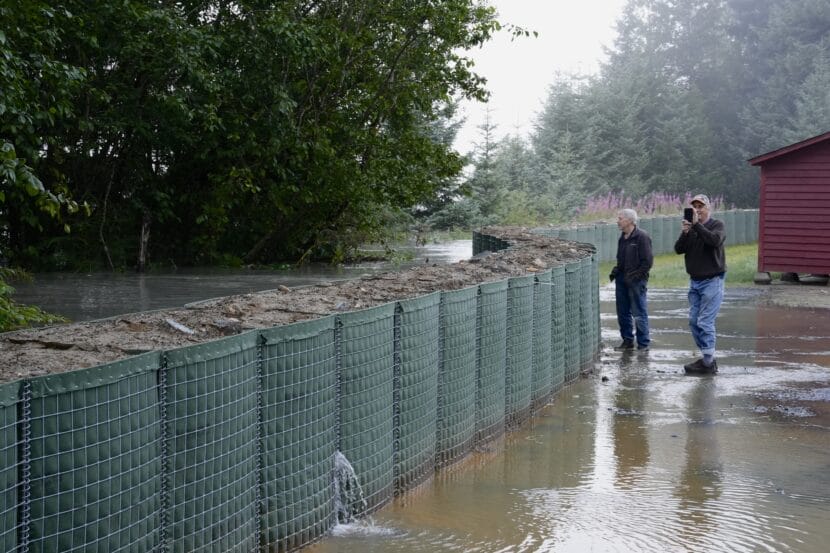
Last year, the Juneau Assembly passed a funding plan to split the original cost of building the flood wall with 466 landowners in the Mendenhall Valley flood zone following a vote of residents in the area. It’s called a local improvement district, or LID. The city would pay 60 percent of the cost; homeowners would pay 40 percent. Most households would have paid up to $6,300 to help protect their homes using sand-filled blocks called HESCO barriers.
Now, the Juneau Assembly has decided the city will cover most homeowners’ portion of the LID. The decision helps resolve a central issue many Valley residents have raised about fairness. Many landowners who weren’t required to pay for the flood wall were likely protected from the record-breaking flood last year.
But some say it doesn’t go far enough.
Debbie Penrose Fischer, a valley resident who leads a flood advocacy group, testified in favor of the amended ordinance at the Assembly meeting.
“This is a chance to correct this inequity and to build a bridge between us,” Penrose Fischer said.
But Penrose Fischer takes issue with a part of the ordinance that still requires four property owners to pay $50,000 each for armoring their section of riverbank with large boulders called rip-rap. Unlike other property owners, these four didn’t do so prior to the flood wall proposal.
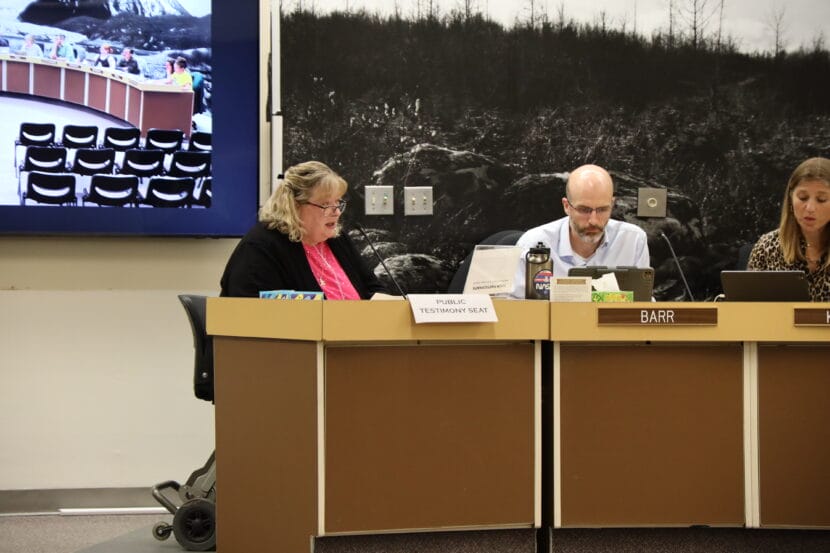
City Manager Katie Koester said the city accounted for the homeowners’ share of Phase 1 of the flood wall through a central treasury loan. Because of that, she said the fund balance for the project won’t be affected by taking on the homeowners’ share.
Koester said the ordinance will help the city move toward answering a broader question about ongoing flood costs.
“How do we fund HESCO barrier maintenance, you know, annually to the tune of $6 to $12 million for this community, and how do we do that in a fair way?” Koester said.
The cost of the flood wall has ballooned. Repairing and raising the wall this year alone costs an estimated $14.8 million. Koester said she wants to discuss funding strategies at a Committee of the Whole meeting in July.
Still, the Assembly’s decision to undo the LID is not likely to alter a lawsuit brought by two riverfront property owners over the flood wall.
Earlier this year, an Alaska Superior Court judge dismissed a portion of the lawsuit that challenged the city’s local improvement district. The court said that part of the case wasn’t “ripe” for a decision because the city hadn’t finalized how much homeowners would have to pay.
Samuel Hatch is one of the plaintiffs in the case. He hosts barriers in his backyard and said the city’s decision to pay for the first phase of construction starts to address the fairness issue, but it won’t influence him to drop the case.
“Riverfront property owners are giving up a heck of a lot for this barrier to work, and even with CBJ paying to install it, you know, everyone’s lost their view, most everyone’s lost almost their entire backyard,” Hatch said. “What’s making that fair or right?”
He’s still suing the city over compensation for the part of his land that’s holding up the flood wall.
Emily Wright, the city’s attorney, said the core question in the case remains: did the city “take” private property to host the HESCO barriers? Both the U.S. Constitution and the Alaska Constitution forbid the government from taking private land for public use without paying the owners.
“The longer this project goes on, the more it becomes a permanent placement on someone’s property versus just a temporary emergency response,” Wright said.
If the flood wall looks permanent, Wright said it’s more likely a judge will see it as a “taking.”
The case is scheduled to go to trial in October.
Clarification: this story has been updated to clarify that the Assembly approved the LID after residents within the LID voted on it.