It’s been a few weeks since a Haines-area backcountry snowboarder was mauled by a bear after coming across its den near Chilkoot Lake.
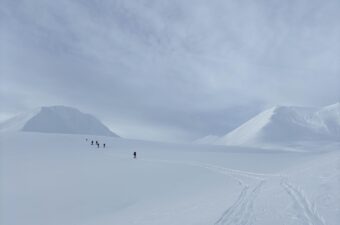
At a presentation hosted by the Haines Avalanche Center and the Great Bear Foundation last week, Haines Avalanche Center educator Jeff Moskowitz said bear habitat is just one more feature to consider when assessing risk while recreating in the backcountry.
“Skiers and riders in the backcountry we need to not only see the terrain as a ski run, we need to see it as an avalanche path,” Moskowitz said. “The same could be true is, [they’re] not only places to go recreate and have fun in the backcountry, but also bear territory and entire ecosystems.”
Alaska Department of Fish and Game biologist Anthony Crupi has been researching bears in the northern Lynn Canal region for years and is currently working on a population study. He’s been tracking their movements and monitoring reproductive rates, survival, and spatial distribution among other things.
Crupi said that bears will set up a den in order to survive the winter’s inclement weather and limited food resources. It helps them conserve energy.
“While they’re in the den conserving energy, their body temperatures decrease by 10 to 12 degrees. Their heart rate severely decreases 20 to 40%. Their metabolism shuts down 50 to 60%,” Crupi said. “While they’re in the den, they lose all that body fat that they stored over the summer months, and they can lose a quarter to a half of their body mass.”
Crupi said although the bears enter a torpor while in their dens, it doesn’t mean they can’t be disturbed.
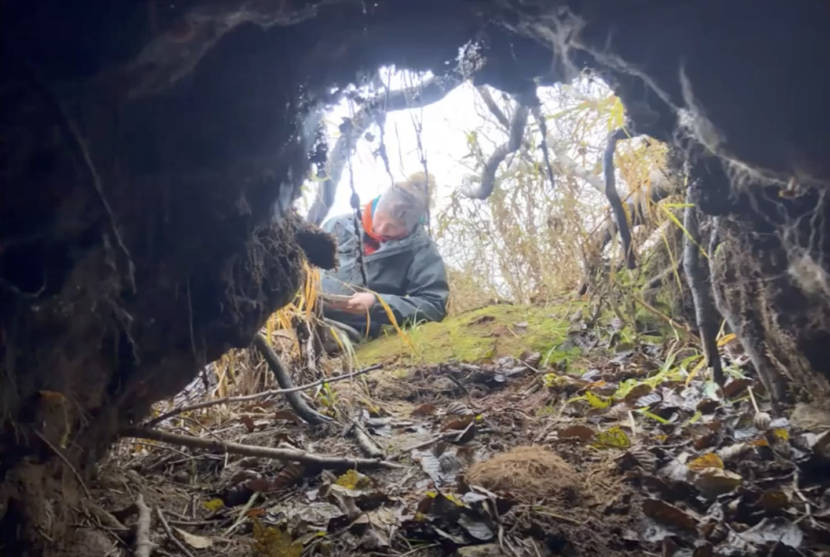
When building a den, bears will often hollow out a cavity underneath the roots of a large tree or a boulder. Others may excavate into the side of a steep hill.
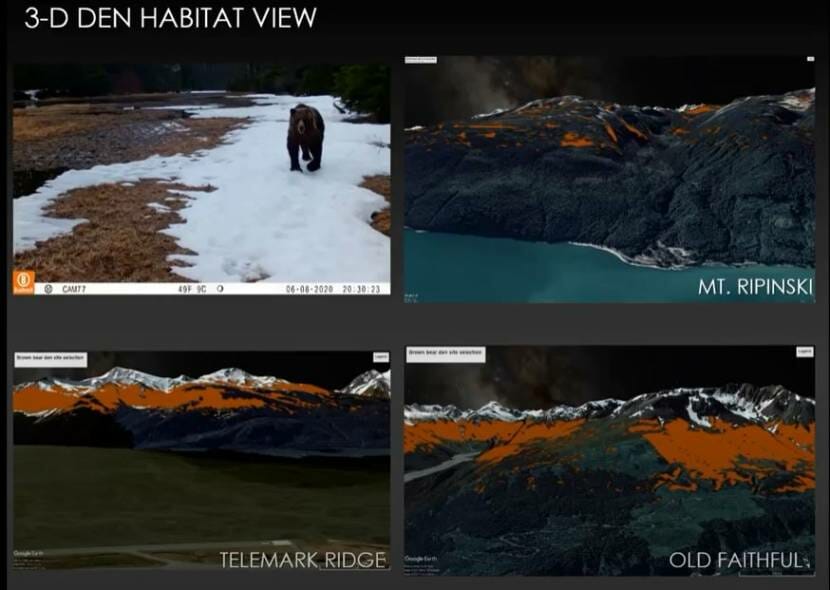
According to Crupi, they tend to build their dens at an elevation of about 2,000 to 3,000 feet. The angle of the slope is usually around 35 to 45 degrees. At one point in the presentation Crupi showed where winter bear dens are most likely to be found in popular local skiing areas like Mt. Ripinsky, Old Faithful and Telemark Ridge.
“You can see there are some places where your chances are better for creating travel routes.” Crupi said. “Some places it’s just where we like to ski happens to be exactly where bears like to den. You just have to be really mindful when skiing and recreating in those areas.”
Crupi urged backcountry users to look for signs of holes that may have been dug out by bears, make lots of noise and carry bear spray when exploring slopes around the Chilkat Valley.
A video recording of the full presentation is available on the Alaska Avalanche Information Center’s YouTube page.
Clarification: A previous version of this story incorrectly stated that bears enter a stupor while in their dens. The correct term is torpor.