The House passed a far-ranging revision of Alaska’s oil and gas tax laws on Friday by a 25-12 vote.
The action came shortly after the House approved an amendment that rewrote the bill. The amendment passed with the minimum votes required, 21-16.
The last-minute changes include eliminating the ability for North Slope oil producers to deduct spending to reduce future taxes.
And tax credits to support Cook Inlet production would end more quickly than in the version of the bill passed by the House Rules Committee.
The amended bill also limited the number of years that new oil projects benefit from lower taxes. While the House Rules version would limit these “new oil” benefits to 10 years, the amended bill limits the benefits to seven years.
The upshot is that the amended bill would save the state much more money than the House Rules version over the next three years, but not as much as Gov. Bill Walker’s proposal would have.
For example, in the fiscal year ending in 2019, the amended bill would save the state roughly $225 million, the House Rules version would save $85 million, and Walker’s plan would save $465 million, according to a Department of Revenue analysis.
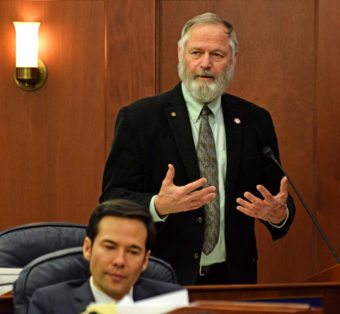
Amendment sponsor Homer Republican Rep. Paul Seaton said the bill would bring the state more money sooner and reduce long-term liabilities, while still supporting current projects.
The amendment drew support from a diverse coalition, including Seaton, North Pole Republican Rep. Tammie Wilson, and all 12 minority caucus members present.
“This is the way we should work together,” Seaton said of his work with Wilson on the amendment. He said they looked for areas of agreement and didn’t include areas where they disagreed, while drawing input from other legislators and industry.
Anchorage Republican Rep. Craig Johnson opposed the amendment and the bill, after having crafted the Rules Committee version. He said the revised bill left uncertainty in Cook Inlet tax policy.
“I believe this bill takes us back to the days of rolling brownouts,” in Southcentral Alaska, Johnson said.
Johnson also expressed concern that the bill would continue to pay tax credits. The Rules Committee version would have shifted toward tax benefits based on companies deducting lease expenditures.
The vote on the amendment was a rare occasion in which most majority-caucus members were on the losing side.
Seaton also said the amended bill addresses a concern Walker raised Friday. Walker said he wants the state government to have a say on which oil and gas projects are eligible for subsidies. Seaton said the bill accomplishes the goal by requiring companies to develop plans that would be approved by the state.
The bill heads to the Senate Finance Committee, which is scheduled to hold a hearing on it Saturday.