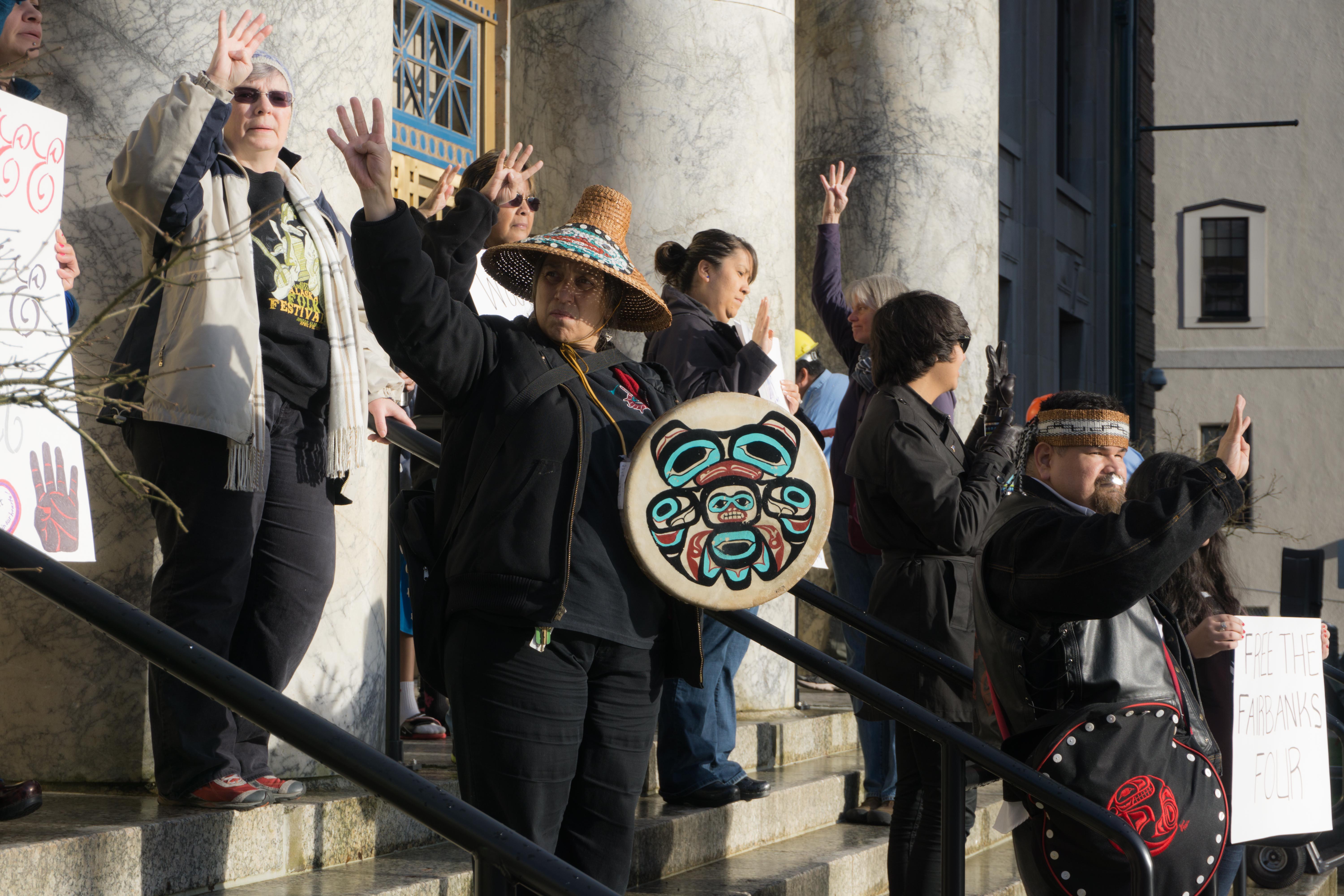
George Frese, Eugene Vent and Kevin Pease are free after 18 years in prison. They were released Thursday in Fairbanks after the court approved a settlement in the case of the murder of 15-year-old John Hartman. The other member of the Fairbanks Four was Marvin Roberts, who was paroled in June.
The outcome is a big win for the Alaska Innocence Project. Executive director Bill Oberly has spent the past six years trying to free the men.
In an interview with APRN’s Lori Townsend, Oberly described the scene in the courtroom when the men were freed. He says as the settlement was finalized, the judge asked the courtroom to remain quiet.
OBERLY: We had been instructed as attorneys to remain seated. Our clients, who were still in custody and had leg irons on, would get up and walk out and only then could we stand up. So they controlled how the scene ended. But I can tell you, when the judge walked off the bench there was a moment of silence. I think it was just sinking in and then the whole place exploded. Tears and hugs — that lasted, through to their gathering at the tribal hall in Fairbanks. I left at 10:30 or 11 p.m. and it was still going strong.
TOWNSEND: What was included in the settlement? There’s been some confusion over whether the men are maintaining their innocence.
OBERLY: There should be no confusion about that. They are, have been and will always maintain their innocence. They are innocent. The parties agreed, the court signed off that there was new evidence not presented in court in their trials and that in the interest of justice demanded new trials. Their convictions were vacated, which took it back to the pretrial stage, and then the state dismissed their indictments — so that means they have no convictions. They stand convicted of no crimes. When they fill out a (job) application, if it says, ‘Have you been convicted of a felony?’ they can check no. From the four young men’s point of view, that’s what we went in looking for when we first filed in 2013. That’s what we got.
TOWNSEND: The state attorney general says this is not an exoneration. What does he mean by that and how much does that matter to you and the young men, the Fairbanks Four?
OBERLY: What he means by that, you’re going to have to ask the attorney general because they are free and they have no record. If that’s not an exoneration, I’m not sure what is. Under my definition and under, I think, the dictionary definition — this is an exoneration. And that means a lot to the boys. They would not have resolved this if they had to maintain convictions. Their two requirements were we want our names cleared and we want to get out. Anything less than that they would not have taken.
TOWNSEND: As part of the agreement, the four men cannot sue the state for compensation for being incarcerated. Is it unusual to give up that ability to sue for compensation from the state?
OBERLY: To be honest, I don’t know. I know that in other jurisdictions there are other terms. It’s a negotiation. It’s not something the young men wanted to give up, but it was something the state required if they wanted to get out now, as opposed to waiting for the judge’s decision. And they didn’t want to spend more time in prison.
TOWNSEND: After spending 18 years in prison, the road ahead won’t be easy for the four men. Based on other Innocence Project work around the country, what do we know about how difficult it is to rejoin society after so many years in prison?
OBERLY: I think it depends on the individual. The examples of people exonerated in other states kind of runs the gamut, but in every case it’s difficult. From my understanding, there’s a honeymoon period where things keep getting better and better… and there is a time when they crash. These young men have a whole community — a whole state — to support them. So I’m hoping the inevitable crash, when it comes, will mean the people who are around them will step up and help them. They walked out of prison with nothing. Things that they had collected in prison — a television, books and things like that — they gave away. They left it at the facility. They left only with their paperwork and nothing else. They didn’t even have a toothbrush. And I’m not sure they even got one last night. That was one of the things people realized late in the evening. ‘We haven’t gotten them a toothbrush yet!’