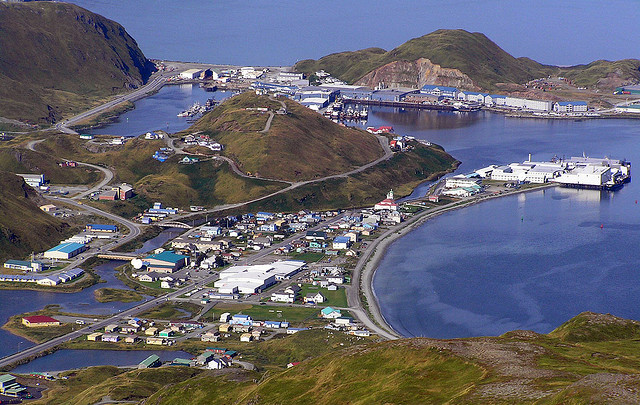
A plan to raise Alaska’s minimum wage saw widespread support during Tuesday’s election. In Unalaska, at least 83 percent of voters approved the measure. And the seafood industry — which is the town’s biggest source of minimum wage jobs — wasn’t expect anything different; they’re factoring in the wage hike as they look cut costs.
Don Goodfellow is the plant manager for Alyeska Seafoods in Unalaska. Leading up to the election, he says they were already planning on scaling back their workforce.
“We’ll have people who, as they retire out of the industry, we just won’t replace them,” Goodfellow says. “Machinery will take over a lot of those jobs.”
Eventually, Goodfellow thinks up to 30 percent of Unalaska’s processing workers could be automated. He says the seafood business is well overdue to make that kind of change.
“I think we’ve already started and it’s not as a response to that bill, specifically. It’s the need to be more efficient about how we do things,” Goodfellow says.
At UniSea, the biggest processing company in town , the potential wage hike just makes that need more urgent. Chris Plaisance is a human resources director for the company. If they had to implement the pay increases laid out in Tuesday’s ballot initiative, he estimates it could cost up to $3.5 million.
“Our margins are so thin that we need to make improvements or we’re gonna have a problem,” Plaisance says..
UniSea would need to trim its workforce — not through layoffs, Plaisance says, but through attrition — by leaving entry-level jobs empty at the end of each season. That leaves room to keep employees who’ve been with the company the longest.
Levell Curtis Standifer, Jr. has been working for UniSea almost year-round since 2010. He’s originally from Washington State.
“Down in the Lower 48, the economy is real bad,” Standifer says. “And I thank God for the state of Alaska, and how they create fishing jobs.”
Standifer and many of his coworkers start out earning minimum wage. But they have ample opportunities to work overtime. Plus they receive free room, board, and transportation from UniSea. Still, Standifer thinks his employer can afford to pay a little more.
“The fishing companies, they’re doing quite well off our labor. That’s the bottom line,” Standifer says.
Judging by the early results, he wasn’t the only one that felt that way. And he certainly wasn’t the only UniSea worker at the polls. Once an hour, the processing plant trucked in employees to cast their votes — and possibly, set their pay.
KUCB’s Lauren Rosenthal contributed to this report.