
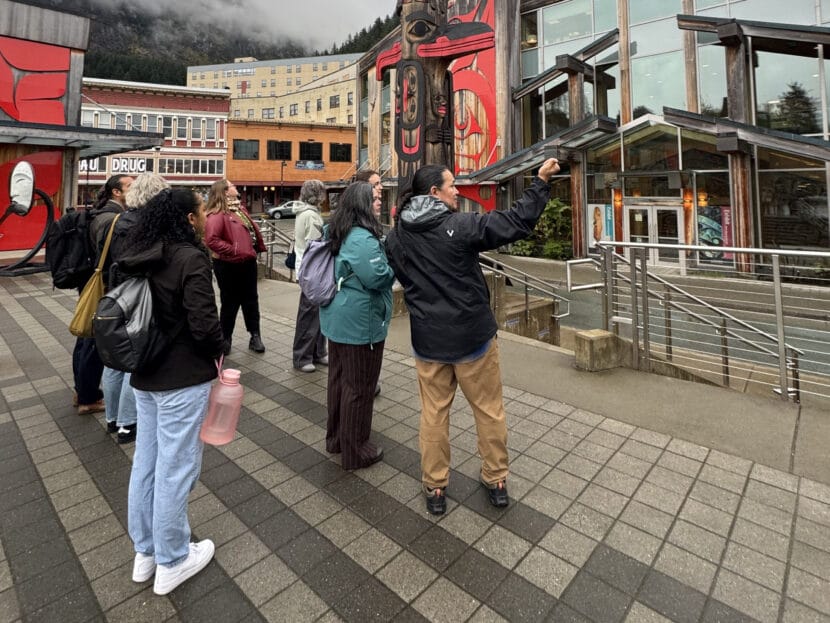
Ivanich works at the Laureate Institue for Brain Research in Tulsa.
Indigenous scholars from across the country are convening in Juneau this week to learn from local experts, write grants, and build community.
The scholars are with the Native Children’s Research Exchange (NCRE) Scholars Program. They specialize in youth development work — from the womb to early adulthood — as well as substance use prevention.
Michelle Sarche helped found the scholars program in 2012. She’s a tribal citizen of the Lac Courte Oreilles Band of Ojibwe. She researches Native American child development, parenting, and early care and education.
Sarche said, in her academic career, she saw a lot of Native scholars working to make a difference, but often without much support.
“Many of these scholars are isolated in their home institutions,” she said. “There aren’t any other Indigenous scholars, and we just really saw the need to first and foremost create community.”
The research exchange has already brought together 41 scholars in different cohorts. The 15th group kicks off with this meeting in Juneau.
Katie Schultz grew up nearby in Cordova, and is a citizen of the Choctaw Nation in Oklahoma. She joined the program as a scholar nearly a decade ago. Now, she teaches social work at the University of Michigan. She focuses on domestic and dating violence.
These meetings for the scholars are incredibly important, Schultz said. And the location helps ground the work they are doing. While in Juneau, she said the cohort got to meet with Sealaska Heritage Institute.
“It’s beyond just writing the right thing in the grant,” she said. “But being able to spend time in community, talking with folks that are doing this work, learning about the different approaches.”
Jerreed Ivanich is Ts’msyen, and took part in the same cohort as Schultz. Now, he helps run the scholars program.
He said while the research often focuses on harm like violence and substance use, the scholars highlight the resilience of tribal groups.
“The first sentence of every grant is like, ‘Here’s the huge negative problem.’ Right, that’s where you start,” Ivanich said. “But I think a lot of the scholars in that room and the folks here are trying to flip that script to say like, tribal communities have a lot of strengths, and like let’s center those strengths. Let’s revitalize that strength, and if we can do that, then we can actually address those issues.”
Ivanich works at the Laureate Institue for Brain Research in Tulsa.
The program meets in Juneau through Friday. The scholars plan to continue meeting with organizations doing work to support child development in Juneau.
Correction: Ivanich is now an investigator at the Laureate Institute for Brain Research in Tulsa.

