
Many Alaska Native families have been touched by the legacy of colonial residential schools. The remains of nearly 30 Alaska Native children who died at residential schools in and out of Alaska are being repatriated to their homelands, about a century after they died, as reported by the Anchorage Daily News.
One Juneau educator wants to use her research skills to help both kids and elders confront this history.
Haa Tóoch Lichéesh’s Hana’ackm Ggoadm ‘Tsoal Naomi Leask said she started researching genealogy because her grandmother was so knowledgeable about her own family tree. She knew every cousin and aunt and uncle.
But there were some dark pieces of history that came up too, associated with an infamous residential school in Pennsylvania.
“First I dug into the Carlisle database because I kept on hearing that one mentioned. My grandma would kind of bring it up every once in a while, just ‘Carlisle in Pennsylvania,’” Leask said. “You know ‘that school’s no good,’ and just little tiny comments like that every once in a while.”
So she began digging through databases of kids who went to Carlisle Indian Industrial School . Carlisle was one of the first residential schools funded by the United States for the purpose of interrupting traditions, languages and cultures of Indigenous people. The school carried out this mission often while abusing children forced to attend there.
Leask wanted to know how many people from her hometown of Metlakatla, Alaska’s only Native reservation, were taken across the country to Carlisle.
“And so that was my starting place was Carlisle, and I knew that maybe one or two people from my hometown went to Carlisle, but when I dug in there and got inside of it, we found a total of like 27 or 28 people from my hometown who went over to Pennsylvania,” she said.
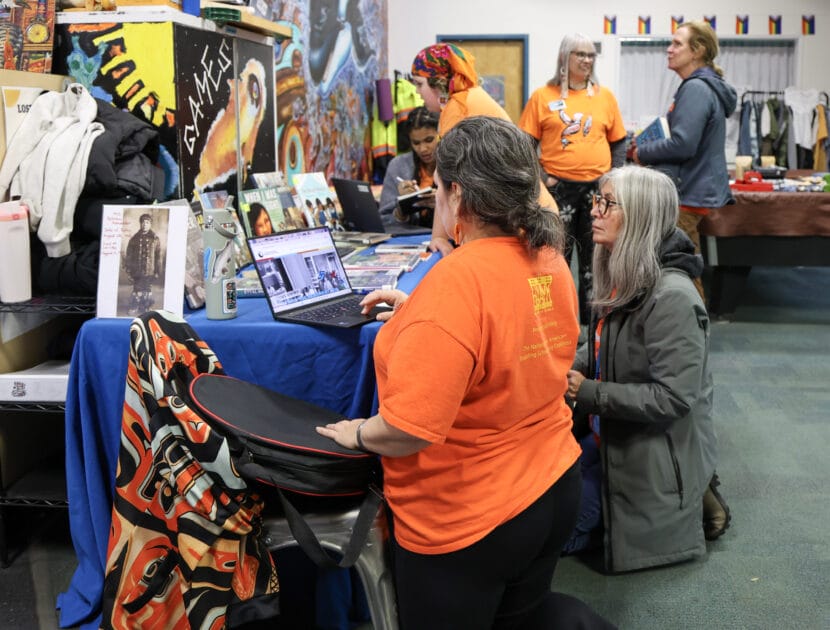
Leask is an educator. She started researching genealogy and boarding schools when she was teaching middle and high school in Metlakatla. She showed her students how to use tools like the databases found in the National Indian Boarding School Digital Archive online.
“My students would kind of, like, get in there and sometimes type their last name, and they’re like, ‘No way, you know, I’m pretty sure this is my grandma,’ or ‘I’m pretty sure this is my great uncle,’” Leask said.
She said she teaches young people in Southeast Alaska about this history because she wants it to inspire empathy for others and an understanding of generational trauma.
But she said she would try to prepare her students for the possibility that their relatives may avoid talking about that part of their lives.
“My grandpa did not want to talk about it. He rarely ever did talk about it, and if you did, like he kind of just looked like he wasn’t in his body anymore,” Leask said. “So I was like, ‘keep those things in mind. You know, don’t be pushy, don’t be forceful, but definitely kind of gently start those conversations’ because I think it is important as part of the healing process. They should talk about it.”
And when it comes to boarding school survivors, now elders, Leask wants to create opportunities for people to talk about the trauma they suffered at the hands of colonialism. Her grandma didn’t go to boarding school, but she felt the repercussions in her community all the same.
“A lot of those stories that my grandma held on to, she held on to her entire life,” she said. “I don’t want anybody else to go, you know, pass away holding on to anything like that.”
Leask is in the process of starting a support group for boarding school survivors in Juneau. She said she wants it to be like a culture camp for elders, where they can learn the arts and skills they were forbidden from practicing at residential schools.
“I think colonialism was kind of just like — I think of it as a puzzle, you know — just took people and just kind of just scattered them all over the place,” she said. “And this could be just one part of the puzzle, putting ourselves back together and healing and trying to move forward and become whole.”

