
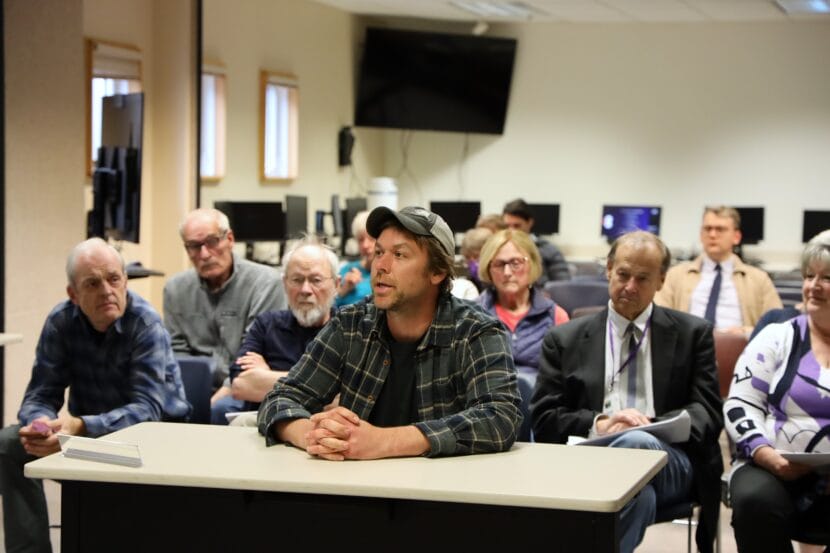
September is Suicide Awarenss Month, but throughout the year, Juneau’s mental heath nonprofit hosts suicide awareness trainings for young people, parents, and community members.
National Alliance on Mental Illness, or NAMI Juneau, Executive Aaron Surma and Youth Program Coordinator Charity Anderson spoke with KTOO’s Yvonne Krumrey to break down what people can do if a young person they know is suicidal — and how to recognize it in the first place.
And a warning, this story contains conversations about suicide and self-harm.
If you or someone you know is in crisis, the Suicide and Crisis Lifeline is available to call, text or chat by dialing 988, or contact the Crisis Text Line by texting TALK to 741741. You can be connected to community resources by calling 211.
Listen:
What brings you to doing this work?
Charity Anderson: I started kind of just as a part-time person in the office, just helping out. I really didn’t really want anything to do with going into those schools and presenting. It just sounded very scary and uncomfortable for me.
But I went one time with Aaron, and we actually presented in a health class, and it was the same teacher that I had when I was in high school. So after that, I was just like, “OK, I think I really like this.”
Then I’ve lost friends to suicide. I’ve had friends attempt suicide. I had my own stuff with mental health, family members, mental health struggles. So, I think it’s just important that it is a conversation that people start to have just regularly.
Aaron Surma: I’m a suicide attempt survivor, and I was 19 years old, and I really had no concept of mental health. It wasn’t something that was talked about in my world, and so I was just unaware of how I felt. I was clearly a depressed, anxious, scared person, but I didn’t know that.
And I had fun, I did fun things, and so I just thought that the world was a stupid place, and I thought everyone felt that way because I didn’t hear anybody else talk about how they saw the world.
And so just looking back, just horrifying. I wanted to die, and it was for a bunch of premises that weren’t even real. And if I would have just had some knowledge, I don’t think my life would have been perfect or fixed or anything else, but it would not have been as ugly as it was. I know that for sure. And so it just seems like I had a certain amount of misery that was very avoidable if only I’d have had some knowledge. And I don’t want other people to have that same experience.
In the course of doing these trainings, what has stuck out to you as something that you wish you had learned earlier, or something that really surprised you?
Aaron Surma: I think something that sticks out to me when we do this presentation — and really all of our suicide prevention presentations — is that a caring individual who is not a mental health professional at all can be support for somebody who’s suicidal.
There are times in my life where I want a professional service. I want a therapist, take medication, whatever else. But there are also times where I just want somebody that understands and is compassionate.
And so I think if I’m suicidal in the future, I might be as likely to get benefit from sleeping on Charity’s couch for a couple days as I would going to a formal service. I think that all that really requires is Charity being confident that she’s doing the right thing. There’s such a breakdown there where the helper in that position thinks, “Well, we need to get formal service. I can’t possibly do this. I don’t know what I’m doing.” When really – and I’m not saying this is a solution to every mental health crisis by a long shot, but – there are some, maybe many, where just being a nice, caring person is enough.
What are the next steps?
Aaron Surma: I think it really depends on what’s going on with the young person and how critical the situation is. There’s a difference between, “Hey, I’m feeling pretty bummed out and I have thought about suicide,” to, “I am suicidal right now. I have a plan to kill myself. I have the means or ability to carry out that plan, and I have the intent to do so.” When those three things [plan, means and intent] are present, this is a crisis. There’s nothing but a little bit of time between right now and a suicide attempt, unless something changes.
And that’s a criteria that the Bartlett emergency room uses — that’s the medical criteria. Those three things, and it might be asked in different ways in different settings, but that’s always what we’re trying to get to to define whether or not it’s a crisis: the plan to kill yourself, the means or ability to carry out that plans — like you have the stuff — and the intent to do so.
So if it’s a crisis, that’s one path, and if a person is struggling but not in crisis – two different scenarios.
And I think in the crisis scenario, it depends on what is going to be helpful, and it’s hard to know. It’s hard for a young person to know it’s going to be helpful if it’s their first time in this kind of situation. We have some different options in our community, some crisis services, and we also have just people supporting one another.
The helper and the young person have a choice to make of what’s going to be best for them in terms of formal services, which normally, for most young people in Juneau, means going to the Bartlett [Regional Hospital] emergency room. And if those three things are present — plan, means and intent — then there they go to Anchorage to either North Star [Behavioral Health System] or Providence [Alaska Medical Center], and you can be taken there willingly if you meet the intake criteria, and you can be taken there against your will if you meet the criteria.
If I’m the caregiver, if I’m the trusted adult, me and the young person struggling, we’re going to be together for the next 10 hours at least. We don’t necessarily need to make a decision this second. We can spend some time and just talk and decompress.
And I think naming a thing and telling somebody about the thing takes away some amount of its power, right? There’s a big difference between me being angry and yelling versus me saying, “Hey, I’m angry right now.” Labeling an emotion takes away some of its effects, and you stop speaking from the emotion; instead speak about the emotion, which is a calming thing. That’s true for any emotion.
And so, I think, assuming that you have the luxury of some amount of time, a couple hours, it doesn’t need to be: “Oh my God, you told me. We need to rush off to this other place right now.” We can talk, we can relate, we can think about our options, and take the time to make a plan. And I think that choice is great. Feeling like you don’t have a choice is constricting. You have a lack of agency. A lot of times, it’s hard for something that’s intended to help, to be help(ful) if the person doesn’t find it helpful. I think spending the time to explain what the options are, to talk about the pros and cons, and to give choice is going to lead to better chances of it being successful for the person.
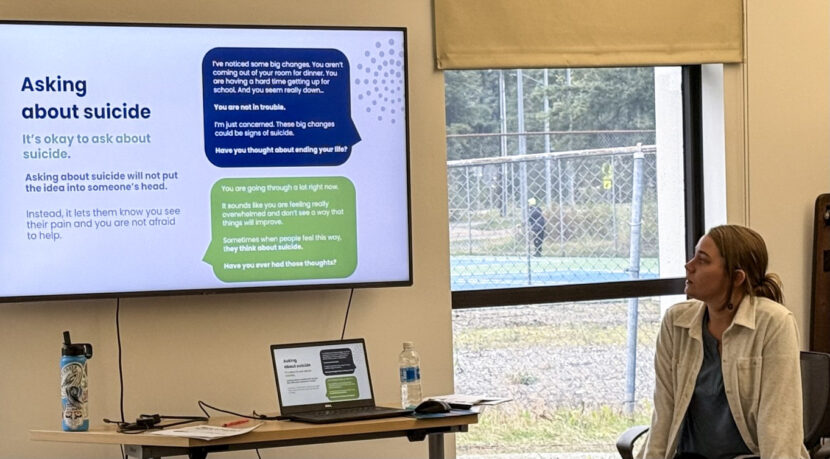
This training is called Signs of Suicide. What are the things that you encourage adults and young people to look for in young people?
Charity Anderson: We’re looking for any major changes in behavior. You know, maybe somebody that’s typically a very happy, bubbly, outgoing person is now kind of isolating. Maybe they’re closed off. Maybe they’re angry and lashing out for no reason.
They could be sleeping a lot more and sleeping or sleeping a lot less. This can be tricky with teenagers because you know they stay up all night or sleep all day. But any big, big, big changes. The same thing with food. If they’re withholding food or eating too much, self harm can also be a warning sign that something is going on. And then, yeah, that isolation; stop doing things that they normally like to do.
Aaron Surma: If you Google “warning signs of suicide for young people,” you’ll get an exhaustive list, and a lot of the stuff is normal stuff for young people, and so I think Charity’s spot on with just check in about stuff if it seems different than what it normally is.
So I think checking in with genuine curiosity about anything that seems different, regardless of the significance of it, can keep the communication open. You can talk about things of some amount of substance, and when things are going on, hard things are going on related to mental health, it makes it more likely that the young person is going to disclose those things.
Charity Anderson: I think the tone and the way that you ask the question obviously makes a big difference. You want to come off respectful.
I tell the kids: if your friend comes to school and you notice that they just don’t look like they normally do, instead of being like, “Oh my gosh, why are you in the same clothes that you were in yesterday? Why are you looking like that?” you want to say something like, “Hey, I’ve noticed you’re in the same clothes that you were wearing yesterday. Is everything OK?” It kind of takes the blame and that bad feeling off of that person.
What should people do if they learn this is true about someone they love?
Aaron Surma: Making a safety plan so that you know what to do to make the current situation better, and what to do if the situation gets worse. And that can be a lot of things.
If I might have a plan to kill myself, but no intent to do so, let’s lock away the stuff that I would use. So that’s why we distribute gun locks. Sometimes folks give their prescriptions to somebody else so that they get one at a time and don’t have access to many at a time. Whatever it is, let’s get the harmful stuff out of the situation.
And what are we going to do to improve my mental health? Maybe Charity is going to be my buddy, and we’re going to go on a walk every other day in the morning because I say that being outside is really good for me. And maybe that’s a piece of it. Maybe I’m also going to find a therapist because I used to go to a therapist, but I haven’t in a while, and having a therapist is always helpful.
So, who’s going to be involved? What are we going to do? How do we all know that that’s the right stuff for right now? And then, what do we do if things get worse?
When a young person is not really willing to disclose exactly how, but they’re exhibiting some of these signs, and if you’re a parent or an adult that they just don’t want to share that with, who are some of the people in these young people’s lives that you can be turning to to ask, “Hey, can you check in with this person? I’m worried about them.”
Charity Anderson: With the students, we tell them, “Think of where you spend most of your time.” They’re at school a lot, so we tell them, “Think of at least two people at school that you would feel confident going to.”
And then I ask, “Who does a sport?” Coaches are great trusted adults. If you hang out at the Zach Gordon [Youth Center], people there are great trusted adults. So with the students, I tell them, “It doesn’t have to be just people in your home. Think of where you spend your time, and you want to have more than one.”
And then on the parent/guardian/trusted adult side, we really try to encourage them to encourage those relationships outside of just them, because kids don’t want to talk to their parents all the time.
Aaron Surma: NAMI Juneau is not a crisis service, but if someone is trying to figure out how to navigate mental health services and it’s not a crisis situation, we can help.
So we get calls and emails from folks who either want support themselves, and more often supporting somebody else. Like, “I have a 15-year-old in my life who seems like they’re struggling. They don’t want to go to a therapist. What do I do?” or “I have a 40-year-old brother who seems to be isolating, and I think he should stop drinking, go to treatment, but he doesn’t want to. What should I do?” And we help people figure out what the options are in those situations. What is available to the helper? What could the person engage with if they wanted to? What are the actual services that exist?
And one of the things that we always bring up during those conversations is help is defined by the person receiving help. So I might be dead set that a person in my life needs to do this one thing, and I’m really banging my head against the wall because they’re not doing it. But if that’s not going to be helpful to that person in their mind, then it really won’t be helpful to that person.
I think a part of the conversation is often trying to broaden our sense of what might be helpful to a person because there are a lot of things that can improve your mental health.
