
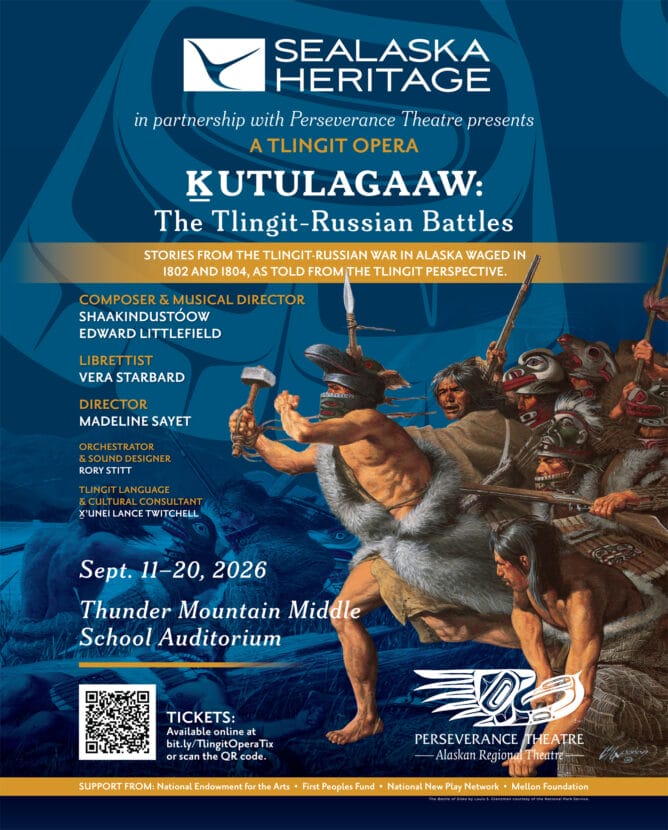
An opera performed entirely in Lingít debuted in Juneau last weekend. The opera, titled “Ḵutulagaaw: The Tlingit-Russian Battles,” is about a series of battles between Southeast Alaska Native peoples and Russian invaders in Sitka. The opera was produced by Sealaska Heritage Institute in partnership with Perseverance Theatre.
The Kiks.ádi clan was especially involved in that history, and a text about the battles say this is their story. But members of that clan say, while it’s exciting the story is being told, SHI never asked the Kiks.ádi for permission to tell this story in the first place.
Still, they planned to talk at the opening night of the opera.
The Kiks.ádi clan leader Aanyáanáx Ray Wilson had given clan member Lduteen Jerrick Hope-Lang permission to speak on behalf of the clan. Hope-Lang said they prepared a speech about two minutes long giving their blessing.
“So our intent was to say this is ours,” he said. “We want you to move forward in this, and we want you to be strong.”
Then, the night before the opening, Hope-Lang heard that SHI leadership wasn’t going to let him talk.
He texted SHI Director Kaaháni Rosita Worl to ask why.
“And her message to me through text was that nobody comes to the opera to hear people talk,” he said. “And she wanted to maintain goodwill amongst the crowd.”
Worl told KTOO that her concerns weren’t just about the length of his speech.
“If we had allowed or invited the Kiks.ádi to speak, we would have had to invite Eagle clans and the Haida to speak as well,” she said. “Because in our culture we have to have social and spiritual balance.”
Worl said there was never a plan for the Kiks.ádi to speak at the opening, but that the clan was invited to dance in with the cast and crew instead. Hope-Lang said he didn’t hear about a plan to dance in.
For Hope-Lang though, this was another way SHI was excluding the Kiks.ádi from being a part of telling their own story. Multiple people involved with the opera and the theatre company spoke at the opening.
Hope-Lang said SHI didn’t follow cultural protocol — it never sought permission from the Kiks.ádi to tell this story.
The creators of the opera based its story on an exhaustive tome of research about the battles; a book called “Anóoshi Lingít Aaní Ká Russians in Tlingit America: the Battles of Sitka 1802 and 1804.”
Lingít author and scholar Nora Marks Dauenhauer, her husband and linguist Richard Dauenhauer, and scholar Lydia Black wrote the book. SHI published it in 2008.
“From the Lingít point of view, the history belongs primarily, if not exclusively to the Kiks.ádi, a Raven moiety clan especially associated with Sitka, because the events took place on their land, and their ancestors died defending it from foreign invasion,” the book states in its preface. “From the Lingít point of view, an unauthorized telling constitutes stealing.”
But in August, Worl claimed at a public panel at SHI that the story doesn’t belong just to the Kiks.ádi.
She said SHI had conversations about the ownership of this story back in the early 2000s, when the organization was compiling the written history of the battles.
“In the discussions that we had, we came to the conclusion that since all of our clans and the Haidas united to battle the Russians in 1802, we believed that this story was owned by all of the clans and the Haidas,” Worl said. “So we moved forward in that way.”
In a phone call with KTOO, Worl reiterated her stance on the ownership of this story. When asked about the book’s claim that the Kiks.ádi own the story, she attributed that discrepancy to one of the book’s authors, the late Richard Dauenhauer.
“I don’t want to undermine Dr. Dauenhauer in any way, he did great work, but I don’t think he understood the complexities of Lingít law and ownership,” she said. “So that was his assumption, and I think it’s because he was interviewing primarily the Kiks.ádi in Sitka.”
Hope-Lang said he doesn’t agree with Worl’s position on who owns the story.
“No one individual can alienate our history from us, although she’s certainly trying,” he said. “So even I, a Kiks.ádi member, could not say to Rosita, ‘because you’re friends with me, or you’ve studied this, I’m going to give you this history, and you can mark it as whatever.’ I can’t alienate my history from my own people. It doesn’t belong to me. It’s collectively owned.”
Hope-Lang isn’t alone in his concerns.
Yeidikook’áa Dionne Brady-Howard is the Kiks.ádi clan mother. She holds important clan knowledge like songs and stories and clan members can consult her on protocols.
When Hope-Lang wasn’t allowed to speak on behalf of the clan, Brady-Howard said it surprised her.
“His remarks would have taken up less than two minutes, which, in the Indigenous world, is really not a lot of time that could have been extended to us as a courtesy,” she said.
She still admires the work everyone has done to make this happen, and doesn’t want this situation to detract from the feat of creating the opera.
But she said the experience has left her with mixed feelings.
“The more ways that we can assert our visibility as a continuing people who are still here, the better,” Brady-Howard. “But as someone whose clan this story is an essential part of, and whose clan was cut out of a very small request to be heard before this story was told for the first time, that also creates a conflict from within me.”
And Hope-Lang said he doesn’t want this to take away from the work so many people put into this project either.
“We have something in Lingít language, telling our history in 2026,” he said. “That should be the celebration.”
Hope-Lang sent a letter to SHI and the Sealaska board outlining his concerns and asking for an apology. Worl said SHI will respond to that letter.
