
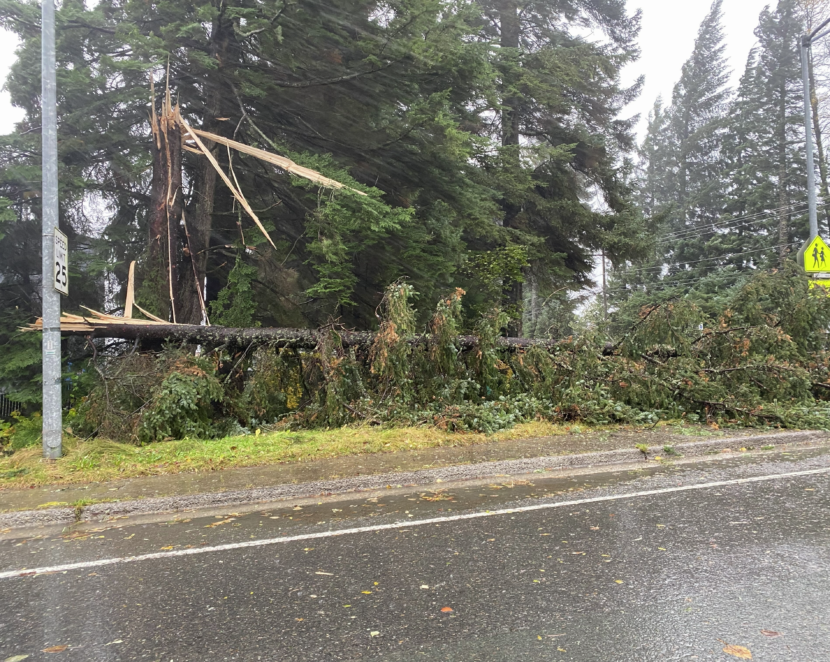
Heavy rain and high winds are slated to continue slamming parts of Southeast Alaska through Tuesday night.
The National Weather Service issued a flood watch as well as high wind advisories and warnings, concentrated mostly in the northern panhandle. Meteorologists expect impacts in Juneau, Sitka, Gustavus, Elfin Cove, Haines, Skagway and Yakutat.
Addie Perez is a meteorologist at the Weather Service in Juneau. She said winds are between 25 and 30 miles per hour, with gusts up to 60 miles per hour.
“We’ve already seen some impacts of trees falling down in the Juneau area as well as the Gustavus area,” she said Tuesday afternoon.
According to Alaska Electric Light & Power, downed trees have caused power outages across a majority of Juneau except for downtown and Douglas, as of 1 p.m. Tuesday.
Perez said the winds should slow down overnight and through Wednesday, and rainfall should taper off late Tuesday night.
She said streams are swelling with rain, and some minor flooding is possible. The Salmon River in Gustavus is nearly full, and Jordan Creek and Montana Creek in Juneau’s Mendenhall Valley are on the rise.
This type of storm is called an atmospheric river, which is a common source of the region’s rain.
“It’s basically just a band of concentrated water vapor in the atmosphere that carries a lot of moisture up from the tropics,” Perez said.
Atmospheric rivers have grown more intense due to climate change, because warmer air can hold more moisture. Those intense storms have led to an uptick in destructive landslides in Southeast, according to research published last year.
Heavy rain and wind caused a landslide that took out an electric substation in Ketchikan just last week.
Ryan O’Shaughnessy, Juneau’s emergency manager, said the city doesn’t have a threshold for issuing a landslide evacuation advisory.
“Landslides are notoriously difficult to predict,” O’Shaughnessy said. “We do not have an established threshold or criteria for an evacuation due to landslide risk. They’re much harder to predict than avalanches or glacial lake outburst flooding.”
But he said people living under steep slopes should generally be prepared during atmospheric rivers by having a ‘go’ bag packed, and he encourages Juneau residents to sign up for the city’s emergency alerts.
For updates on the storm, visit the National Weather Service website.

