
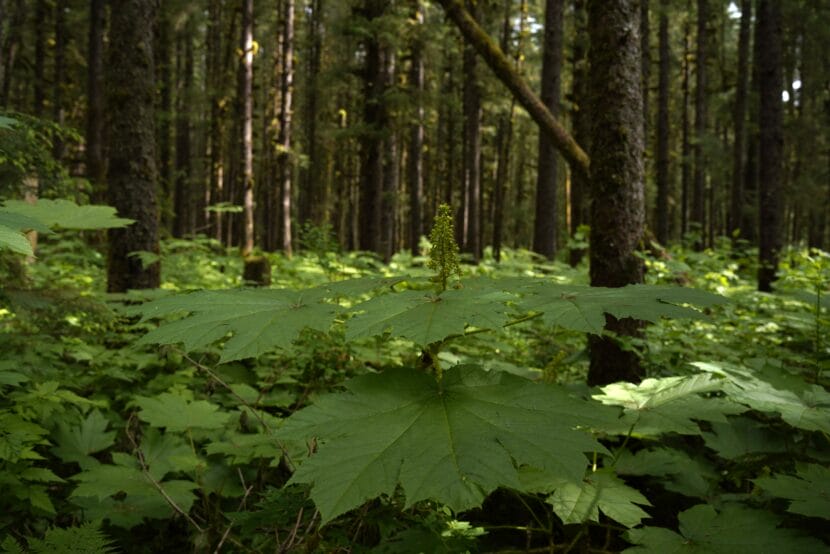
Public comments closed Tuesday on a federal proposal to lift a roadbuilding ban in national forests across the country, including the Tongass National Forest.
More than 370,000 people submitted public comments online and 99% of them oppose a rollback of the Roadless Rule. That’s according to an analysis published Wednesday by the Center for Western Priorities, a conservation advocacy group.
At nearly 17 million acres, the Tongass is the largest national forest in the United States and the largest intact temperate rainforest in the world. Many comments pointed to research that shows the Tongass holds more than 40% of all carbon stored in U.S. national forests, and called the forest the “lungs of the Earth.”
Nearly half of the Tongass — more than 9.2 million acres — is inventoried as roadless. During a statewide subsistence hearing held virtually by the U.S. Forest Service last week, all 26 people who testified said they want to keep it that way.
Judith Ramos is Lingít from Yakutat, where she did research on subsistence as an anthropologist for the Yakutat Tlingit Tribe. She said that both Alaska native and non-native households in the community depend on the forest for food.
“Almost 20% of the households got 75% of their protein from subsistence,” Ramos said.
Many who testified at the hearing said the forest helps provide salmon and deer that people in rural communities need to thrive.
The Roadless Rule has flip-flopped multiple times since it was established to protect forestlands in 2001. Rolling it back again aligns with President Donald Trump’s executive orders to stimulate logging and other natural resource extraction in Alaska.
Adrian Lee is a representative of the Tongass Hub of the Women’s Earth and Climate Action Network. She testified that her small village of Hoonah is still recovering from issues brought by logging camps.
“The impacts with addictions and violence was huge in our community,” Lee said.
While tribes and environmental groups have said millions of acres of Tongass forestland could be opened up to logging without roadless protections, some members of the timber industry disagree.
Sarah Dahlstrom is the director of public relations at Viking Lumber and board president of the Alaska Forest Association, an industry group that advocates on behalf of timber companies in Southeast and supports lifting the roadbuilding ban. Her family’s multi-generational sawmill is on Prince of Wales Island.
In an interview with KTOO, Dahlstrom said that timber sales likely won’t open immediately if the Roadless Rule is lifted. Plus, amendment to the current Forest Management Plan will be necessary to identify areas that could be available for roadbuilding and logging.
“I’m going to say it’s a very small amount of acreage that gets opened up that could have road building on that,” Dahlstrom said.
Clarence Clark is a board member at the Alaska Forest Association. In an email to KTOO, he estimated that around 188,000 acres in currently roadless areas could be considered suitable for logging under the 2016 Tongass Forest Management Plan. That would be less than 2% of the Tongass.
Clark said that’s because most roadless areas of the Tongass have additional layers of protection, like a wilderness, natural area or recreation designation.
The Forest Management Plan is currently undergoing a revision.
The Forest Service did not respond to a request for comment. A final decision on the Roadless Rule is expected by the end of the year.

