
Listen to this story:
The Trump Administration has reinterpreted language in the federal Endangered Species Act that would allow for the incidental killing of endangered species and habitat loss. Wildlife attorneys say it guts protections, but the Alaska Department of Fish and Game supports the change.
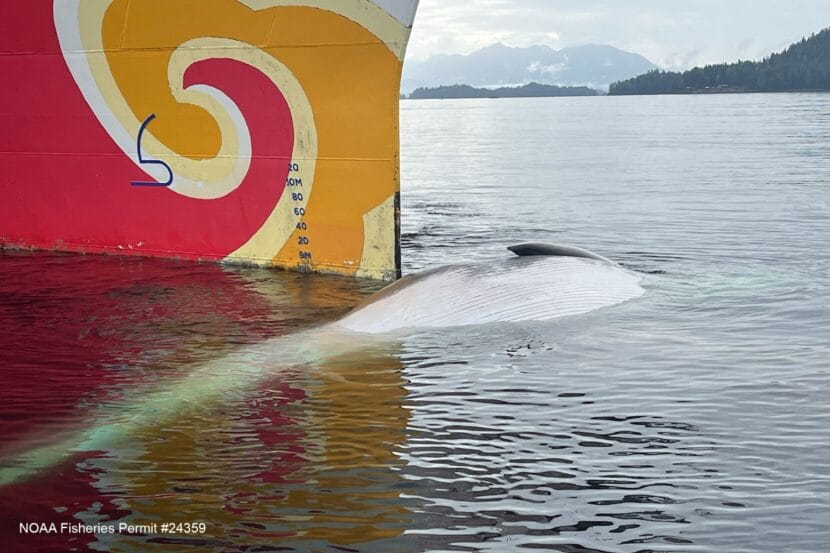
Last month, a cruise ship struck and killed an endangered fin whale on its way to Sitka. Another cruise ship docked in Seward in June with a dead, pregnant fin whale on its bow.
Previously, incidentally killing endangered species could result in criminal penalties and fines. Now, such ship strikes would no longer be considered an illegal “taking” of whales under the Endangered Species Act because they weren’t intentional. That’s according to an internal U.S. Fish and Wildlife Service memo leaked to the New York Times last month.
Ben Levitan is an attorney at EarthJustice, an environmental law firm. He’s worked on several cases on endangered species in Alaska and said this shift is reckless.
“For the most part, the reason species are going extinct is not that people wake up in the morning and decide they want to kill endangered species,” Levitan said.
The new interpretation comes on the heels of another reinterpretation of the law by the Trump administration. The U.S. Fish and Wildlife Service and the National Oceanic and Atmospheric Administration rescinded the definition of “harm” to allow for habitat degradation.
John Chu, public affairs director for NOAA Fisheries, said in an email to KTOO that the change will “maintain protections for endangered species while reducing unnecessary or duplicative permitting requirements, cutting compliance costs and eliminating confusion for Americans.”
EarthJustice and other environmental groups filed a lawsuit against the U.S. Fish and Wildlife Service and NOAA over that change in July. The new interpretation took effect Sept. 14.
“The major threat to species has been habitat destruction,” Levitan said. “That continues to be true.”
He said the Endangered Species Act of 1973 has primarily protected species from “incidental take” — the very thing the Trump administration would allow with its new interpretations.
The law has prevented the extinction of 99% of listed species and has aided in the full recovery of 39 species, according to a 2019 study by the Center for Biological Diversity.
Levitan said it’s been a huge success.
“There are species that this generation will pass on to the next generation because the Endangered Species Act has been protecting them, and that’s the legacy that’s at stake here,” Levitan said.
More than 20 species that are listed as threatened or endangered spend at least some of their lives in Alaska. Most are marine mammals, like the polar bear, blue whale and fin whale.
Marine mammals remain shielded by the Marine Mammal Protection Act. According to NOAA, violators can face up to a year in prison, civil fines up to $36,498, and vessel forfeiture. But Chu told KTOO that none of the nine confirmed vessel strikes in Alaska this year have resulted in criminal prosecution or fines so far.
Doug Vincent-Lang is commissioner of the Alaska Department of Fish and Game. He said he agrees with the Trump administration’s new understanding of the Endangered Species Act.
“We are supportive of not only this definition of how to look at take and harm, but also of rolling back those critical habitat designations,” Vincent-Lang said.
He named the Arctic ringed seal as an example, which is listed as threatened due to sea ice loss as a result of human-caused climate change. Under the Endangered Species Act, NOAA designated an area off the coast of Alaska that’s about the size of Texas as critical habitat. Vincent-Lang said that’s too big.
“When you apply it on these broad levels, it just gives way too much authority to the federal government to control habitats,” he said.
Vincent-Lang said he doesn’t think large swaths of land or water should be managed primarily to benefit one species.
The U.S. Fish and Wildlife Service declined to comment for this story.

