
Listen to this story:
Scientists predict that a super El Niño could break ocean temperature records this winter. Hotter seas cause more toxic algal blooms, which could hurt Alaska’s shellfish industry. Researchers at the University of Alaska Southeast are trying to detect toxic blooms sooner, before oyster farms are forced to shut down.
Shellfish in Alaska eat algae, including a toxic species called Alexandrium catenella. It causes paralytic shellfish poisoning. According to the Alaska Department of Environmental Conservation, just one milligram can kill an adult.
For oyster farmers like Meta Mesdag, a toxic algal bloom means she can’t sell her oysters until the algae clears out. A bloom can last weeks, and leads to large losses over time.
“Maybe $20,000 to $30,000 in revenue and loss of customers,” Mesdag said.
Mesdag owns Salty Lady Seafoods Co., the only oyster farm in Juneau. In the past, her team has tried to predict blooms by looking at water samples under a microscope.
“If we see that there is a lot of harmful algae and we think that we’re going to end up with a toxic bloom, we can just electively choose to not sell product — so we can close ourselves,” she said.
But that method was unreliable, and meant she sometimes closed the farm for longer than necessary.
“It’s been a crapshoot, quite honestly,” Mesdag said.
El Niño’s occur when trade winds weaken and water in the central Pacific Ocean warms. With upcoming forecasts of a super El Niño, the seafood industry is bracing for what could be a difficult year. The last major El Niño between 2014 and 2016 had disastrous consequences for fisheries across the West Coast. The federal government disbursed more than $141 million in fisheries disaster relief.
Jason Kuhn is a biochemist and professor at UAS. He’s studying ways to predict toxic algal blooms, which he said could happen more frequently in Southeast due to the El Niño.
“When you have something like an El Niño, where you have warmer water temperatures, that could definitely impact the likelihood of the blooms happening,” Kuhn said.
He said toxic algal blooms used to be less frequent in cold-weather months, but now he’s seeing blooms at all times of the year
“Because of impacts due to climate change, in large part that window has expanded,” Kuhn said.
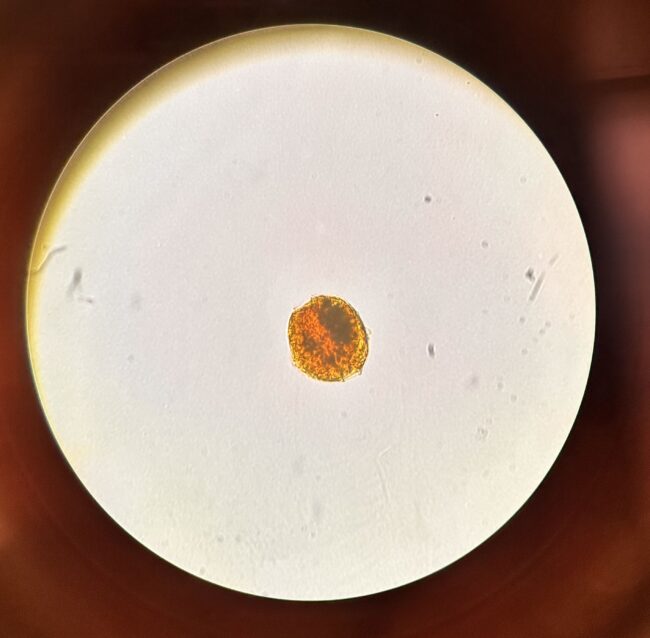
In his basement laboratory, he and his team test seawater using a method called environmental DNA, or eDNA, to see if they can predict when a bloom could cause shellfish farmers to shut down.
Environmental DNA has been used to foresee health outcomes before. Researchers used this method to test human wastewater for COVID-19 to track how the virus spread through communities before cases spiked in hospitals.
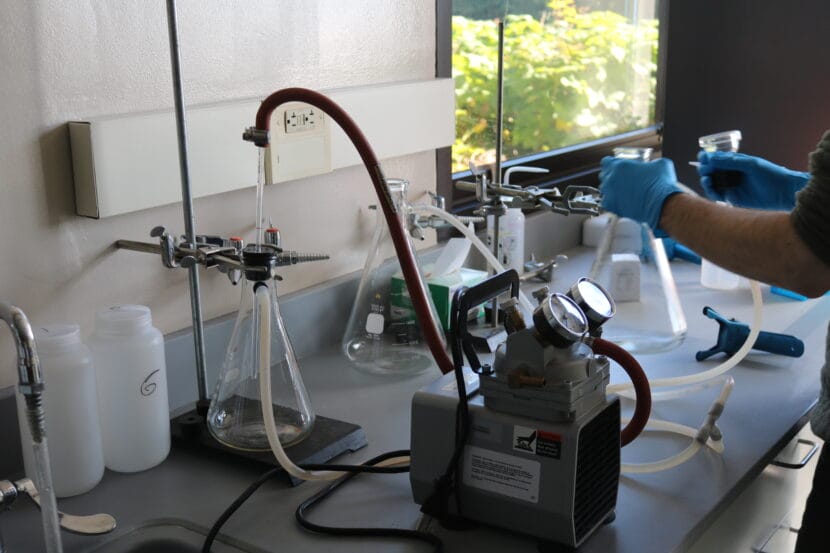
Arianna Workman, one of Kuhn’s undergraduate research assistants at UAS, runs a liter of seawater through a fine filter to pull out the algae. Then, she uses chemicals and a machine called a centrifuge to strip it down into readable DNA.
“That is what DNA extraction is: putting things in one tube into another tube,” Workman said.
After Workman extracts the DNA, she puts it in another machine that glows when it detects the toxic algae.
“The brighter it gets, essentially means that there’s more DNA in the sample,” she said.
The more toxic algae there is in the water, the more shellfish are eating it. Kuhn said it takes time for shellfish to filter enough algae to become toxic themselves.
“This is a method that allows you to specifically, sensitively, and quantitatively determine how much Alexandrium is in that sample,” he said.
Kuhn shared his unpublished eDNA data with KTOO. It shows a spike in toxic algae in seawater samples a whole week before the toxins appear in his blue mussel samples.
John Harley is an environmental toxicologist who studies paralytic shellfish poisoning at UAS and the Southeast Alaska Tribal Ocean Research network, but isn’t involved with Kuhn’s work. He said this method is promising.
“I think any research that goes into better understanding when and where these blooms might occur is very valuable to continue to allow people to safely harvest shellfish,” Harley said.
Kuhn plans to wrap up data analysis from this summer at the end of the year.
