
Listen here:
Student enrollment is dropping at the Juneau School District. The district predicted as much, but this year, it’s even worse. District leadership reported during a September school board meeting that there are 94 fewer students than originally planned for.
Sybil Van Derhoff, the district’s human resources director, said that’s affected both the district’s budget and staffing.
“We needed to take a look at our staffing allocations and really see what schools came in much below and and what schools were at the levels that we had predicted,” she said. “And so at that point we identified four schools that were […] significantly below the projections.”
Those schools are Auke Bay Elementary, Kax̱dig̱oowu Héen Elementary, Mendenhall River Community School and Sítʼ Eetí Shaanáx̱ – Glacier Valley Elementary.
The staffing levels at the district’s neighborhood schools are determined by a student to teacher ratio, set by the school board. When a certain threshold of students isn’t met, teaching positions have to be eliminated. Those four impacted elementary schools had to get rid of one position each — all after the school year had already started.
Some of the largest changes happened at Sítʼ Eetí Shaanáx̱, which is one of three elementary schools in the Mendenhall Valley.
Principal Kelly Stewart said the district recently transferred one teacher to another school to stay within the new staffing limits. And then Stewart had to reconfigure classes to make up for that loss. But, she said it did mean going from a primarily mixed grade structure to more single grade classrooms.
“I would say, probably the biggest win, if you want to find the wins in the reconfiguration, is that now all K-3 classrooms are solid grades,” she said.
But some classes increased in size. Classes for fifth and sixth graders increased from the mid-twenties up to 30 students.
Stewart said the focus now is making sure students have a smooth transition to the new classes.
“It’s not ideally what we wanted to happen,” she said. “We would have loved to have kept all our teachers, but it’s now that we know where we are. We need to set forth and get started, or continue with what they’ve started.”
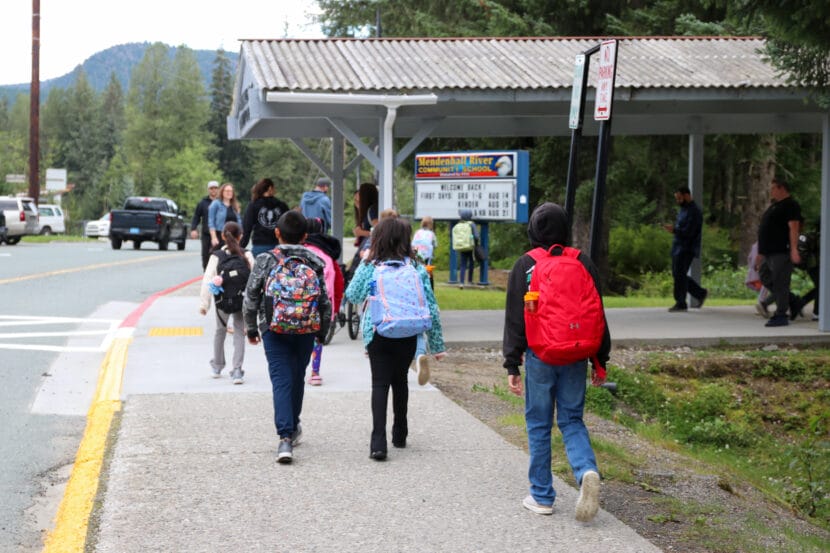
Mendenhall River Community School also shifted students and teachers around. Parent Mary Catharine Martin found out the news in mid-September. Ten days later, her kindergartener started class with a different teacher.
Despite the change, Martin said she appreciates the communication and support coming from the school.
“As a parent, you can be kind of worried about changes or transitions, especially at the start of something like the start of a school year,” Martin said. “But I know at least for my kid, they felt really positive about it the way that it was presented to them.”
Her child’s first day with the new teacher was this week, and Martin said it’s been going well so far.
Overall declining enrollment has affected other elementary schools. Gwenna Corvez teaches a combined fourth and fifth grade class at Harborview Elementary. She has 36 students.
What’s different about Harborview compared to the other four schools is Harborview was able to make adjustments before the school year started.
Corvez said the school lost one teacher from the previous school year due to declining enrollment. Staff had time to plan accordingly.
“Myself and a colleague teaching fourth and fifth grade decided that we would take the larger class sizes to make that possible, and so we knew ahead of time,” she said. “We were part of the decision making,”
Corvez has been teaching for nearly two decades, and 36 students is the largest class she’s ever had. She wishes she could have more time working with students individually, but is focused on teaching them to work independently and setting high expectations. She said her students are doing well.
“It would be nice if we could keep all our teachers and have smaller class sizes, but that’s not the way the district and the funding works,” Corvez said.”
The school board sets the student to teacher ratio during its budgeting process the prior year. Those decisions are based on projections.
“We have to build a budget in the spring, not not knowing how much revenue we’re going to have from the state, and in many ways it turns out to be our best guess,” said Van Derhoff, the district’s human resources director. “But it is a guess at the end of the day.”
She said declining enrollments give schools less wiggle room when their projections are off. If the district had more concrete numbers to budget off of, Van Derhoff said these changes after the school year has started would be less common.
Rep. Andi Story, D-Juneau, introduced a bill to address these uncertainties during the Alaska Legislature’s regular session this year. However, lawmakers did not pass it in time.
Overall, Van Derhoff said the community needs to come together to plan for the declining enrollment.
“This is kind of like a canary in the coal mine moment,” she said. “I think that we are being faced as a community with an issue that is not going away, and declining enrollment is here to stay, and we have been seeing it for a decade, and it’s going to continue.”
Getting a final count on student enrollment this year isn’t over. The district will do the official count it submits to the state in October, and numbers are typically approved in January.
