
Listen to this story:
What if, instead of using graphs and words to share environmental data, scientists used music? A student at the University of Alaska Southeast spent her summer doing just that.
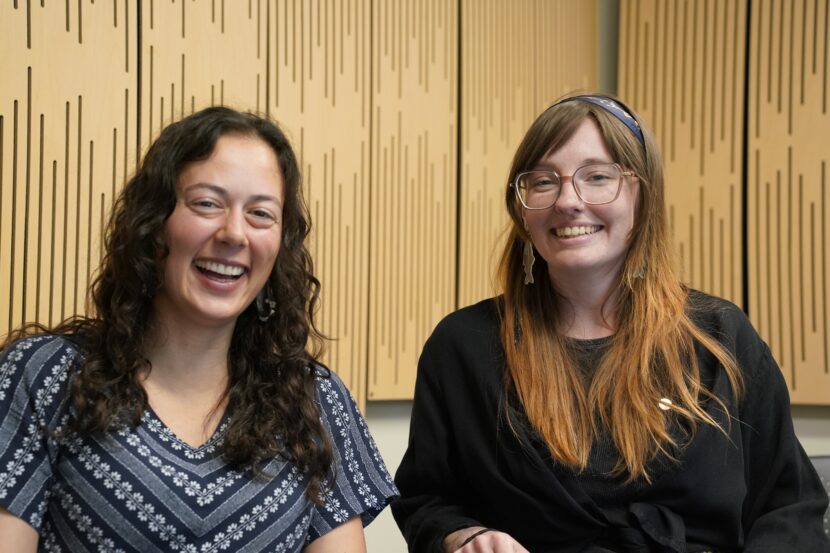
Ashlen Smith composed songs from complex stream data collected in the Davies Creek Watershed at the north end of Juneau in the Héen Latinee Experimental Forest.
“Sonification is taking data and turning it into sound,” Smith said. “So it’s kind of a unique way to immerse yourself in environmental patterns.”
She composed the songs as part of a paid internship with the Alaska Coastal Rainforest Center and presented her project last month at the center’s first student symposium.
Smith said she hopes the music will help listeners feel some semblance of how a young coho salmon might experience these ecosystems.
“For example, the brown water is more dark and organic — textural — versus the snow-fed, which is more light and crystalline — fast flowing,” Smith said.
The songs represent data collected from January to December of 2024 in four different freshwater salmon habitats within the Davies Creek Watershed: the main glacial stream fed by the hanging Davies Glacier, a snow-fed stream, a rain-fed stream and a beaver pond.
Lindsey McCulloch, Smith’s mentor for the summer, is a PhD student at the University of Alaska Fairbanks in the College of Fisheries and Ocean Sciences. She’s studying how fish grow and take advantage of food webs within those four different stream types.
“We collect a lot of biochemical data, water quality data, streamflow data, which you can visualize through like 5 million different graphs, but it’s kind of challenging to consider altogether,” McCulloch said.
She said she came up with the idea for this sonification project after listening to an episode of the podcast Future Ecologies that made the evolutionary tree of jumping spiders into a song.
“I thought that it would be really cool to try and visualize the complicated data we have from the streams in the same way,” McCulloch said.
Smith said it took some trial and error to match McCulloch’s data to pleasing sounds that work together. She highlighted data more central to the ways a fish might experience the ecosystem.
“We have water level as the melody,” Smith said.
That’s the low, mellow bell sound mixed with a field recording of the water body.
“There’s temperature — as a harmonic foundation, it’s kind of this warm, airy synth pad,” she said. “There’s dissolved oxygen, which is a wind sound.”
Turbidity, a measure of how murky and nutrient-dense the water is, is represented as a noisy, distorted bass.
Glacial stream
The glacial stream is ruled by the dynamics of the hanging Davies Glacier. It’s consistently cold. It flows faster and turns turquoise in the summer as glacial melt sends pulses of sediment downstream.
Snow-fed stream
The snow-fed stream drains a bowl filled with snow, called a cirque, high in the mountains. It’s whitewater — with cliffs and waterfalls that drain into cascading pools. It’s cold, oxygen-rich, and can be heavily influenced by storms.
Rain-fed stream
The rain-fed stream meanders through the shadowy forest and it’s dyed brown by the tannins in the leaves that fall in. That makes it high in dissolved organic carbon. It’s calmer than the other streams, but is also influenced by storms.
Beaver pond
Finally, the beaver pond is more stagnant and open to the sky above, making temperatures fluctuate daily. It has slow-flowing channels and lots of plant life. It can lose oxygen as plants decompose.
Smith said the goal of the project is to help people resonate with the waters around them.
“I would hope that it would help people be more in tune with their environment.”

