
Listen to this story:
Juneau city leaders posed some major questions about glacial outburst flood funding – including possible flood taxes – at an Assembly committee on Monday night, but they don’t have answers yet.
At the meeting, City Manager Katie Koester said a long-term solution sponsored by the U.S. Army Corps of Engineers will require the city to cough up a portion of the funding.
“I think we have a much stronger argument when we go and say, ‘We need a big chunk of money for this project, Congress,’ if we have both our own bond for match in place, and we have participation, you know, by our partners in different layers of government,” Koester said.
According to a memo Koester wrote to the Assembly, the federal government typically requires local funders to cover 25% of the cost for permanent flood control projects across the U.S. But Koester said the city is working with Alaska’s congressional delegation to amend a bill called the Water Resources Development Act that could drop it down to a 10% match instead.
Assembly Member Greg Smith said it will probably be a lot of money either way.
“If it’s a $400 million project and a 10% match, that means we need to come up with $40 million, and if it’s a 25% match, we need to come up with $100 million,” Smith said.
Koester said the Army Corps will propose a solution and a cost estimate in December and the Assembly should decide how to pay its portion by then. She said the Assembly could ask Juneau as a whole to pay for it, or just those in the flood zone, using property taxes.
Koester said if voters approve a municipal ballot proposition to raise Juneau’s property tax rates in the election this fall, it would give the city more flexibility to do that.
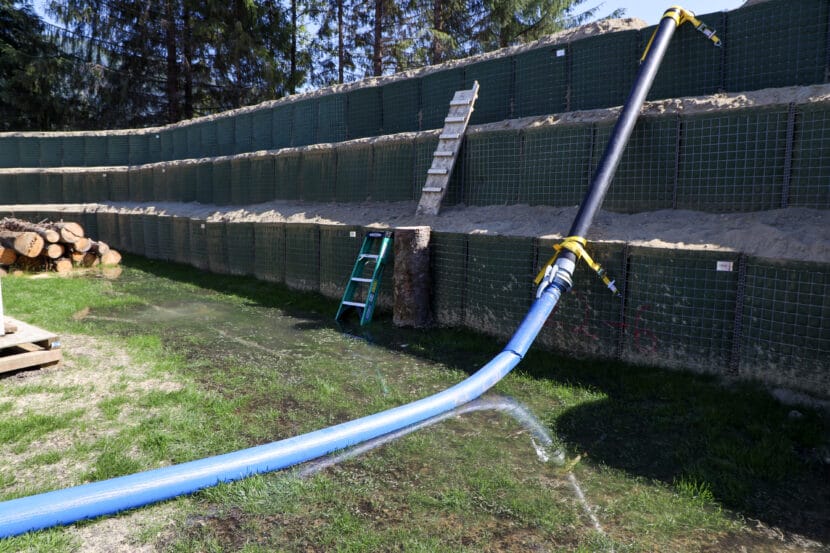
But that wouldn’t cover maintenance costs for the current, temporary solution. The temporary flood wall, made of HESCO barriers, lines most of Juneau’s Mendenhall River and needs annual upkeep to protect valley neighborhoods until a long-term solution comes online.
Koester said the Assembly might want to consider a special service area to pay for it. That would require a majority of registered voters within service area boundaries to agree.
“How big is that service area? That’s another question that this body needs to weigh in on,” Koester said.
In June, the Assembly voted to undo a controversial funding plan that required some homeowners protected by the flood wall to help pay for it, but not all.
Koester said the flood wall protected 1,371 homes worth nearly $840 million during the flood last month. But that number isn’t static. Last year, the flood wall covered fewer neighborhoods.
The city has spent more than $20 million on the flood wall over the past two years. Koester estimates Juneau taxpayers covered about $9.6 million, and the other half came from grants and loans from the state and the Central Council of the Tlingit & Haida Indian Tribes of Alaska
After the flood in August, the city estimates the HESCO barriers will need $6 to $12 million more in repairs.
Koester also posed a question that could address a fairness issue within the flood zone.
“Do we compensate property owners for hosting those HESCO barriers?” she asked.
A couple of homeowners are suing the city for using their land to host the flood wall, without compensation. According to a memo from City Attorney Emily Wright, establishing temporary easements with riverfront property owners could resolve the issue.
Assembly Member Christine Woll added that limiting development within the flood zone is also worth discussing.
“I would say a temporary moratorium to consider so that you’re not putting a bunch of resources into protecting something and at the same time adding to that problem,” Woll said.
Mayor Beth Weldon said she wants to dedicate a few Assembly members to discuss these questions and present options to the wider Assembly.
“I talked to Mr. Steininger, Mr. Brooks, and Ms. Hall today because two of you are going to be gone, and one of you is running for election, and Ms. Adkison didn’t want to do it,” Weldon said.
It’s unclear when the Assembly will vote on these funding questions.

