
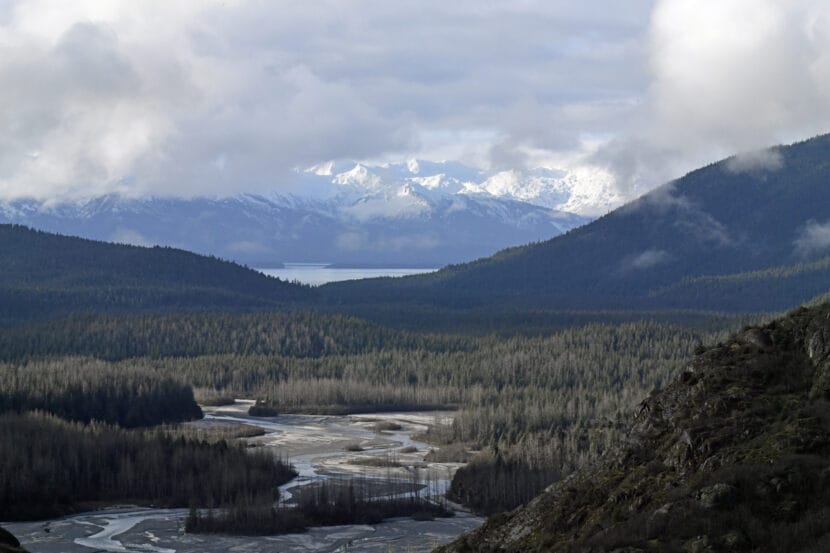
The U.S. Department of Agriculture filed to rescind the Roadless Rule on Tuesday. A rescission would allow new road construction in undeveloped parts of national forests across the country, including the Tongass National Forest.
Nearly half of the Tongass is inventoried as roadless.
The rule has flip-flopped multiple times since it was established to protect forestlands in 2001. Rolling it back again aligns with President Donald Trump’s executive orders to stimulate logging and other natural resource extraction in Alaska.
Yolanda Fulmer is a Lingít culture-bearer and activist with Women’s Earth and Climate Action Network in Juneau. She said she doesn’t want to see roadless protections end in the Tongass.
“It’s not just about trees for us,” she said. “This is our homeland. For Lingít people, the forests, the water, the animals that are sustaining us – this is spiritual for us. It’s not just physical, and for us, you know, these forests — we don’t consider them just undeveloped land. These are places that provide for us. These are places that named us. These are places that know us.”
Fulmer said it’s exhausting to have to fight for protections over and over again.
Alaska Native people throughout Southeast voiced broad opposition to ending the rule during subsistence hearings before the Trump administration rolled it back in 2020. That’s according to a 2024 paper by U.S. Forest Service scientists that analyzed testimony from more than 190 Southeast residents.
Logan Berner is a forest ecologist at the University of Alaska Southeast and the Alaska Coastal Rainforest Center in Juneau. He said debate over the rule raises an important question for American society:
“How much do we value increased timber extraction and mining at the expense of these intact ecosystems that provide a suite of really important services as well?” Berner said.
Some of those services, he said, include clean drinking water for millions of Americans and wildlife habitat.
The USDA said in a press release that the Roadless Rule is a barrier to reducing wildfire risk, but Berner disagrees.
He and his colleagues wrote a paper published in the journal Biological Conservation in June that called the Trump administration’s reasoning “flawed.”
“Roads are a really key avenue by which ignitions for wildfires occur,” Berner said. “Something like 85 percent or more of the wildfire ignitions that occur within the country occur adjacent to roads.”
The Tongass is a high-latitude, temperate rainforest where wildfires are rare.
Berner also said it could be fiscally irresponsible for the Forest Service to build new roads. Nationally, the agency has a backlog of deferred maintenance for existing roads and bridges that totaled about $7 billion last year.
Ending the ban on new roads has been widely unpopular in the past. When the first Trump administration rolled back the Roadless Rule in 2020, nearly all of the public comments advocated to keep it in place.
The proposed rescission is scheduled to be published in the Federal Register on Thursday. The public has about a month to comment on it. The deadline is September 21.
