
Over a month ago, Shelley Cotton cast the first vote in Alaska’s statewide primary election, downloading a blank ballot and sending it quickly by mail from Texas to Alaska.
Since then, more than 31,000 other Alaskans have cast their ballots, and tens of thousands more residents will vote in an election that will start to decide who Alaska’s next governor will be.
What’s on the ballot?
Seventeen people are vying to replace Gov. Mike Dunleavy, who is term-limited and unable to run this year. In that race and all others on the ballot, voters will pick one candidate. The top four vote-getters, regardless of party, advance to November.
There are 16 candidates for U.S. Senate, including Republican incumbent Dan S. Sullivan and Democratic challenger Mary Peltola.
There are 15 candidates for U.S. House, including Republican incumbent Nick Begich III, independent challenger Bill Hill, and Democratic challenger Matt Schultz, who suspended his campaign last month and decided to back Hill.
As in the governor’s race, voters pick one candidate for each of those races, and the top four candidates advance to November.
There are 40 state House races and 10 state Senate races; each part of the state has one House race, and only half of the state has a state Senate race.
If there are four or fewer candidates for one or both of the legislative races, all candidates advance to November. Only five of the 50 legislative races have more than four candidates.
On the back of the ballot, there’s also an up or down vote on Ballot Measure 1, which would reimpose limits on how much money that people can donate to political candidates.
Ballot Measure 2, which has been the subject of extensive advertising, isn’t until November.
Where do I vote and what do I need to vote?
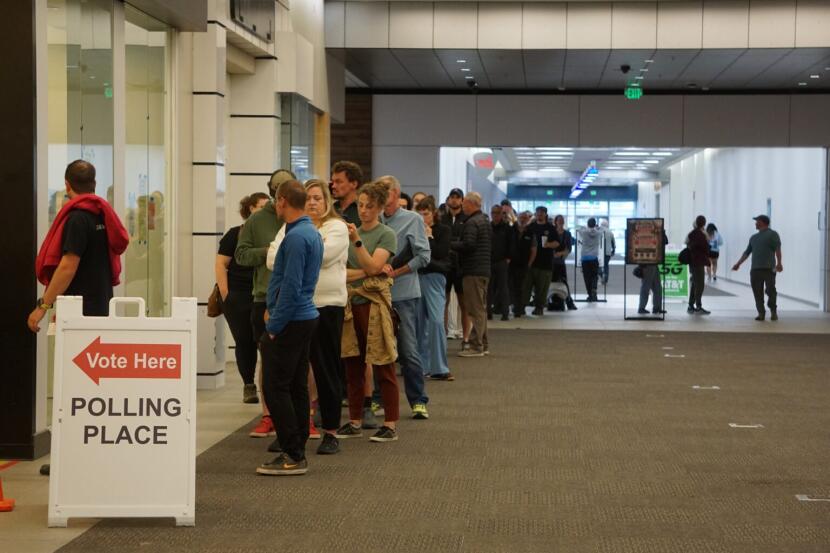
You can find your polling place by entering your information here. Bring a governmental ID; it doesn’t have to have your photo. If you don’t have an ID, bring a piece of mail with your name and address.
If you can’t make it to your polling place on election day, you can go to another polling place and vote there, but you’ll be asked to provide additional identity information because that polling place won’t have a way to immediately check that you’re registered to vote.
What do I do if I want to vote by mail?
It’s too late to request a blank ballot. If you already have your blank ballot and need to return it, DO NOT just drop it into a mailbox. Your ballot must be postmarked by election day, and in Alaska, it may take a day or more for a ballot to be postmarked after it is mailed. Instead, go into a post office with your sealed ballot and ask the postal clerk to postmark it by hand.
If you’re near a polling place, you can also drop your sealed ballot in the box there.
How many people have already voted?
As of noon Monday, according to statistics published by the Division of Elections, almost 22,000 Alaskans had already voted early, in person at 10 polling stations in the Railbelt, Juneau and Nome. Another 9,000 voters had cast absentee ballots.
That’s less than 5% of all eligible voters.
In early voting, a voter’s ID is checked when they cast their ballot, guaranteeing that the vote is counted. In absentee voting, the voter’s ID is checked later, and their ballot could be disqualified if elections officials aren’t able to verify that it was cast by an eligible voter.
In 2020, 2022 and 2024, absentee ballots leaned Democratic, with election day results favoring Republicans and then leaning away from Republican candidates as additional votes were counted.
This year, through Sunday, the division had received absentee ballots from 2,702 registered Republicans, 1,996 registered Democrats, and 4,467 undeclared and nonpartisan voters.
Importantly, of the 22,838 blank absentee ballots requested by Alaska voters, only 9,232 had been returned by Sunday, indicating many more filled-out ballots could still be in the mail.
When do we know the results?
The Division of Elections has said the first partial, preliminary results will be available on its website about 9 p.m. Tuesday night. As more votes are counted, those results will be updated until early Wednesday morning, when elections officials take a break and go to sleep.
More counting may be needed on Wednesday or later this week to complete the election day tally.
Mailed ballots will be counted through Aug. 28, with results updated regularly through then.
Any candidate who finishes in the final four can withdraw until Aug. 31.
Governor and lieutenant governor run on a single ticket, and a governor can change out his or her lieutenant governor candidate until then as well.
Entering election day, six big questions remain unknowns.
Who will be the finalists in the governor’s race?
Pre-election polling indicated Democratic candidate Tom Begich was likely to finish first among the 17 candidates for governor. Because there are only two Democratic candidates, fellow Democratic candidate Jonathan Kreiss-Tomkins also appeared likely to finish in the top four.
What was less clear was which of the 12 Republican candidates would finish in the top four, and whether independent former Gov. Bill Walker would also make the cutoff.
Will there be voting problems in rural Alaska?
In previous years, the Division of Elections has struggled to find election workers in rural towns and villages across Alaska. On Monday, observers tracking the division said the polling station in the North Slope community of Point Lay would open late because workers would not arrive until the morning flight.
In addition, prior elections saw elections officials reject an unusually large number of absentee ballots cast in rural Alaska. It isn’t yet clear whether that trend will continue this year.
On Saturday, the early voting station in Nome failed to open on time, an issue that helped prompt the Alaska Federation of Natives — in conjunction with other groups — to issue a statement saying they were deeply concerned by potential staffing issues and any effects on rural voters.
How enthusiastic are Democratic voters this year?
In other states that have already held their primary elections, Democratic voters turned out in large numbers, motivated by the desire to vote for candidates who oppose Republican President Donald Trump.
If the number of votes cast for statewide Democratic candidates exceeds or approaches the number of votes cast for statewide Republican candidates, that could indicate strong Democratic enthusiasm in Alaska as well, something that could affect the November result.
Two years ago, Democratic candidates posted unusually strong results in the August primary — but Alaska still voted for Trump by six percentage points and elected Republicans to statewide office.
Will any incumbents be voted out early in the Alaska Legislature?
Of the 50 state House and Senate races on the ballot Tuesday, there are only five with more than four candidates. Three of those races — two in the Matanuska-Susitna Borough and one in Eagle River — have incumbents.
Incumbent lawmakers traditionally have an advantage in crowded primary elections because of name recognition and popularity, but it’s possible that one or more could lose.
Rep. Garret Nelson, R-Sutton, was appointed to his office by Gov. Mike Dunleavy and is running for election for the first time against five challengers. Rep. Jamie Allard, R-Eagle River, is facing four challengers, as is Rep. Kevin McCabe, R-Big Lake.
In Bristol Bay, Speaker of the House Bryce Edgmon, I-Dillingham, is competing with four other candidates to replace Sen. Lyman Hoffman, D-Bethel, who is retiring as the longest-serving state legislator in Alaska history.
Seven people are competing to replace Edgmon in the state’s most crowded legislative race.
Will donation limits return to Alaska’s state political campaigns?
In 2006, 73% of participating voters approved a ballot measure that limited the amount of money that a political candidate can receive from a person or group.
A three-judge panel of the 9th U.S. Circuit Court of Appeals overturned those limits in 2021, and the Dunleavy administration declined to fight the issue further.
Now, voters will be asked to reimpose some limits. The new measure isn’t as comprehensive as the last measure, in part because the U.S. Supreme Court ruled in 2010 that states cannot limit third-party spending by groups acting independently of campaigns.
Those groups have flooded Alaskans’ mailboxes with mailers ahead of the primary, but stanching the flow could require an amendment to the U.S. Constitution or a new ruling by the Supreme Court.
