
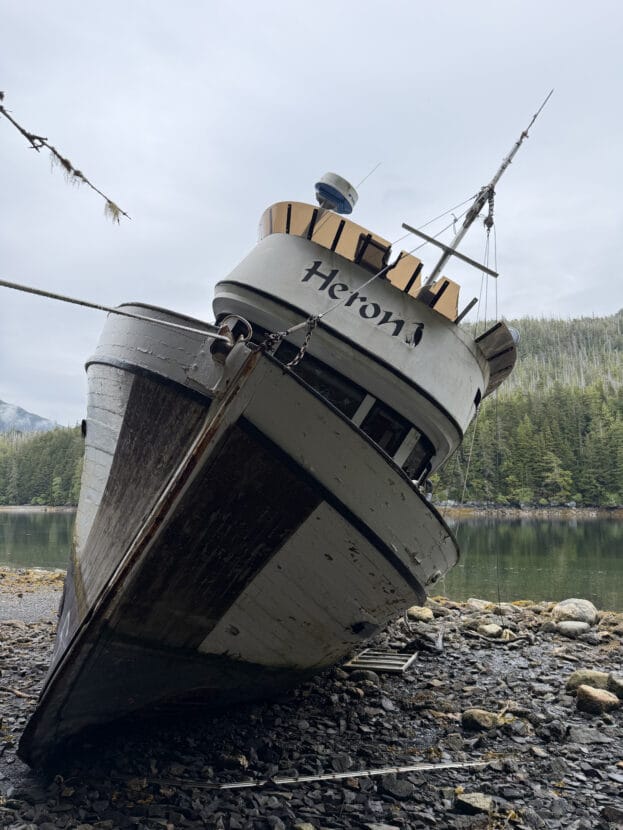
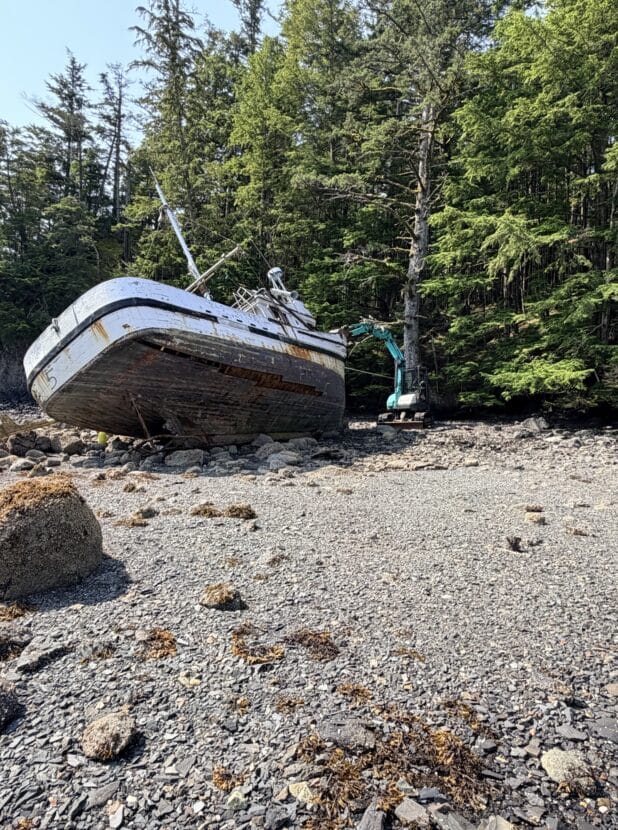
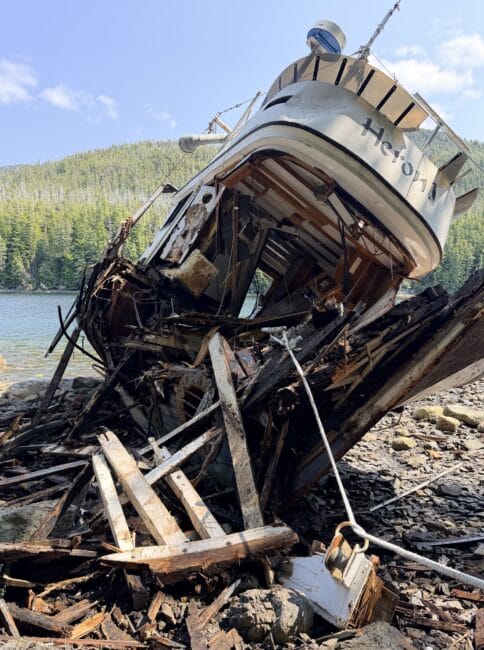
The Metlakatla Indian Community is in the process of removing 27 abandoned and derelict vessels from its waterways. It’s part of an effort – also happening in Yakutat and Sitka – to improve marine habitat and clean up tidelands, funded by the National Oceanic and Atmospheric Administration’s Marine Debris Program.
Michael Moore, Program Director for BoatUS Foundation which administers the program, spoke with KTOO about the removal and disposal of abandoned and derelict vessels in Southeast Alaska.
Listen:
The following transcript has been lightly edited for clarity.
Mike Lane: How many vessels are there in Alaska that are slated for removal?
Michael Moore: So we have three projects. The Metlakatla Indian community is in the process of removing a total of 27 abandoned derelict vessels. We have, the Yakutat Borough, as well as Sitka Conservation Society have applied and was approved, and they are removing vessels. It’s over 40 vessels that are being removed in totality in all three locations.
Mike Lane: And that’s just in Southeast Alaska, of course. Why is it important to remove derelict vessels, and what hazards are created by these ADVs?
Michael Moore: On the surface, it’s it’s a navigational hazard, right? It can be a navigational hazard. You know, it’s it’s easier seeing if they’re halfway sunk or they’re not sunk. You know, you can see it, but it’s still you know visibly it’s not appealing. But if it is sunk, it’s become a navigational hazard, right? Or a safety hazard to the community. Not to mention what’s in that vessel, whether there’s anti-fouling agents and fluids, whether there’s anything that’s bio-related. If there was a latrine on on board, or if it’s got propane or any other fuels, it becomes an environmental and safety concern in that regard. It can impact a variety of environmental habitats, whether it’s fisheries in general, you know, ultimately impacts communities.
Mike Lane: Now, how do those vessels typically become abandoned or derelict?
Michael Moore: The short science of it is that vessels, you know, especially those that are being used, need routine maintenance on them. You’ve got to keep them up. Ultimately, it’s through neglect. Sometimes it’s because of financial concerns or issues. Sometimes the owner, sometimes they pass away, and then it’s passed on to someone who isn’t who operates boats, or been on a boat often, or doesn’t know the the needs of boat maintenance. And then years pass, and it’s just neglected exponentially, and that boat then becomes an issue, becomes sank. Sometimes boat owners get to the point where the end of life of the vessel, they’ve kept it up to the point they can, and now the vessel isn’t seaworthy, and they need to dispose of it. And they don’t know how to dispose of it.
Mike Lane: What is the cost of removing and/or recovering a vessel?
Michael Moore: It depends on the condition of the vessel, where the vessel is. You know, on the lower side of things, that can be you know roughly $10,000 in some cases, a little less. Little more, depending on your your area, it’s exponentially more if and especially the larger the vessel, it can be you know 20, 30, $40,000, depending on your location, what type of vessel, and what needs to be done to it.
Learn more about the BoatUS Foundation at boatus.org.
