
Listen to this story:
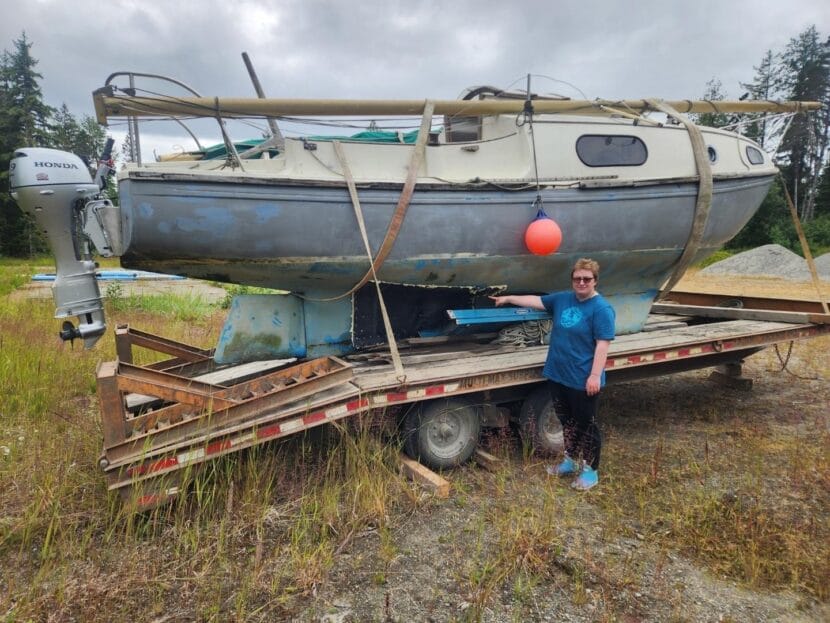
A Gustavus family’s sailboat suddenly sank in Glacier Bay National Park on July 29. The family survived. When they recovered the sailboat a few days later, they found something unusual: the rubbery, black skin of a humpback whale.
Tania Lewis has been a wildlife biologist at Glacier Bay National Park for decades. But that Wednesday, she wasn’t venturing through the fjords for work. She was on vacation with her husband Eric and their 23-year-old, Lu, aboard the S/V Windrush, their 25-foot sailboat.
Tania said that day was beautiful and sunny. They hiked near Reid Glacier, then anchored in the cove next to Gloomy Knob for the night. They watched a humpback whale feeding nearby, but it left the cove after a little while.
“We had a beautiful dinner, we watched a wolf on the beach, we played a game in the cabin, and then Eric and I went to sleep,” Tania said.
But Lu said they stayed awake reading in bed at the bow of the boat.
“Then, at about 11:30 — we’re estimating — there was a gigantic thud, bang, loud crash sound, and the boat was pushed violently,” Lu said.
Lu yelled out, waking up their parents.
“I saw that water was coming into the boat very fast, about from underneath where they were sleeping,” Lu said.
Tania and Eric got up and realized the boat was quickly sinking. Eric checked that the bilge pump was running in the cockpit. Tania said she grabbed two synthetic sleeping bags and stuffed them in the drybag backpack they’d used on their hike that day.
“Then I grabbed our radio bag, I put that in there,” Tania said. “By then I was, like, thigh deep in water.”
She said she didn’t have time to grab life jackets. The family went to escape in their dinghy, which had been tied with two lines running to the sailboat’s bow and stern. But Tania said one of the lines had snapped and the dinghy was flipped over. Eric flipped it back, then Lu and Tania climbed in.
“But it was still tied by the bow, and so as the ship was sinking, the dinghy started flooding with water,” Lu said.
While Lu bailed water from the dinghy, Tania said Eric managed to untie it from the sailboat.
“The boat basically disappeared from under him,” Tania said.
She said it was eerie to watch the light from Lu’s reading lantern vanish beneath the water.
Tania and Lu estimate the sailboat sank within three minutes of being struck.
Eric started swimming, trying to pull his wife and kid to shore in the dinghy, but it was still full of water and unstable. He ended up tipping it over while trying to get in. When they flipped it back over, it emptied enough water for them to start rowing to shore. By then, Lu had started swimming toward the beach carrying their phone in their teeth and the backpack.
“I remember there was bioluminescence in the water, which felt like a weird thing to notice and point out at that moment,” Lu said. “But it was, I don’t know, something kind of nice about swimming to shore in the middle of the night.”
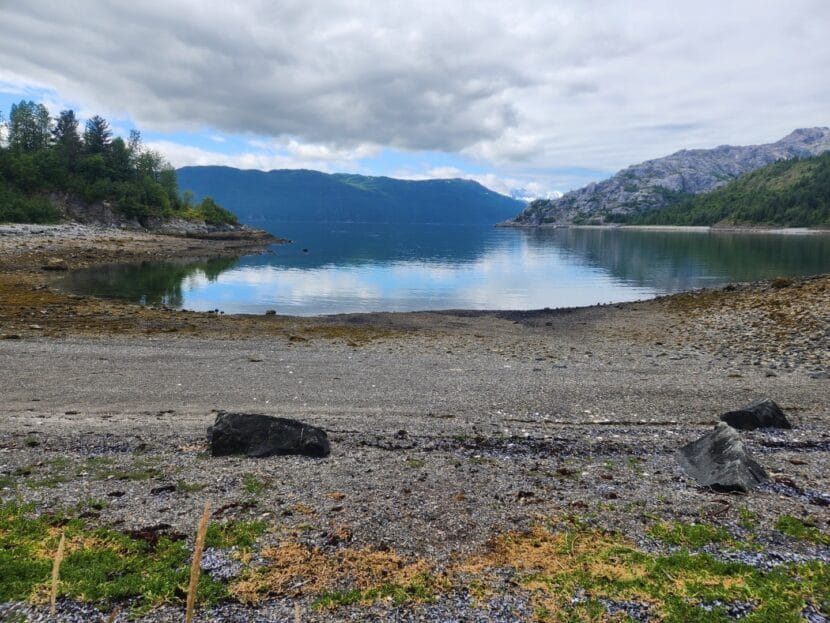
The family made it to shore at about the same time. It was nearly midnight. They were all barefoot and wearing thin, soaked clothing. Tania dumped out the backpack and discovered some extra layers, most of which were wet.
“Then this little emergency bag I carry everywhere, which had lighters, an emergency blanket, and I had put in a paperback book that my friend had sent me months ago,” Tania said.
She tore out pages to start a fire. Tania said they were lucky to find ample dry driftwood on the beach.
“Eric was shivering uncontrollably at that point,” Tania said. “Lu was shivering, but not uncontrollably, and they huddled under the emergency blanket with those drenched sleeping bags around them.”
Tania said she made a few mayday calls on her personal radio and Park Service radio, but didn’t get a response. After warming up by the fire for a while, she decided to row out of the cove to try to get a signal.
“I was able to hit a repeater and talk to our emergency dispatch, but it was really poor communication,” Tania said.
She said she told the story about five times until she finally heard from the dispatch that Glacier Bay rangers had been notified. Since everyone had warmed up by that point, she said they were no longer in a life-threatening situation and didn’t want a U.S. Coast Guard helicopter rescue.
At about 3 a.m., the light of the National Geographic Quest, a small cruise ship, came into view. Tania radioed the captain, who she said was eager to help. But because their sailboat mast posed a navigational hazard in the shallow cove, Tania said they’d rather wait for the rangers. So the captain used his satellite phone to ensure the rangers had the right information about their location.
While the family huddled by the fire, they guessed at what could have happened to the sailboat, and thought it must have been struck by a whale. The previous night, Lu said they had woken up their mom when they heard two humpback whales pass close to the boat in Reid Inlet.
“I was nervous,” Lu said. “We just, like, thumped on the boat, which is a well-known thing to do to let the whales know you’re there if you’re not running a motor.”
But the night the boat sank, Lu wasn’t worried about whales anymore.
“There was one at like 8 p.m. but it was totally gone by the time we went to bed,” they said. “There was no sign of it. I didn’t hear any spouts. I didn’t hear anything until the giant crash.”
At around 6:30 a.m. the next day – seven hours after that giant crash – the Park Service arrived to pick them up. The harrowing part was over.
Then came the search for answers.
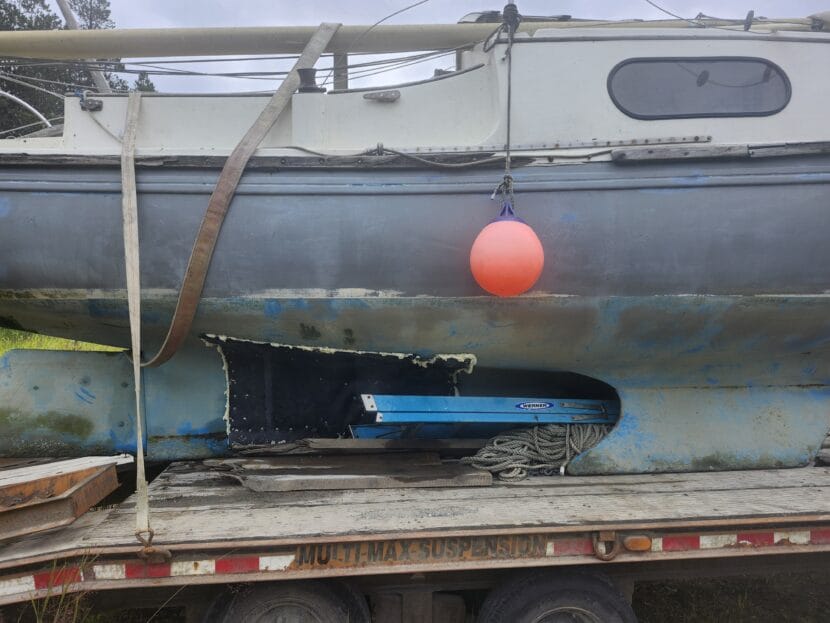
Over the weekend, Eric headed back out with a salvage crew to haul the sailboat ashore, patch it, and tow it back to Gustavus. They found a massive puncture large enough for someone to crawl through in the fiberglass hull on the starboard side.
“I was helping Eric muck out the rest of the stuff from inside, and he had this handful of this black, rubbery, thick stuff,” Tania said. “He was like, ‘What is this? It stinks!’ And it was these huge chunks of whale skin.”
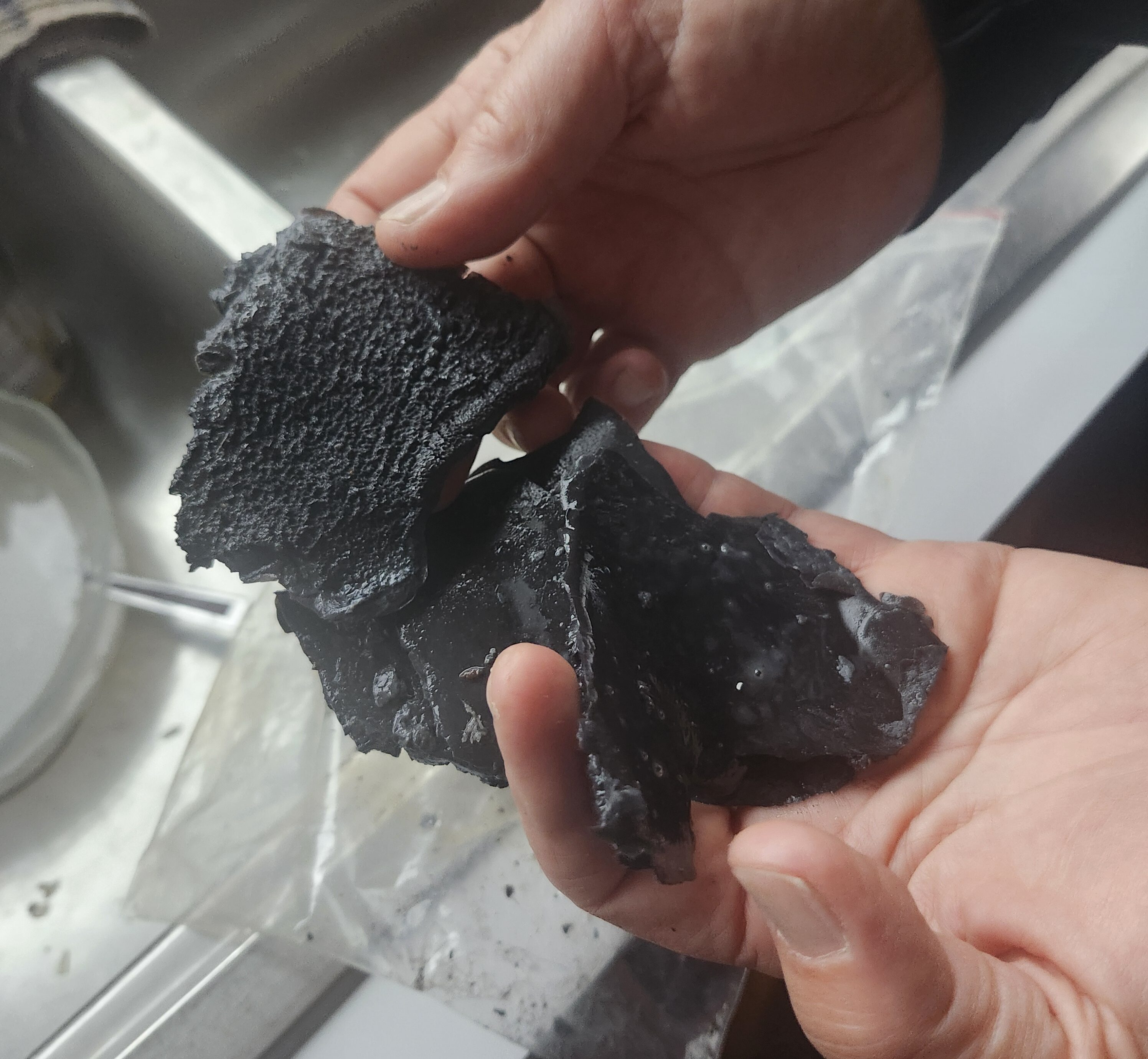
Tania gave some of the skin to her whale biologist colleagues who confirmed that it was from a humpback whale. She said the collision probably wasn’t enough to seriously harm the whale.
Lu collected some too.
“I have a little bit in a baggie full of salt that I am going to keep,” they said.
It’s not unheard of for humpback whales to hit stationary boats, according to research by Glacier Bay whale biologists.
According to a study that summarized whale-vessel collisions in Alaska between 1978 and 2011, humpbacks hit 15 anchored or drifting boats, including two sailboats, which sank. Unlike orcas intentionally hitting yachts in the Strait of Gibraltar, local research suggests that the humpbacks hit those quiet boats in Alaska by accident, because they couldn’t hear them.
Tania said she should have left her depth sounder on to alert whales of their location. It pings high frequency sound waves through the water column.
“Even though they can’t hear the frequency of the depth sounder sonar, there are harmonics that they can hear,” she said.
Reflecting on the near-death experience, Tania said she’s grateful for her family and the actions they each took to keep from drowning or freezing to death. But although they had an emergency bag — which she said saved them — she said she wishes they had discussed beforehand what they would do in that scenario. Now they know.
This story has been updated with additional photos.
