Juneau’s downtown Fourth of July parade committee released a new rule discouraging political opposition and protest during the parade earlier this summer. The Juneau community was left speculating what this rule would mean for the parade.
Then, on the day of the event, a Juneau man said he wasn’t allowed to be in the parade carrying a sign that criticizes war. He says it’s an infringement of his First Amendment rights, and wants the city to get involved.
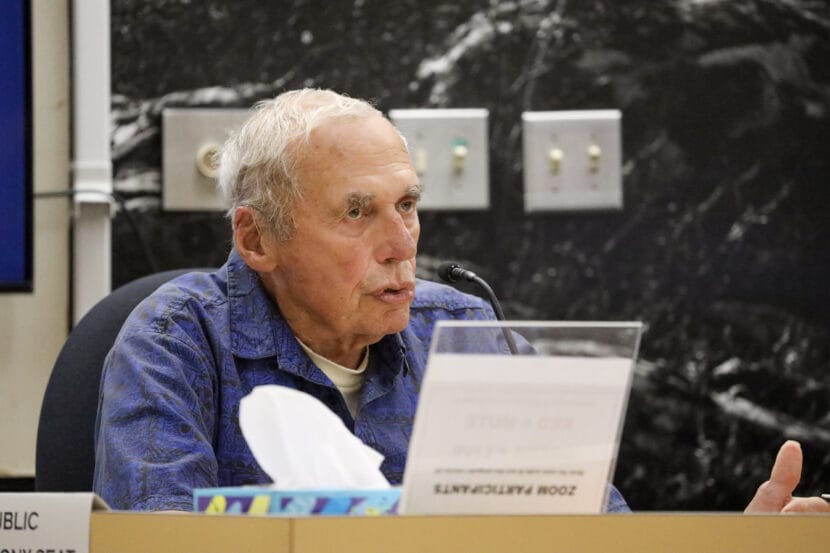
KJ Metcalf refused to march in the parade without his sign, which called wars “illegal” and “immoral.” He testified about the experience at Monday night’s Juneau Assembly meeting.
“And at the Fourth of July parade I was prevented from carrying a sign in the parade. I was stopped as the parade started to come out of the staging area, and I felt ashamed,” he said. “I felt that my sign was not hate speech. It was protected speech.”
Several weeks before the parade, the Juneau 4th of July parade committee posted a new rule to its website that said parade entries needed to “maintain a Patriotic, Positive and Fun experience for all.”
It went on to say that the parade was “not the time or place to express you [sic] political opposition, carry picketing signs or incite hateful language.”
Metcalf is a member of Veterans for Peace, an advocacy organization that protests against U.S. involvement in wars.
And that advocacy work – which he says the parade committee denied him that day – is personal. Metcalf served in the military in the 1950s and faced threats of nuclear weapons.
“I’ve come out of that with the fact that I’m dedicated my life for justice, for no wars and for the abolition of nuclear weapons,” he said. “I was denied that.”
Assembly Member Greg Smith said he doesn’t think the City and Borough of Juneau had control over the parade committee.
“It’s my understanding that the organization that operates the parade is a nonprofit, and therefore can, I think, set their own rules,” he said.
But Juneau lawyer Doug Mertz said it is within the city’s purview. He also testified about the incident Monday.
“KJ had been basically kicked out of the Fourth of July parade by the organizers simply because he had a banner advocating peace,” Mertz said. “And this on public streets by a group authorized by the borough insured reliability by the borough, and backed by, in his case, backed by the use of the police department to enforce what they wanted to do.”
Mertz pointed to a 2004 resolution that linked the city and both July 4th parade committees, Juneau and Douglas.
“I have here, by the way, a copy of the resolution way back from 2004 authorizing the creation of that committee, empowering it, and insuring it at public expense,” he said.
And he warned the Assembly that there could be legal risks to the parade’s new policy.
“I want to remind you that when you are delegating the right to interfere with a citizen’s civil rights, there’s tremendous potential liability,” Mertz said.
In a call with KTOO, City Attorney Emily Wright said the city wasn’t aware of its own resolution, now more than 20 years old.
“Now, with this new information brought forward by several people, we’re digging into it more,” she said. “And if we do have that connection still, if that resolution is still in play, we absolutely will meet with the committee and talk to them about First Amendment rights and issues. Because if we are connected, then then there are clear rules about state action, government action violating First Amendment rights.”
Wright said the city has been providing insurance coverage for the parade since 2004.
Assembly members asked Metcalf what he thinks a reasonable resolution would be, and he said he wants the city to form a committee to look into the new policy.