
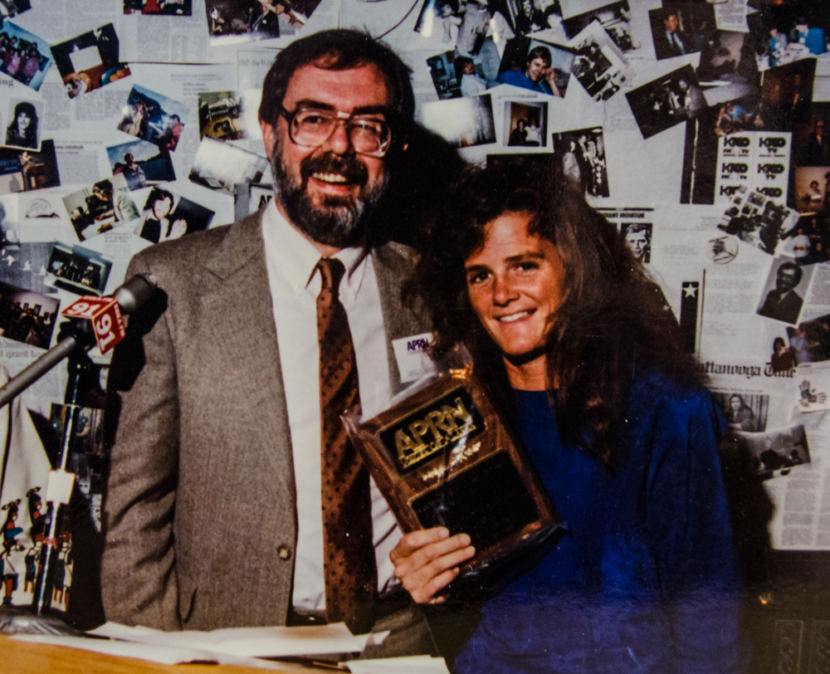
Our beloved colleague, Elizabeth Arnold, has died.
Elizabeth was an award-winning broadcast journalist whose work for National Public Radio spanned coverage of presidential politics, Congress and the global environment, died at her home in Anchorage on Thursday, June 18.
She died from complications of endometrial cancer, her family said. She was 66.
An unstoppable, one-of-a-kind reporter, Arnold also was an avid fisherwoman, runner and Harley Davidson rider who started her career at the Tundra Drums newspaper in Bethel, Alaska, and worked her way east to cover the nation’s powerful in Washington, D.C. Later, she was drawn back to the 49th State where, for the last 17 years, she taught at the Department of Journalism at the University of Alaska Anchorage. She also served as its chair.
Across her more than two decades as a reporter, she was one of the “girls on the bus” covering the presidential campaigns of Bill Clinton in 1992 and Bob Dole in 1996. She produced environmental stories that explored climate change in the highest peaks of Tibetan China, wild salmon restoration in Russia’s Kamchatka Peninsula, snow leopard protection in Mongolia and two scientific expeditions to the North Pole and one aboard both US and Russian icebreakers in the Bering Sea.
She recently asked her adult son, Jack Consenstein, if her time away from him while she worked as a reporter was too much. Not at all, he assured her, noting that not every kid’s mom calls into their 3rd Grade classroom from the North Pole.
“Elizabeth was one of NPR’s most respected and talented journalists,” said Jay Kernis, founding producer of NPR’s Morning Edition. “Her top-notch political and environmental reporting made listeners smarter. She used her microphone to take listeners to so many important places, including the Arctic. She brought that area to life. She was a great reporter and a great person.”
Born in Northampton, Massachusetts, Arnold was a 1982 graduate of Colgate University in Upstate New York. Her journalism career began soon after in Bethel at the Tundra Drums. “I was first and foremost the typesetter, then the honey bucket dumper, and THEN the reporter,” she wrote for Transom, a public radio collaboration. She alternated working for Alaska newspapers with spending summers on the fish processing slime line in Dillingham and as a gillnetter deckhand in Bristol Bay.
In 1985, she began working as a full-time local radio news reporter for KTOO, a public radio station in Juneau. Four years in, she was selected to spend a month in Washington working at NPR headquarters. The day she arrived, March 24, 1989, the Exxon Valdez slammed into Bligh Reef in Prince William Sound off the coast of Alaska.
She pitched in all night, helping national reporters understand the impact and schooled them on how to pronounce “Valdez”. She asked to be sent to cover the spill, but NPR decided it needed her expertise in Washington, where the crisis response was organized and investigations were launched into the cause. A day later, she was at the White House for a press conference held by President George H.W. Bush and Alaska’s congressional delegation. Most reporters in the White House briefing room were shouting questions about the Iran-Contra scandal and President Bush looked visibly relieved when Arnold asked one of the few questions about the federal response to the spill.
NPR kept Arnold in Washington to cover the White House and congressional hearings on the spill, eventually offering her a full-time job. She went on to cover Congress and presidential campaigns in addition to her first love, the environment.
Among her many awards, she received the 1997 Dirksen Award for Distinguished Reporting on Congress and the prestigious Alfred Dupont Columbia Journalism Silver Baton in 1994-95 as part of NPR’s political team. In 2018, she was a fellow at Harvard’s Shorenstein Center on the Press, Politics and Public Policy.
Arnold, known to friends as Betsy, eventually moved west to Seattle reporting for NPR, and then made her way back to Anchorage. She was a contributor to public radio programs including Marketplace, The World, America Abroad, PRX and National Geographic Radio Expeditions.
In 2009, Arnold became an associate professor in the University of Alaska Anchorage’s Journalism and Public Communications Department. Over a tenure that lasted until her death, she taught courses including Radio Reporting, Podcasting, Natural Resource Reporting, the First Amendment and Media Ethics, which she said was her favorite – and sometimes the most confounding to students.
As an academic, Arnold was dismayed by the national media’s portrayal of climate change “victims,” specifically in Alaska’s rural communities. Her research paper, Doom and Gloom: The Media’s Role in Public Disengagement on Climate Change, challenged the journalism community to improve and received widespread coverage. It led to national and international speaking engagements and two TEDx talks. Later, when her son Jack was a sophomore at Williams College, he was assigned to read her paper — which both pleased and surprised her.
Arnold mentored scores of students who have made their way into Alaska’s radio, television, newspaper, and online news organizations.
“If you turn on the radio, watch a local TV broadcast or look at the bylines of almost any newspaper in Alaska, you will find a former student of Betsy’s who will tell you that she is the reason they chose Alaska journalism as a career,” said Lisa Busch of Sitka, Alaska, who along with Arnold was a founder of the Alaska News Coalition, which provides grants, guidance and technical support to local news organizations. “She really believed in her students and she brought grit and determination to everything she did.”
Arnold was a founder and board member of the Alaska Center for Excellence in Journalism, which seeks to support the too-thin bench of local journalists across Alaska. She was a co-founder of the Reporter Exchange Program, which sends working reporters to Juneau for a month during the legislative session and sends a University of Alaska journalism student to replace the reporter at their home news organization. In the 2025-26 school year, she shepherded through an occupational endorsement certificate in Community Reporting.
She is survived by her husband Steve Buckley of Anchorage, son Jack Consenstein of San Francisco, brother Peter Arnold of New York and former husband Danny Consenstein of Anchorage.
The family suggests, for those interested, that donations can be made to the Alaska News Coalition.
