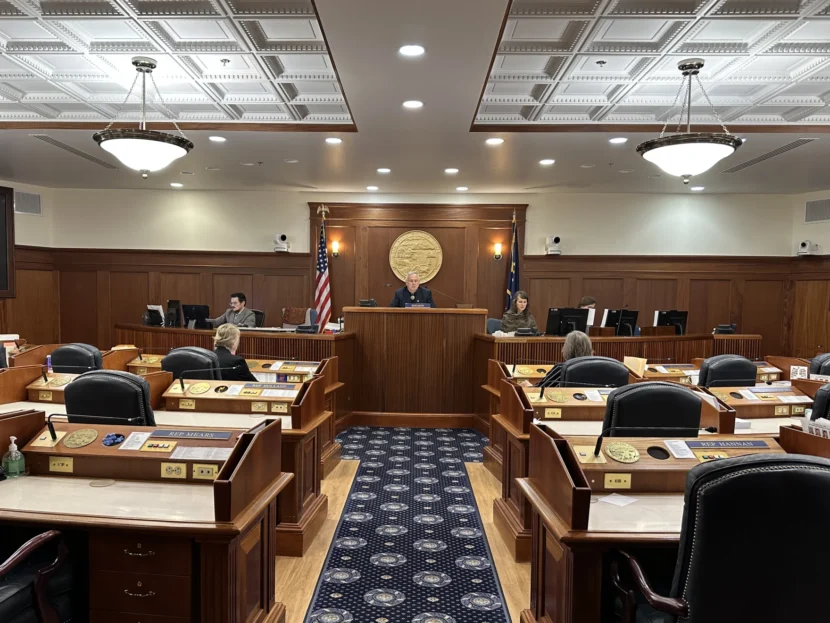
A handful of state legislators returned to Juneau Monday to once again talk about tax breaks for the Alaska LNG project.
It’s their third special session this year. Gov. Mike Dunleavy called lawmakers back on July 16 after threatening to veto a bill crafted by a conference committee and passed by the state Senate.
That bill would have imposed corporate income taxes on some private oil and gas companies, including large producer Hilcorp, leading Dunleavy to reject it.
Alaska Public Media’s state government reporter, Eric Stone, joined Alaska News Nightly host Casey Grove to talk about what lies ahead.
This transcript has been lightly edited for clarity.
Casey Grove: Eric, lawmakers and the governor couldn’t agree on a bill back in May. They couldn’t agree in June. And they couldn’t do it in July. What are you expecting out of yet another special session?
Eric Stone: It’s hard to say. But everyone here at the state Capitol seems to agree that this is Dunleavy’s last shot this year — and since he leaves office in December, his last shot, period.
Here’s House Speaker Bryce Edgmon, a Dillingham independent.
Bryce Edgmon: The clock is ticking very loudly right now, and the governor realizes that. And I could tell you that if we don’t get it done this special session, that I don’t know that there will be another opportunity this year.
Eric Stone: And that’s consistent with what we heard at the end of the last session — House and Senate leaders said that conference committee bill you mentioned was the Legislature’s best and final offer.
Casey Grove: Remind us — what was that best and final offer?
Eric Stone: We’re talking about a multibillion-dollar property tax cut that Glenfarne, the lead developer of the Alaska LNG project, says is necessary for the project to receive financing. And lawmakers have made a lot of progress since Dunleavy introduced the bill in March.
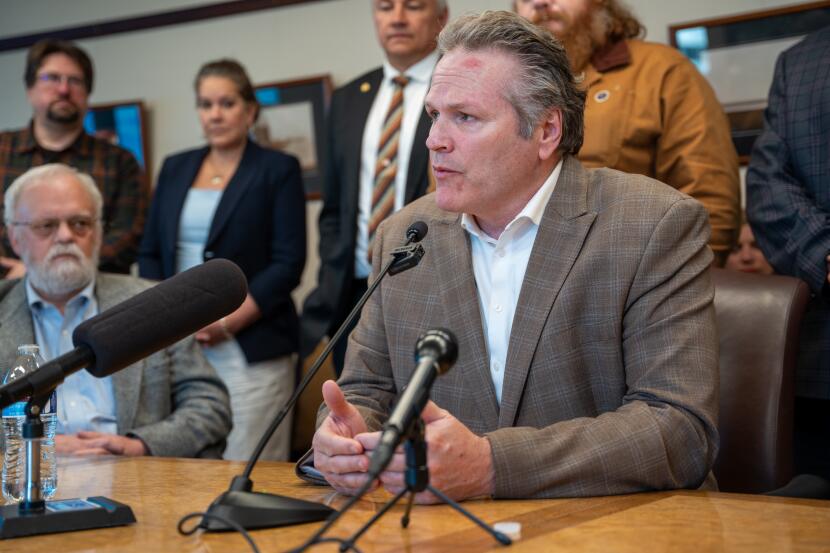
Glenfarne has made a number of concessions: They’ve been willing to pay tens of millions to help communities with their costs from construction. They’ve committed to building a spur line to Fairbanks. They’ve agreed to make deals with unions to maximize the use of Alaska labor. They’ve committed to a price cap to ensure the cost of gas isn’t prohibitive for Alaskans, though of course that price cap is about 50% higher than current rates in Southcentral. And, not for nothing, they agreed to a higher tax per unit of gas than the governor originally proposed.
Here’s Glenfarne Alaska LNG President Adam Prestidge.
Adam Prestidge: There’s been a lot of movement. There’s been a lot of collaboration to make sure that this is a bill that works for everyone.
Eric Stone: But what caused the demise of the last version here in mid-July was a corporate tax change that would apply the state’s corporate income tax to private companies like oil and gas giant Hilcorp — but would exempt Glenfarne. A group of 11 Democratic and Republican senators saw that tax as a must-have to pass the Alaska LNG bill, but Hilcorp, of course, would much rather not pay the tax.
The Legislature’s chief negotiator this last time around says Hilcorp essentially sank the last version of the bill because it included that tax change, though Glenfarne disputes that.
Now lawmakers are basically throwing their hands up and saying, well, governor, you figure it out. Here’s Speaker Edgmon again.
Bryce Edgmon: It cannot be bottom-up driven at this point. We’ve tried that. It hasn’t worked. It has to come from the chief executive of the state of Alaska, and he has to play a central role.
Eric Stone: And it’s not just the bipartisan majorities. Here’s the leader of the House’s all-Republican minority caucus, Palmer Rep. DeLena Johnson.
DeLena Johnson: I did have some conversation with the governor, and it sounded like he’s hopeful that there could be, maybe, some new developments, but that’s going to be his negotiation. I don’t believe the Legislature can do much more at this point.
Eric Stone: Johnson says with the primary election less than a month away, and the general election in November, there’s some fatigue setting in among legislators. So as lawmakers see it, the ball is firmly in Dunleavy’s court.
Casey Grove: And how is Dunleavy seeing things? Is he taking the ball and running with it? Is he taking the ball and going home?
Eric Stone: We will see. We don’t have a new ball, I mean, bill, for lawmakers to work on yet — that’s one reason there were only a handful of legislators here in Juneau today (July 27). There wasn’t anything for them to consider.
But Dunleavy says he’s up for the challenge. He put out a statement on social media today (July 27) saying that before he puts out a bill, his administration is “going to continue meeting with all parties to determine the best path forward to an agreement.”
House Speaker Edgmon characterized those discussions as “preliminary” for the moment.
It’s not clear who’s involved in the negotiations aside from legislators and probably Glenfarne — there’s been no official confirmation from Dunleavy. His office declined an interview request.
Nor is it clear how Dunleavy is going to bridge the gap. He didn’t describe what’s being negotiated, though Edgmon says he expects it’ll take at least some kind of compromise on the corporate income tax. He says it’s his impression that’s a point up for negotiation.
Bryce Edgmon: I think that’s what it’s going to take. And absent that cooperation, I don’t know that there’s going to be a consensus to number one bring the legislature back into town, and number two to get the votes to get a bill to the governor
Eric Stone: But until the governor comes up with a bill, I wouldn’t expect much activity out of the Capitol. There were just three out of 40 House members here today (July 27) for what’s known as a technical session. And in what might be a sign of the Senate’s skepticism, there was just a single senator in the chamber — Juneau Democratic Sen. Jesse Kiehl.
Jesse Kiehl: If there is a new approach proposed by the governor, if the governor is open to solving some of the more overarching issues, you’ll, I think, see the Legislature come back to work. If not, the governor has the power to waste time and money constitutionally. We’re going to waste as little of it as we possibly can.
Eric Stone: But as we’ve seen over the past several months, it is difficult to find an approach that works for everyone involved — everyone’s got different interests, different constituencies, et cetera. And everyone says they want the gas pipeline to be built — Kiehl says any suggestion that the Senate is throwing up roadblocks to stop the project is “horsefeathers.”
For his part, Prestidge, with Glenfarne, says he’s hopeful. He says delaying a tax deal any longer — you know, beyond the election — would make it harder to address the looming shortfall of natural gas from Cook Inlet.
Adam Prestidge: That’s where the real challenge comes in: carrying an opportunity and a challenge like this across the finish line, the last mile, the last stretch. That’s where we are right now, and I do have the confidence that, you know, we’re going to be able to get it done.
Eric Stone: But whether lawmakers and Dunleavy can find some common ground, we’ll have to wait and see.