
Listen to this story:
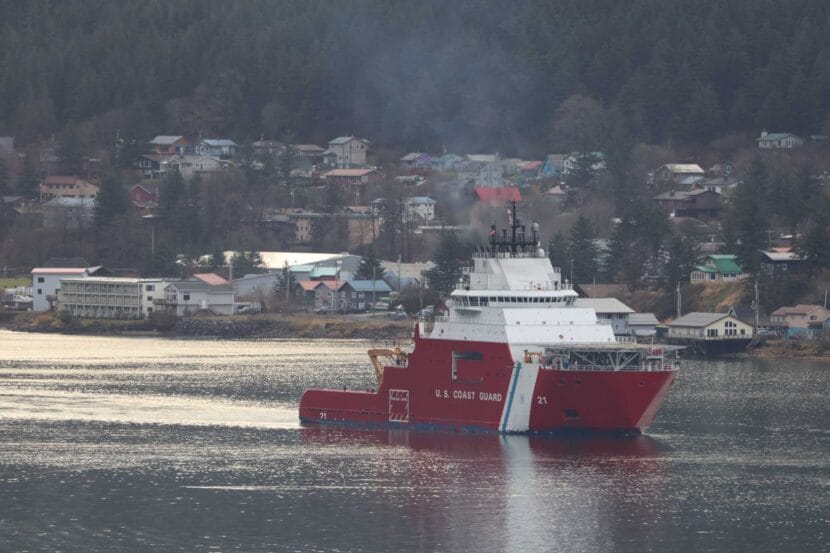
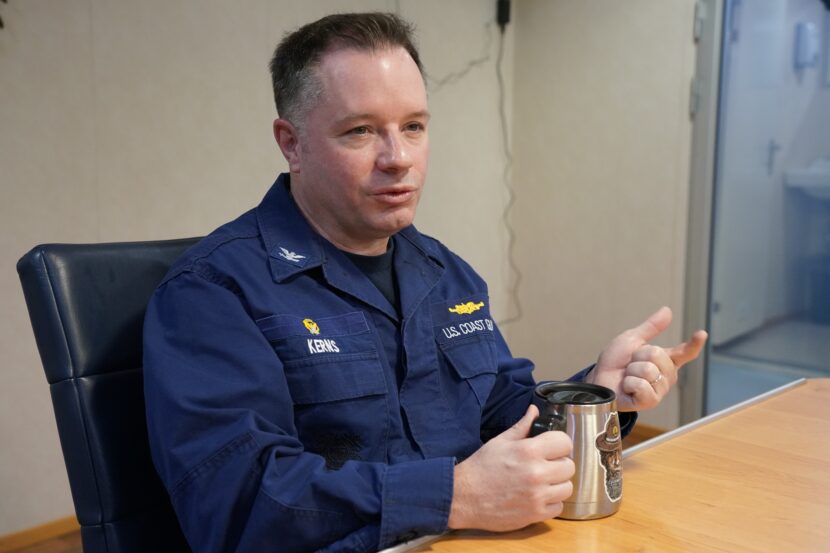
After a 4.5-month deployment in the Arctic, the U.S. Coast Guard icebreaker Storis visited its future homeport of Juneau this week. At a press meeting aboard the ship in Juneau on Tuesday, Captain Corey Kerns said the mission’s purpose was to enforce U.S. sovereignty in Arctic waters.
“We have some sovereign rights here,” Kerns said. “We want to make sure that those things aren’t being, you know, violated.”
He said the crew mostly monitored Chinese research vessels operating above the Arctic Circle. Kerns also mentioned seeing South Korea’s icebreaker, the RV Araon, as well as Japanese Navy training ships and a Japanese research vessel.
“That’s basically what Storis is for,” Kerns said. “We can get into the ice and we can see what they’re doing.”
Kerns said the ship spent most of July through September in the sea ice, and reached as far north as the 82nd parallel in the Arctic Ocean.
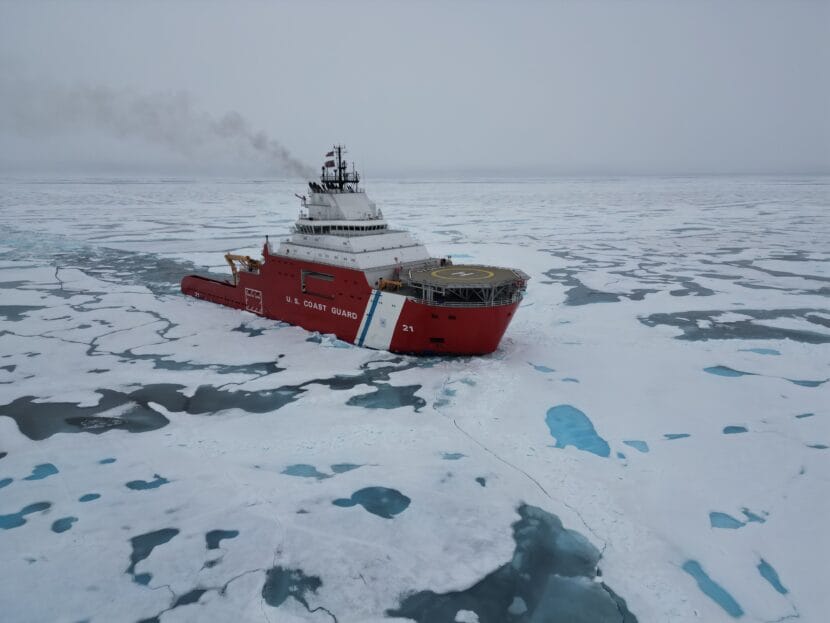
He said watching foreign vessels is an adjustment for the Coast Guard, which has grown accustomed to domestically focused missions like tending buoys, search and rescue, fishing vessel inspections and oil spill response.
For a portion of its voyage, Kerns said the Storis sailed alongside the Canadian Navy vessel HMCS Max Bernays to practice collaborative defense.
“That’s not the norm for us, and so I think that’s new,” Kerns said. “Getting the crew to wrap their head around — and the Coast Guard to wrap their head around: it’s a changing security environment. We were kind of leading the way this year on how that might look in the future.”
The Coast Guard’s icebreaking fleet lags behind Russia’s as Arctic sea ice coverage continues to decline due to climate change. The Trump Administration has identified the opening waters of the north as both a national security threat and a commerce opportunity.
The U.S. is working with two other circumpolar nations, Finland and Canada, to expand defense in the region.
Homeports in Alaska
This year, the Coast Guard awarded contracts to build 11 new Arctic Security Cutters.
The Coast Guard has said two new icebreakers will homeport in Kodiak, and one will homeport in Seward. Although Juneau is slated to be the homeport for Storis, Public Affairs Officer Pam Manns said housing needs for crew and their families make the timeline unclear.
“The Coast Guard is prioritizing and looking into it, but I don’t have an answer as of yet,” Manns said at the press meeting.
Manns said the Coast Guard plans to release a request for proposals sometime in the near future to build housing in Juneau. Kerns said the Storis crew could number between 85 and 117.
The Coast Guard’s plan to build a new pier for Storis at the Coast Guard station in downtown Juneau is moving ahead. Manns said permitting is underway and a contract to design and build the pier should be awarded by the end of this year, with a plan to complete construction in 2030.
A multi-mission cutter
During the latest Arctic voyage, Kerns said Storis crew completed law enforcement training and boarded a fishing vessel for the first time.
“That’s probably the future of what the ice-breaking fleet is going to be,” he said about law enforcement. “We have to be multi-mission.”
Storis also took on a couple of science projects when the Coast Guard cutter Healy, the nation’s primary Arctic research vessel, broke down this summer.
Kerns said Storis helped install data buoys and tested a navigation system called inertial navigation that’s more resistant to hacking or disruptions than GPS. He said the Storis crew also retrieved an ice data buoy for the National Ice Center.
But since the Storis wasn’t originally built to be a Coast Guard cutter, Kerns said it still needs some work to reach its full capabilities.
For instance, Kerns said Coast Guard headquarters has not yet enabled the ship to land helicopters on its helipad, which is key for search and rescue operations.
“We could redo our helicopter fuel system so that I could do the in-flight refueling, which seems like that would be, you know, somewhat lower-hanging fruit,” Kerns said.
The ship is also not yet equipped to assist in oil spill response and clean-up. Plus, Kerns said that although the ship is one of the strongest towing vessels in the world, it doesn’t yet have towing gear.
“We haven’t gotten over the hump of purchasing equipment,” Kerns said.
He said rising costs have slowed down ship upgrades.
“We were planning to do a major engine overhaul, and now all those parts, you know, that were quoted last year, I think, are like two to three times the cost that they were last year,” Kerns said.
Next, Storis plans to return to its temporary homeport in Seattle to get ready for another Arctic mission next summer.

