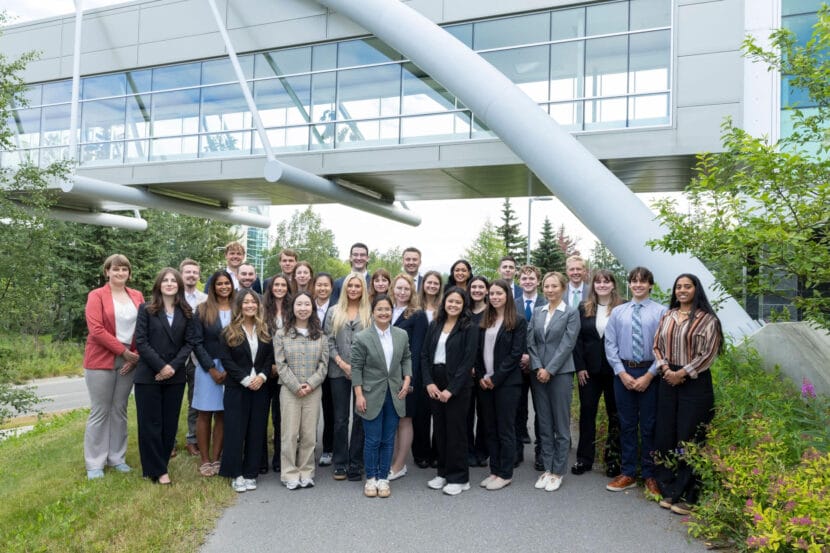
A record 30 students have started their medical education this month in a special multistate collaborative program, the University of Alaska Anchorage and University of Washington announced.
The 30 students this month entered the WWAMI program, named after the first letters of the states that participate through universities: Washington, Wyoming, Alaska, Montana and Idaho. The program allows students to begin their medical education at universities in their home states — at UAA, in the case of Alaska — and complete their work toward medical degrees at the University of Washington School of Medicine in Seattle.
The WWAMI program offers Alaska’s only in-state education toward a medical degree. There is no medical school in Alaska. Students in the program typically spend their first 18 months taking classes and doing training work at UAA before moving onto studies at University of Washington. There are other options, including an option to complete the entire program in Alaska.
The milestone of 30 Alaska students starting their WWAMI education marks a turnaround in fortunes for the program.
In 2019, Gov. Mike Dunleavy proposed entirely eliminating state funding for the Alaska portion of the WWAMI partnership. At the time, he characterized WWAMI as a waste of state money.
Three years later, Dunleavy took the opposite position. He proposed expanding WWAMI funding so that the program could expand from 20 students from each cohort year, which was the enrollment at the time, to 30 per cohort year.
The Legislature in 2023 approved a funding increase that allowed 25 students to start the WWAMI program last year and 30 this year.
The WWAMI program’s history dates back to 1971, when nine students enrolled in preliminary courses at the University of Alaska Fairbanks arranged in partnership with the University of Washington. They then completed their education in Seattle. Montana and Idaho entered the program in 1972, and Wyoming entered it in 1996, according to a history compiled by UAA. Alaska WWAMI relocated from UAF to UAA in 1989.
This article has been updated to include that there is an option to complete the program inside Alaska.